


Making it easier, working together
Support
and assistance
The City Know-how team offers author support services for urban health researchers
and assistance services for city makers to develop their projects.
Author support services for urban health researchers
1. Manuscript preparation

You are ready to write up your research and publish your findings. Prepare your article so that it effectively communicates your research and helps readers understand the issues.
Begin your journey with this guide to support you through the article preparation stage. Your manuscript must meet publishing standards and present your most important ideas. Our resources will help perfect your work before you submit.
High quality research deserves clear writing. We have brought together teams with expertise in subject-relevant editing to ensure that manuscripts meet international standards and are free of grammatical, spelling, and other common language errors.
Our Scientific Editing service is designed to provide you with the guidance you need to deliver a comprehensive, well-articulated journal article, ready for submission. Our experienced reviewers will undertake an in-depth evaluation of your manuscript, offering advice on everything from key reporting requirements related to study design, to the strength and positioning of your research argument.
Writing a book isn’t an easy process. Now that your work is ready, you’re keen to make sure your research is showcased in the best possible way.
Taylor & Francis has been supporting book authors since the early twentieth century and has a significant reputation in the academic book publishing industry. We publish over 7,000 new books each year, and key brands are Routledge and CRC Press, imprints that specialise in Humanities, Social Sciences, and STEM content. With a books backlist of around 145,000 titles, we serve scholars, authors, instructors and professional communities worldwide.
You can find more information about the benefits of publishing with us here.
For authors currently writing a book and who need English language support, our Book Editing service offers you the opportunity to have your work reviewed by editing experts.
Based on the level of development your book needs, you can choose between two book editing options: Standard Book Editing (with a focus on language editing that gives the book a natural English tone and voice), or Consultative Book Editing (providing a more substantive and developmental approach).
You have dedicated time and effort to your research, with the intention of contributing to your field. We will ensure that no language barriers stand between you and the research world.
Let our experts translate your work accurately from multiple languages into English. You can be sure that the translation maintains absolute accuracy, is free of language errors, and retains your unique voice. Our highly trained translators all have native English-speaker levels of competence, with advanced degrees in a wide variety of subjects
Making sure that your manuscripts are formatted according to rigorous journal standards can be a time consuming and frustrating process. You have to adhere to the guidelines for title page information, abstract structure, reference style, font size, line spacing, margins, layout, and paragraph style. Don’t worry, help is at hand.
Our editors have deep experience in working with formats like APA, MLA, ACS, and AMA. We ensure consistency in the document, matching your article to your target journal’s Instructions for Authors.
Your manuscript can be improved with the right graphs, charts, illustrations, schematics, photographs, and diagrams. Our Artwork Preparation services help you to create visuals that comply with your target journal’s specific requirements for layout, format, size, and resolution.
Our highly experienced illustrators can work with a range of file formats, and they understand technical artwork guidelines across a wide variety of journals. When you send us your final editable artwork files, our team formats and revises your complex figures.
So, go ahead and showcase your data with beautiful figures, and improve the impact of your work.
2. Journal submission
You’ve been working hard to prepare a quality article, your next challenge is submitting it to a journal.
This can be both time consuming and complex. What you need is the confidence to know your article is ready for submission.
Read on for how we can support you through your journal article submission.
Have you properly acknowledged and cited other authors’ work in your manuscript? It can be hard to keep track, but failure to do so is viewed by journals as unethical and often leads to rejection. Using our Similarity Review Report is a great way to avoid accidental plagiarism.
We use iThenticate software to help you identify passages in your manuscript that could be flagged by journals for accidental plagiarism. You will receive an iThenticate assessment and a report that will guide you in making it clear in your manuscript where you are building on the work of others.
You can find more information about publishing ethics, including plagiarism.
Manuscripts can be rejected during peer review because of poor manuscript structure, a weak argument, or other factors that may have been overlooked by authors. If you choose our Rapid Technical Review service, our experts will review your article to identify major reasons for rejection. This means you can address the issues before you submit your article to the journal of your choice. You’ll rapidly receive your review, allowing you to revise your manuscript and still meet publication deadlines.
Making sure that your manuscripts are formatted according to rigorous journal standards can be a time consuming and frustrating process. You have to adhere to the guidelines for title page information, abstract structure, reference style, font size, line spacing, margins, layout, and paragraph style. Don’t worry, help is at hand.
Our editors have deep experience in working with formats like APA, MLA, ACS, and AMA. We ensure consistency in the document, matching your article to your target journal’s Instructions for Authors.
Our Scientific Editing service is designed to provide you with the guidance you need to deliver a comprehensive, well-articulated journal article, ready for submission. Our experienced reviewers will undertake an in-depth evaluation of your manuscript, offering advice on everything from key reporting requirements related to study design, to the strength and positioning of your research argument.
3. Science communication
Your paper has been submitted, and the reviewers and editors have informed you that your journal article has been accepted for publication. Your publication journey has ended, right? Not quite. There’s still plenty you can do to make sure your research reaches its full potential.
There are millions of journal articles published every year. For your research to have impact you must find ways to make your accomplishments stand out.
Read on if you want to invest in creating a wider impact.
Why chose a lay summary?
A clear, concise, jargon-free summary of your research article, written in plain language. Designed to improve understanding of key research findings amongst non-expert audiences such as patients, practitioners, professionals in nearby disciplines, funders, the media, and the public.
Share an engaging press note, highlighting real world impact and elements of newsworthiness of your published article. Designed for sharing with journalists and through various online media channels, the research impact summary can also be a compelling tool to emphasize the impact of your work for funders, grant-makers, government, and public agencies.
A templated 60-second video highlight created using stock-footage and captions. The bite-sized video format encourages social sharing and helps drive readers to your published work
Visual summary of your full research article, to communicate key findings at-a-glance.
Eye-catching highlight of your research conclusion, designed for social sharing.
Assistance services
Assistance services for city makers and local government
1. Urban diagnostics
Sealed pavements taking over green soils result in rainwater runoff and hazardous urban heat spots impacting soil, water, and air quality. The consequence is environmental degradation capable of destroying local ecosystems, habitats, wildlife: and our living conditions.
Urban Diagnostics is a multimedia format to start problem-solving climate and health issues for sustainable development.
With a citizen science approach, Urban Diagnostics helps decision-makers think visually about whats happening in their neighborhoods at the pedestrian level.
The starting point is to assess information and data at the city scale on health-related problems deriving from the urban environment (built and green).
Analyses take in the complexities, interdependencies, and uncertainties of the real-world dynamics happening at the human scale.
Lorem ipsum dolor sit amet, consectetur adipiscing elit, sed do eiusmod tempor incididunt ut labore et dolore magna aliqua. Ut enim ad minim veniam, quis nostrud exercitation ullamco laboris nisi ut aliquip ex ea commodo
Lorem ipsum dolor sit amet, consectetur adipiscing elit, sed do eiusmod tempor incididunt ut labore et dolore magna aliqua. Ut enim ad minim veniam, quis nostrud exercitation ullamco laboris nisi ut aliquip ex ea commodo
Lorem ipsum dolor sit amet, consectetur adipiscing elit, sed do eiusmod tempor incididunt ut labore et dolore magna aliqua. Ut enim ad minim veniam, quis nostrud exercitation ullamco laboris nisi ut aliquip ex ea commodo
Lorem ipsum dolor sit amet, consectetur adipiscing elit, sed do eiusmod tempor incididunt ut labore et dolore magna aliqua. Ut enim ad minim veniam, quis nostrud exercitation ullamco laboris nisi ut aliquip ex ea commodo
Data viewers are made with infographics that bring new insights about the neighborhood and communicates them persuasively, especially to pedestrian planners, on how to develop efficient actions with accurate outcomes.
2. Stakeholder workshops
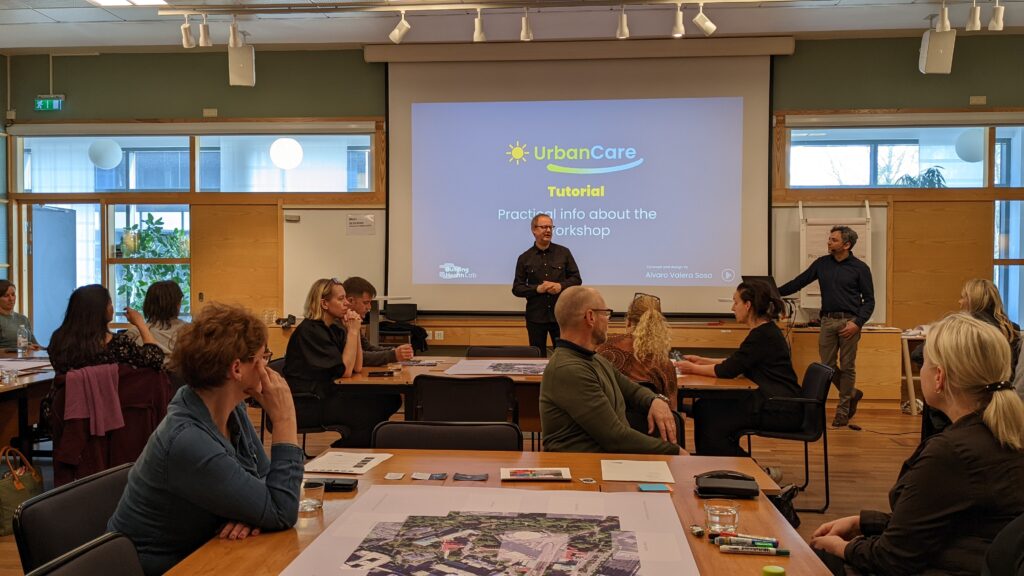
Stakeholder Workshops review the Urban Diagnostics data gathered on users’ needs and the local ecosystem to prioritize which neighborhood public spaces to improve first and define where and how.
Citizens, specialists, and authorities discuss the findings and together find possible solutions that channel responsible investments towards sustainable development goals.
Our workshops are ideal for neighborhood regeneration, new urban development plans, or redeveloping institutional urban sites such as hospitals and university campuses.

In this warm-up session, participants split into groups. Each group works on a site to discuss the needs and requirements of slower groups, such as children, the elderly, and people with different types of disabilities. The aim is to identify urban scenes that hinder the active mobility of slower groups. ‘Pedestrian Challenge Cards’ and mentoring are available at all times.
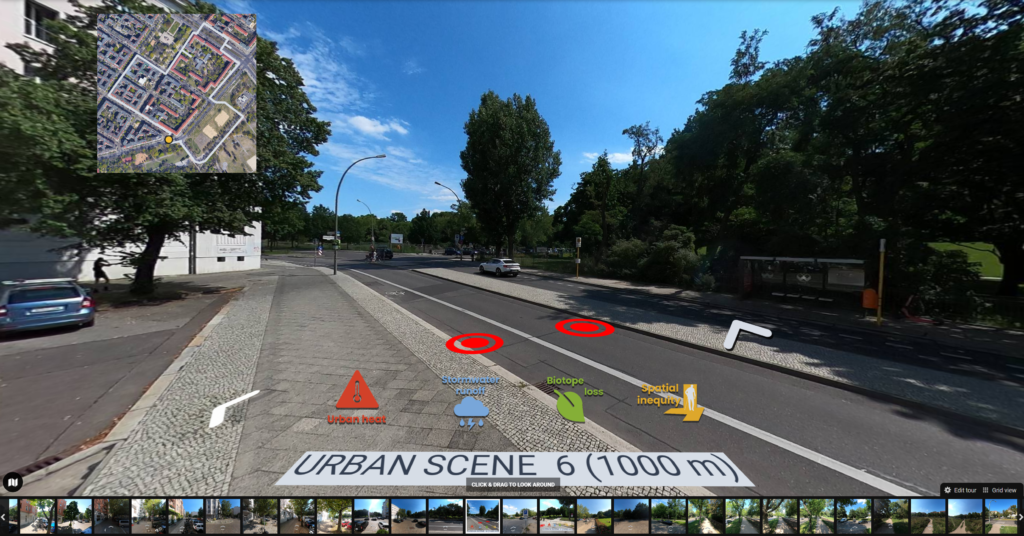
“Street Eco-Cards” describes physical environmental factors that degrade the urban ecosystem. “Pedestrian Disease Cards” define how our health is affected by these environmental factors. Participants are encouraged to make card combinations and place them in urban scenes of the site that challenge slower groups.
Information boards on Policies, Technical Resources, and Economic resources for climate mitigation and mobility are displayed. Participants pin facts and ideas on the boards to map resources and create management positions for developing healthy green urban solutions.
The last step offers inspiring input on ‘how to communicate urban issues and possible solutions.’
Participants create 10-minute urban sketches first on issues, then on comprehensive climate & health solutions from a pedestrian perspective.
With the drawing on hand, one participant for each group must convince a ‘City planner’ and an ‘Investor’ on where and why to develop.
3. Action dialogues
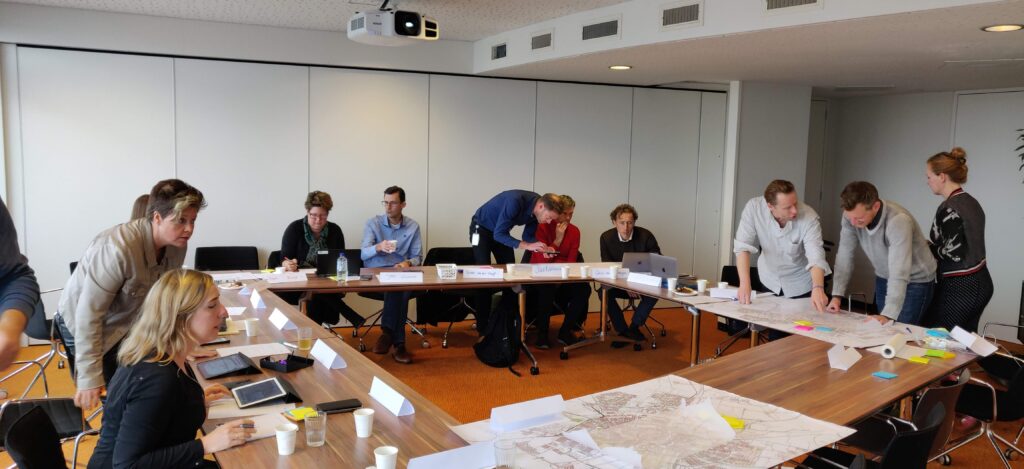
The Dialogues are urban incubators to create investment-ready projects for health and well-being as the spearhead for sustainable development.
Local government representatives meet with urban health and climate specialists and development agencies to define action plans that attend to the needs of people, improve the local climate, and prove to be bankable.
Sessions are prepared by topics based on a needs assessment made with municipalities.
Visit the UrbanCare Dialogues with Brazilian Municipalities.
Local Gov representatives present their cases with video clips revealing pressing urban issues, ongoing solution approaches, and management obstacles. Q&A follows, where advisors take note of the issues.
Our advisors take the floor to address the problems identified in the Urban Cases setting out evidence-based guidelines, instruments, and strategies. After each talk, a Q&A allow Gov representatives to resurface their local issues in search of solutions.
Our advisory topics:
Healthy
• Age-friendly settings
• Walkability
• Urban-associated diseases
Green
• Passive cooling designs
• Water sensitive planning
• Biophilic urbanism
Bankable
• Evidence of project outcomes
• Financial access flow
• Investment-ready projects
Gov representatives break into groups. Mentored by an advisor, each Gov group prepares a short presentation summarizing problems and explaining an integrated development process seeking solutions.
Integrated development includes:
• Urban diagnostics summaries
• Planning & design requirements
• Public space maintenance
• Post-occupancy evaluations
“I was very much taken by your approach. This way of thinking about making attractive loops (for the 60 percent) for walking is a new approach. (At the Municipality) We have drawn pedestrian networks as I showed, but this is a new way of thinking, also for me. After the workshop I started drawing loops around the Grote Markt, where we just started with an analysis and program of requirements.”