

City Know-hows

How to design neighbourhood outdoor spaces to improve the mental health of all citizens?

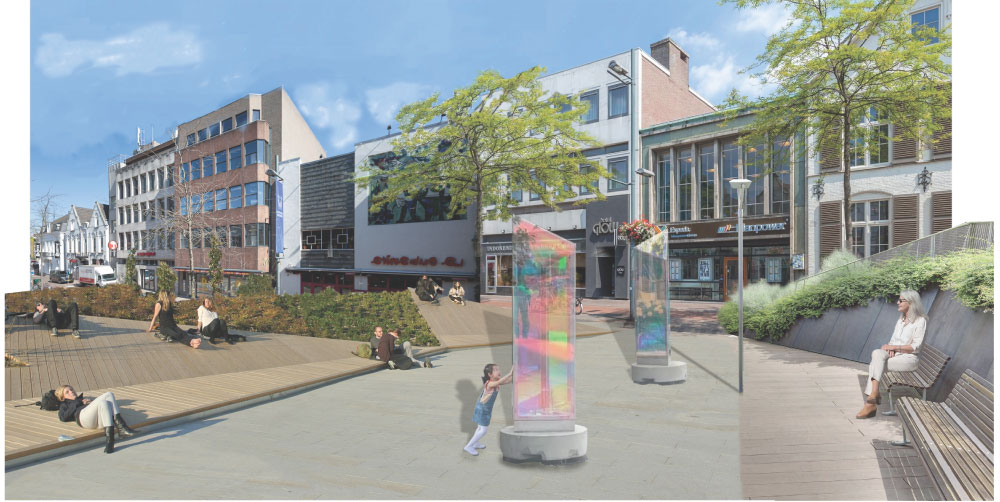
An impression of a neighbourhood outdoor space with integrated design elements that can reduce stress and attention fatigue and potentially improve mental health. Design elements include slight slope, ground cover variation, sculpture, seats, and streetlights.

Poorly designed neighbourhood outdoor spaces can harm citizens’ mental health, such as presenting them with information overload, crowding or low exposure to nature. Our research explored which design elements can support urban designers in designing neighbourhood outdoor spaces that can reduce stress and attention fatigue and improve the mental health of all citizens.

Share

Target audience

Urban designers and policymakers for city and town planning and development.

The problem

As our cities grow, we see a rise in citizens dealing with stress-related mental health issues. As researchers, we are gradually discovering that neighbourhood outdoor spaces can reduce stress and improve mental health. However, simply acknowledging the potential of neighbourhood outdoor spaces for better mental health is insufficient information for designers. To design neighbourhood outdoor spaces that improve mental health by reducing stress and attention fatigue, designers need to know which spatial elements play a role in this process. Unfortunately, this knowledge is currently scattered across different fields of research, and it is unclear how designers can use it in design practice.

What we did and why

We performed a literature review. Sixty-two studies were critically evaluated to identify restorative spatial characteristics of neighbourhood outdoor spaces. Furthermore, the applicability of the current literature in design practice was critically reflected upon, and options were given to guide future research and design practice.

Our study’s contribution

In our study, we found 32 restorative spatial elements of neighbourhood outdoor spaces that can be applied in design practice to improve the mental health of all citizens.

  • Designers should focus on a variety of vegetation, consider the position of design elements, and optimise the design of adjacent buildings to enhance restorative potential.

Although more research is needed into the applicability of the currently available information in real-life settings and for a variety of participant groups, our study is an initial guide some aspects of designing healthy neighbourhoods.

Impacts for city policy and practice

This study can be used as an initial guideline for urban designers and policymakers to design neighbourhood outdoor spaces that improve the mental health of citizens. Ideally, more research can be done in the future that includes various demographic groups, such as senior citizens, so that neighbourhood outdoor spaces are designed for all.

Further information

Designing neighbourhoods to promote mental health and self-reliance: Project website

Full research article:

Leave a Reply

Your email address will not be published. Required fields are marked *

Related posts

Making cities walkable for caregivers: bridging urban complexity and mobility justice

We examine how caregiving-related needs remain overlooked in walkability and Transit-Oriented Development strategies. Despite high levels of urban complexity, many transit-accessible areas lack essential caregiving-support places, particularly in vulnerable neighbourhoods. This spatial mismatch limits care-engaged individuals’ ability to chain trips, and access services, reinforcing mobility and social inequities. Our research highlights the need to integrate caregiving accessibility into planning frameworks to ensure that walkable cities are also inclusive and care-supportive.

Read More »

The hidden burden of traffic crashes

The high risk of death and disability from being struck by a car is unevenly distributed geographically and socially. Our analytics reveal a troubling pattern in that people from Black and Latino neighbourhoods facean especially high risk of crashes, both near and far from home.
Vision Zero leaders in the hundreds of participating cities across the world in planning departments, nonprofits, and community groups need to look at our approach.

Read More »