

City Know-hows

The benefits of green infrastructure on campus for student and visitor health

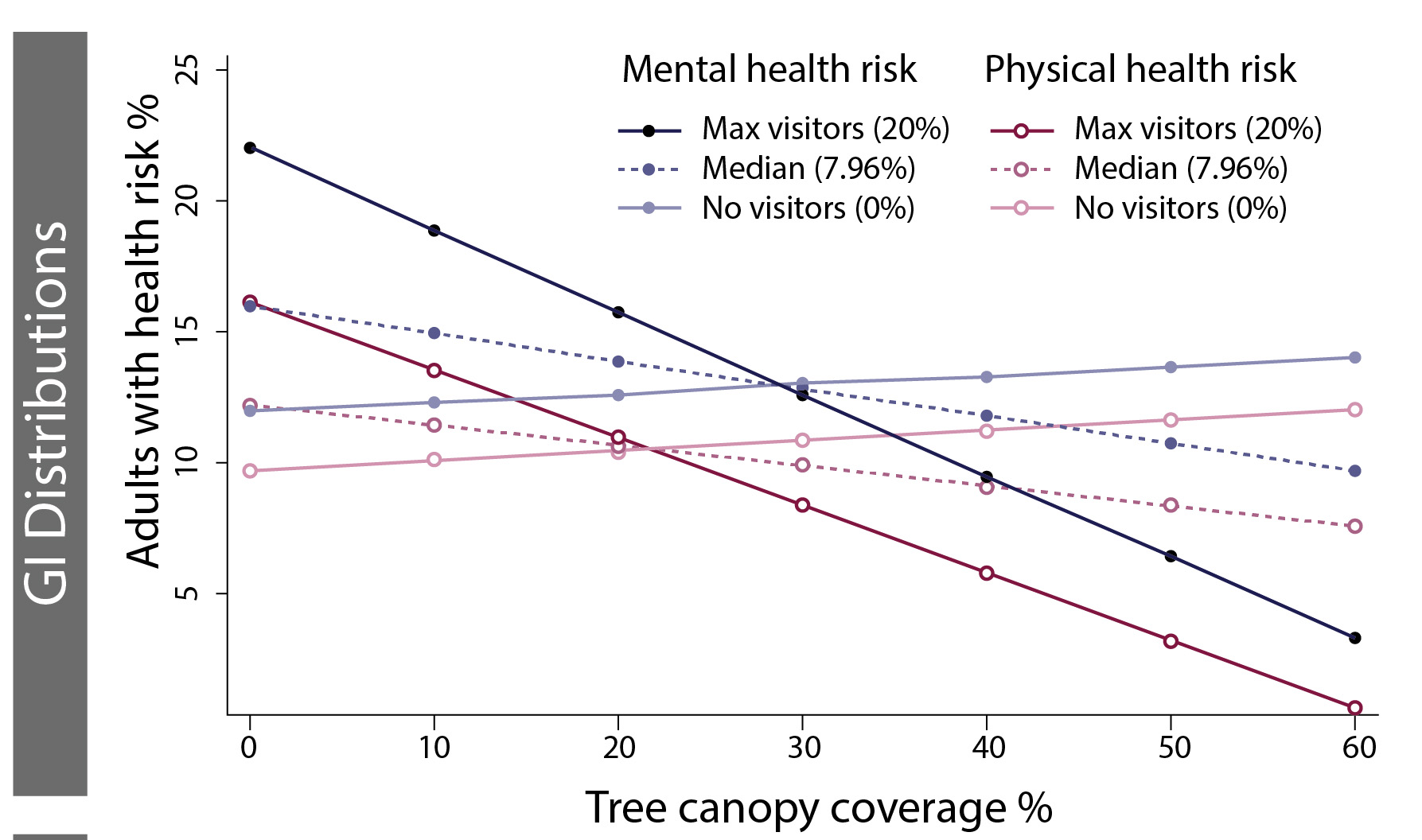
Predictive margins of tree canopy and campus visitors.

Increasing tree canopy coverage stands out as a promising green infrastructure planning and management strategy that can contribute to the health of campus users and communities.

Share

Target audience

City planners and policymakers responsible for managing green spaces and promoting public health; Higher education organizations responsible for student health; Organizations advocating for student health and wellness.

The problem

Green infrastructure in college campuses and their surrounding communities can bring multiple health benefits. However, existing secondary data are typically available at the city/neighbourhood level only and not available for these campuses. This study aims to address some of these limitations and contribute to advancing our understanding of the campus environment and student health relationships by utilizing new data and methods.

What we did and why

Using ‘SafeGraph’ mobility data, this study indirectly gauges the relationship between green infrastructure and campus health by measuring the proportions of campus users across communities. We aimed to 1) identify the mental and physical health characteristics associated with green infrastructure and the numbers of campus users across three campus communities; and 2) examine the moderating effects of green infrastructure on the health conditions of the campus users.

Our study’s contribution

Our results indicate there is a strong benefit of green infrastructure on community health. A significant moderating effect was found for several green infrastructure variables, indicating the potential added health benefits of campus users compared to non-users.

Impacts for city policy and practice

For city planners and policymakers, increasing the tree canopy coverage stands out as the most promising green infrastructure planning/management strategies to contribute to health of campus communities/users. The tree canopy data are also more widely available than most other green infrastructure variables, making its use for the purpose of monitoring, intervention, and assessment feasible for various stakeholders.

Further information

Full research article:

Green infrastructure and community health: exploring the characteristics of campus users in three university towns in Texas by Ryun Jung Lee, Zhicheng Xu, Galen Newman, Chanam Lee, Yang Song, Wonmin Sohn, Dongying Li and Yizhen Ding

Related posts

Adolescents’ ideal park: Usage, benefits and preferences

Green spaces bring several health benefits. However, adolescents’ infrequent use of green spaces, especially in southern European cities like Porto, can be attributed to cultural and contextual factors, including limited green space, maintenance issues, and equipment scarcity. Thus, there has been a great push to enhance green space provision. However, achieving effective greening interventions requires understanding user perspectives, addressing barriers, and considering various age and socioeconomic groups to ensure universal access and youth-friendly spaces.

Read More »

Understanding community perspectives on livability metrics

Livability is a people-oriented concept, and accurately measuring it requires a contextual understanding of what local stakeholders deem essential for making communities livable. Despite extensive research on livability indicators, most studies have taken a top-down approach, with few considering the input of the communities.
Read More »