


City Know-hows

Walking and wheeling in Low Traffic Neighbourhoods: A mixed methods study of the impact of schemes on disabled people’s journeys

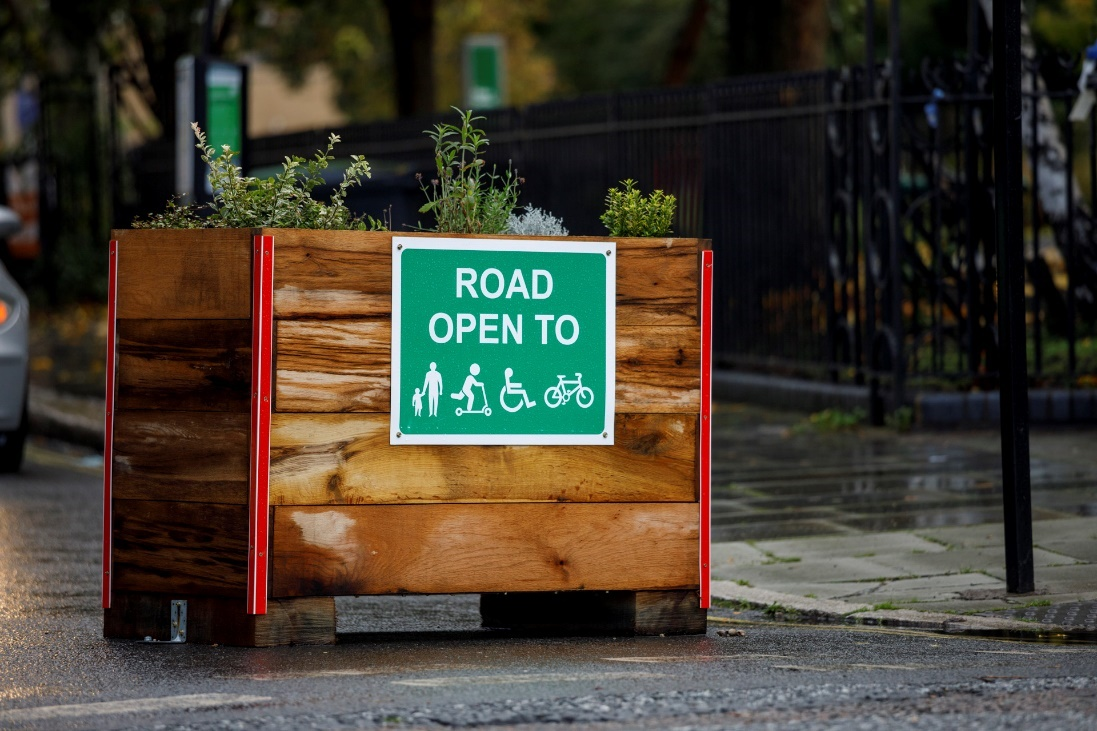
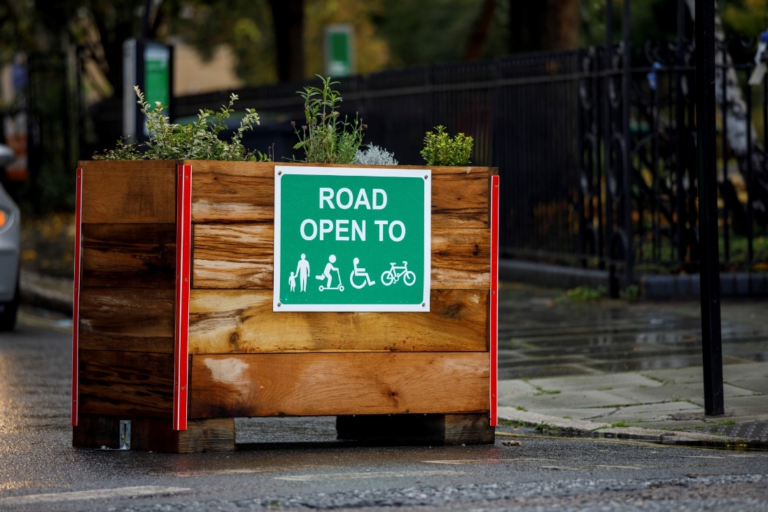
A wooden planter with some flowers in the middle of a residential street. On the front is a green sign saying 'ROAD OPEN TO', followed by icons representing an adult holding a child's hand, a person on a push scooter, a person using a wheelchair, a bicycle.
A planter used to indicate the entrance to a Low Traffic Neighbourhood in London. Credit: Crispin Hughes www.crispinhughes.co.uk

Our new mixed-methods research highlights the importance of traffic calming and footway improvements to enhance disabled people’s journeys, accesses and health.

Share

Target audience

National and local officers involved in built environment and transport decisions. Organisations led by people with disabilities.

The problem

Low Traffic Neighbourhoods are being introduced in UK cities to reduce motorised through-traffic in residential areas, create better conditions for walking, wheeling and cycling, and change the hierarchy of uses in public spaces. Existing evidence shows that schemes work and generate important public health benefits. However, the experiences of disabled people with these schemes have yet to be explored. This is important because public space and the built environment are important facilitators and barriers in the lives of disabled people.

What we did and why

We used mixed-method research to understand how Low Traffic Neighbourhoods affect disabled people journeys. We collected pixelated video data in three Low Traffic Neighbourhoods (and matched control sites). We counted people walking and wheeling with mobility aids before and after Low Traffic Neighbourhoods’ implementation. We interpreted any increase in this quantity as indicator for roads being more welcoming for residents with disabilities. We then qualitatively analysed the videos, together with focus groups and interviews with disabled people, to understand whether the Low Traffic Neighbourhoods were associated with changes in the quality of journeys made.

Our study’s contribution

The analysis revealed the potential for Low Traffic Neighbourhoods to improve disabled people’s access, but also the need for further actions. Quantitatively, we observed modest positive trends in the number of pedestrians using mobility aids. Qualitative analysis showed that where significant reductions in traffic were achieved, mobility aid users travelled more smoothly. However, we also observed that poor footway quality continued to make walking and wheeling difficult. These footways need to be widened and smoothed to meaningfully improve disabled people’s journeys.

Impacts for city policy and practice

Our study provides further evidence of the importance of understanding accessibility as a complex, multi-factorial process. Improving accessibility means not only reducing the dominance of traffic, but also addressing the structural and material barriers that the built environment creates for disabled people. While Low Traffic Neighbourhoods offer opportunities to improve accessibility for some, their success depends on a wider commitment to inclusive design and infrastructure improvements that prioritise diverse needs.

Further information

Full research article:

[OPEN ACCESS] Walking and wheeling in Low Traffic Neighbourhoods: A mixed methods study of mobility aid users’ interactions with changing public spaces by Ersilia Verlinghieri, Harriet Larrington-Spencer, Alisha Pathania, Anna Goodman, Jamie Furlong and Rachel Aldred.

Related posts

User experience of neighbourhood greenspace and perceived impact on health and wellbeing: the case of an urban extension to a ‘Healthy New Town’ in England

Providing access to greenspace is insufficient in ensuring that positive benefits are realised. Critical characteristics may distinguish between those spaces that encourage people to visit them and those that are uninviting. This article provides a case study of a residential urban extension in one of the UK’s ‘Healthy New Towns’.
Read More »

How can we reconnect mental and urban health?

Our study found that community place-based initiatives involving the public and private sectors can provide public spaces, such as public parks and communal gardens, that are appropriate for reconnecting mental and urban health using the concept of co-benefit endorsed by the World Health Organization in 2011. We examined this concept in large projects in Seoul and Singapore to show the advantage of intersectoral collaboration for reconnecting mental and urban health initiatives by urban planning.
Read More »