City Know-hows
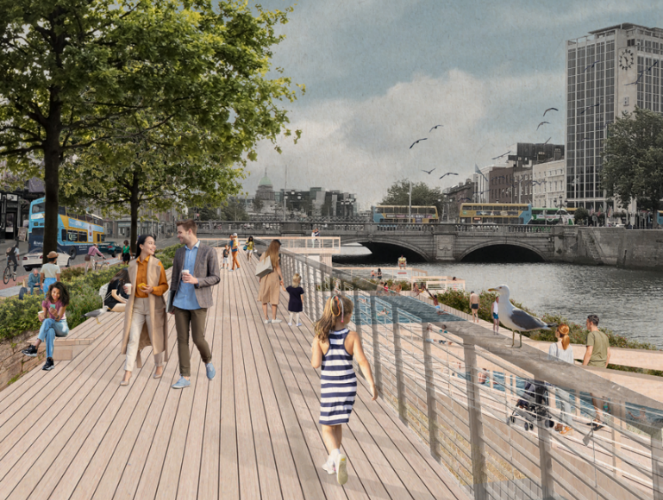
Delving into the world of nature-based urban design to breathe new life into city riverfronts! Read this article about exploring the socio-ecological transformation of Liffey Boardwalk in Dublin.
Share
Target audience
Urban designers, architects, and landscape architects. Government policymakers at national, regional, and local level.
The problem
Major and accelerated changes in waterfronts (bearing little resemblance with rivers’ once natural state) have led to greater water overflows, pollution, and the destruction of ecosystems, exacerbated in the context of rapid urbanisation and climate change. Interfering infrastructural works were sometimes followed by social conflicts or protests, as the social connectivity along riverfronts was temporarily or permanently altered. Such a challenging case is Liffey Boardwalk disconnected from the river and facing anti-social behaviours.
What we did and why
Interventions on riverfronts require close consideration of contextual ecological and social aspects. We adopted a research-by-design process to discuss nature-inspired urban design strategies in an Irish context.
• We conducted a desk study of academic literature and urban policies to establish the suitability of various methods for the site characteristics;
• We performed site analyses (site observations, footfall counting, photographic documentation) for an in-depth understanding of the existing conditions;
• We developed urban design scenarios to envision potential approaches, for which public feedback was sought.
Our study’s contribution
This study provides new perspectives on how riverfronts could be transformed into more natural and vibrant social spaces, bridging the gap between academia and urban design practice. While documenting multiple blue-green infrastructure or water-sensitive urban design approaches and techniques, the site conditions restricted their applicability to a handful. For the Liffey Boardwalk, the biophilic design emerged as the most pliable strategy. The entire research-by-design process is presented and illustrated in urban design scenarios.
Impacts for city policy and practice
For the incorporation of nature-based strategies in complex and problematic real contexts, more effort and further innovative approaches are needed to link rigorous academic research (that requires more time and resources) with design practice (usually having a limited timeframe of delivery). This would, however, eliminate some of the obstacles in implementation and uptake. Involving citizens in co-designs and co-creation could ensure public interest and acceptance, or lead to further refinements of scenarios.
Further information
Full research article:
[OPEN ACCESS] Research-by-design for nature-based riverfronts in socially complex urban areas: rethinking Liffey Boardwalk in Dublin Aura-Luciana Istrate and Emelie Madfors
Related posts

Our study investigated whether apartment dwelling and building design attributes influenced residents’ housing satisfaction in the initial stages of the COVID-19 pandemic. Multivariate models showed that residents’ perceptions of their apartment’s internal space and layout and the thermal comfort it afforded them in winter were independently associated with increased housing satisfaction.

Community well-being is acknowledged as being ‘greater than the sum of its parts’. Our paper identifies current gaps in Community well-being assessments and recommends participatory mixed methods.

We compared cross-city differences in the walking environment in Madrid and Philadelphia as a case study