City Know-hows

The role of greenness during the COVID-19 pandemic

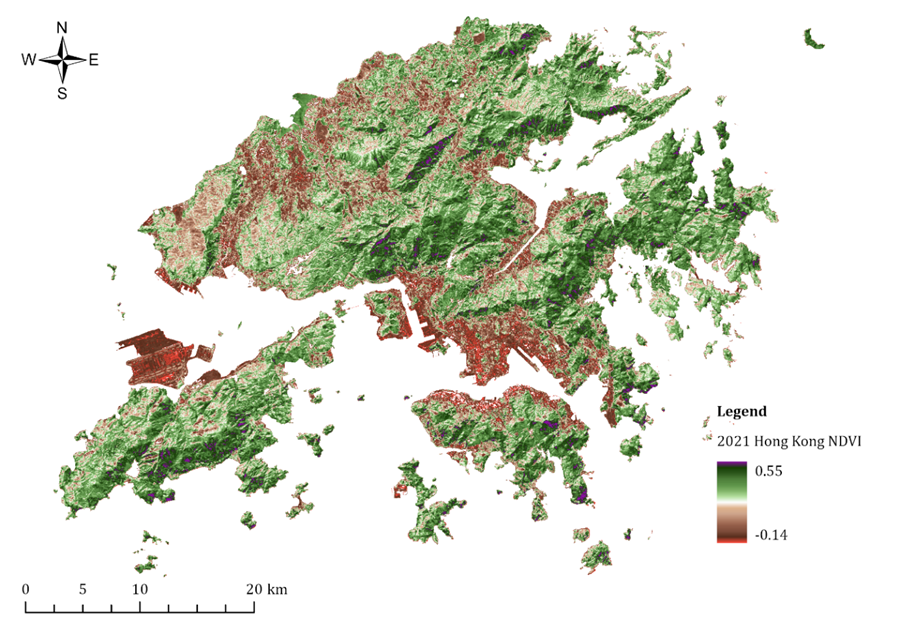
Map showing the health and density of vegetation (NDVI) of Hong Kong. NDVI greenness was calculated from a Landsat8 OTL/TIRS imagery of 30m spatial resolution obtained from the Landsat Archive in 2021.

Residing in a neighbourhood with higher greenness within 400 metres was associated with higher residential greenspace visitations during the COVID-19 pandemic. Policies towards scaling up and optimising residential greenness may constitute important interventions for enhancing population-level resilience during public health emergencies.

Share

Target audience

Urban planners and designers, public health researchers, local officers and developers.

The problem

Exposure to greenspace is protective of physical and mental health, but its role during the COVID-19 pandemic is unclear.

What we did and why

We examined the associations of residential greenness with behavioural, physical and mental health outcomes during the fifth wave of COVID-19 in Hong Kong. A questionnaire of 160 participants assessed frequency of greenspace visits, physical activity, and physical and mental health. Residential greenspace was measured in terms of number of greenspace, proximity to greenspace, and satellite-derived greenness as a metric of quality.

Our study’s contribution

We found that residing in a neighbourhood with higher greenness within 400 metres was associated with higher residential greenspace visitations. The count of residential greenspace was protectively associated with physical and mental health outcomes. The beneficial association between greenness and greenspace visitations remained robust at a 500-metre network buffer, among private housing residents, men and those aged >40 years.

Impacts for city policy and practice

Post-pandemic urban planning should further synergise evidence worldwide for optimising provisioning, design and siting of greenspaces to promote active living and mental well-being, and thereby improve population health and resilience.

Further information

Full research article:

Associations of residential greenness with behavioural, physical, and mental health: a Hong Kong study during the fifth wave of COVID-19 pandemic by Chi Cho Cheung, Ka Yan Lai, Rong Zhang, Eric Schuldenfrei, Qingyao Qiao, Chris Webster and Chinmoy Sarkar

Related posts

Understanding the community and social determinants in mental health inequity: the impact of mass social distancing during COVID-19, USA

The psychological impact of social distancing order during the COVID-19 pandemic can be determined by combining the effects of both individual and community capacities. This study supports the need to improve the physical environment to implement more sustainable health policies in different communities and cities across the world.

Read More »

Cooler kids need greener spaces

Heat exposure and greenness influence health and learning outcomes. Satellite images show schools on the Coast have strong heat stress levels and low vegetation; schools in the Andes have the largest solar radiation. Reforming school infrastructure standards is urgently needed in Ecuador. To describe environmental conditions in nine Ecuadorian schools, we analyzed three variables: temperature, vegetation, and solar radiation derived from satellite images that we downloaded from Google Earth Engine. We compared schools across three ecoregions to see differences in range and average values.

Read More »