
City Know-hows
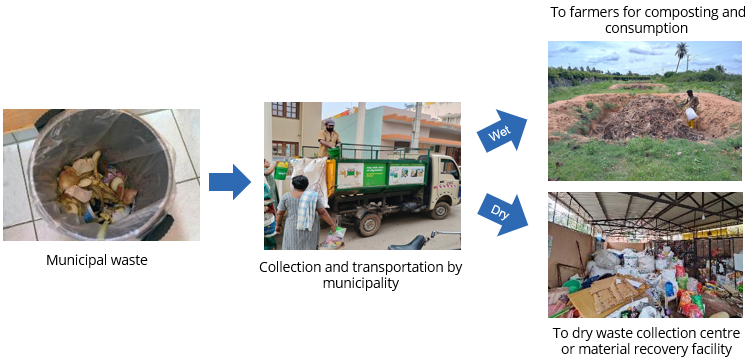
This review aims to establish a sustainable relationship between municipalities (cities) and local farmers, facilitating the processing of biodegradable wet waste into organic compost.
Share
Target audience
Urban local bodies, farmers (communities), solid waste management practitioners
The problem
Improper solid waste management causes significant environmental damage. In India, solid waste management is a major challenge, particularly for urban local bodies. While larger cities have access to sufficient funds to provide solid waste management services, smaller cities with limited resources struggle to sustain financially viable solid waste management operations. Consequently, solid waste often ends up in landfills, contaminating the environment instead of being processed effectively. At the same time, the excessive use of chemical fertilisers in agriculture degrades soil health and further contaminates the environment.
What we did and why
We aim to establish a sustainable relationship between municipalities (cities) and local farmers, facilitating the processing of biodegradable wet waste into organic compost. The method proposed involves a simple, cost-effective, and scalable waste-processing model known as pit composting. Additionally, we identify challenges and opportunities for smaller cities, and research gaps related to pit composting and outlines future opportunities for its improvement. By addressing both SWM and the use of fertilizers, this approach can significantly reduce the carbon footprint of urban and agricultural practices. It also promotes a circular economy and sustainability by preventing waste accumulation in landfills.
Our study’s contribution
This study interlinks solid waste management with sustainable agriculture, offering a dual solution for waste processing and soil health improvement, which is one of the major issues in society. Also encourages a circular economy by limiting landfill waste and replacing chemical fertilisers
• Challenges for smaller municipalities: In India, smaller urban local bodies face financial limitations, making it difficult to maintain effective and sustainable waste management operations.
• Pit composting as a scalable solution: This review promotes a low-cost, scalable pit composting model, turning biodegradable waste into organic compost that can enrich agricultural soil.
Impacts for city policy and practice
Our work is of significant relevance for policy-making, particularly in advancing sustainable waste management and agricultural policies. By linking urban waste producers with farmers as compost consumers, this paper demonstrates a scalable model for circular economies that local governments can adopt to address rising urban waste and declining soil fertility.
Insights from the study’s comprehensive analysis contribute valuable data to support policies promoting pit composting as an environmentally beneficial and economically viable waste management solution. Overall, this review empowers policymakers to develop science-based guidelines for urban and rural waste management, support compost-based soil enrichment strategies, and enhance agricultural productivity, ultimately contributing to sustainable development and improved rural livelihoods.
Further information
Full research article:
Integrating pit composting with sustainable agriculture: a review of decentralized urban wet waste management in India by D A Kiran, H K Ramaraju and S V Pushkara.
Related posts

Although the CASE and MAPs were supposed to be temporary shelters for displaced persons, after fourteen years, they have not received proper maintenance and are dilapidated. This scenario opens to the idea that living in these places could negatively affect different psychological aspects, including perceived urban quality and environmental well-being.

Who supports proposals to manage if, when and where new takeaways can open near schools? According to our recent study,over 50% of adults living in Great Britain!

Public spaces in universities target skateboarding through hostile architecture and security. Hostile designs exclude skateboarding as a novel form of physical activity. Maybe ‘just’ urban design guidelines can produce more inclusive and diverse public campus spaces.