City Know-hows
Citizen science projects can form the basis for sustainable and inclusive urban development in accordance with SDG 11. Citizens, researchers and city authorities work together to explore the city and implement urban planning that meets the needs of all those involved in a city.
Share
Target audience
Urban planners, researchers, city administration and citizen scientists.
The problem
The SDG 11 (sustainable cities) strives for participatory urban development that enhances citizens’ quality of life and well-being. This demand requires new processes in urban planning that take into account and realize the well-being and experience of the city’s residents. Inclusive urban development must consider the needs of all stakeholders in the city, including its diverse community.
What we did and why
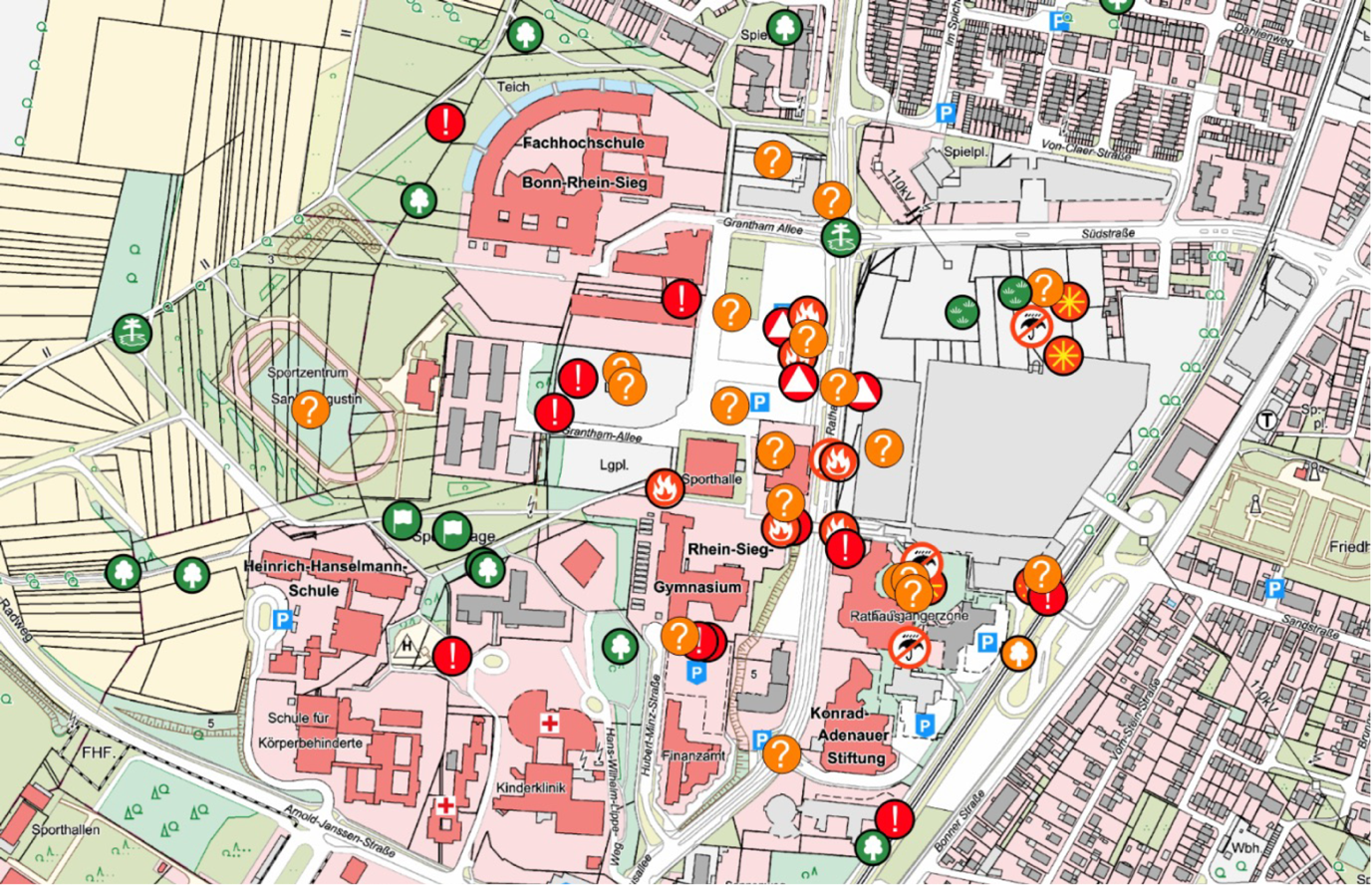
Together with citizens, the city administration and local research institutions, we have developed an online WebGIS based crowdmapping tool for the German city of Sankt Augustin using a citizen science approach. With the help of this tool, the citizens of the city can map grievances and sustainability deficits in the city. These maps form the basis for a joint planning process for the city with the participation of citizens. Thus, aspects of subjective well-being and subjective evaluation by the city’s citizens in particular can be taken into account, which often are not considered in top-down planning. In this way, SDG 11 can be implemented at local level and urban development implementation measures can be created that meet the needs of citizens.
Our study’s contribution
Our study shows how the needs and subjective well-being of a city’s citizens can be taken into account in urban planning. We provide an online tool that allows all citizens of a city to participate in urban development and address sustainability deficits.
Impacts for city policy and practice
Cities and researchers who are concerned with sustainable urban development can use our methods to get a better understanding of both sustainable deficits of a city and the needs of the citizens. The interaction between citizens, administration and science allows for a targeted and comprehensive analysis of the urban environment and planning that is tailored to the needs of the urban community.
Further information
Full research article:
Inclusive urban planning: leveraging citizen science for community well-being by Johannes Klement, Andreas Rienow, Christian Daniel, Wiltrud Terlau.
Related posts

For city planners and policymakers, increasing the tree canopy coverage stands out as the most promising green infrastructure planning/management strategies to contribute to health of campus communities/users. The tree canopy data are also more widely available than most other green infrastructure variables, making its use for the purpose of monitoring, intervention, and assessment feasible for various stakeholders.

We took a significant step in identifying the existing gaps in knowledge translation for healthy cities and adopting a proactive approach to laying out opportunities for improvement. By developing a visual representation for a renewed conceptual framework, we provide a clear and insightful tool for planners, designers, and policymakers aiming to enhance knowledge translation processes. As a result, this study not only elevates knowledge translation as a field of study for urban professionals but also reinforces its importance in public health.

How do children perceive and interpret different noises and how their personal experiences correlate with objective measurements? What are the long-term repercussions of sustained noise exposure during the formative years on adult cognition, behaviour, and health outcomes?