
City Know-hows
Target audience
City leaders and city planners in low- and middle-income countries.
The problem
We expose serious structural problems in the housing, transport, health and water, sanitation and hygiene sectors. These structural weaknesses inhibit the efficiency of the urban systems whilst at the same time limiting the ability of policy makers to effectively respond to pandemics such as COVID-19.
What we did and why
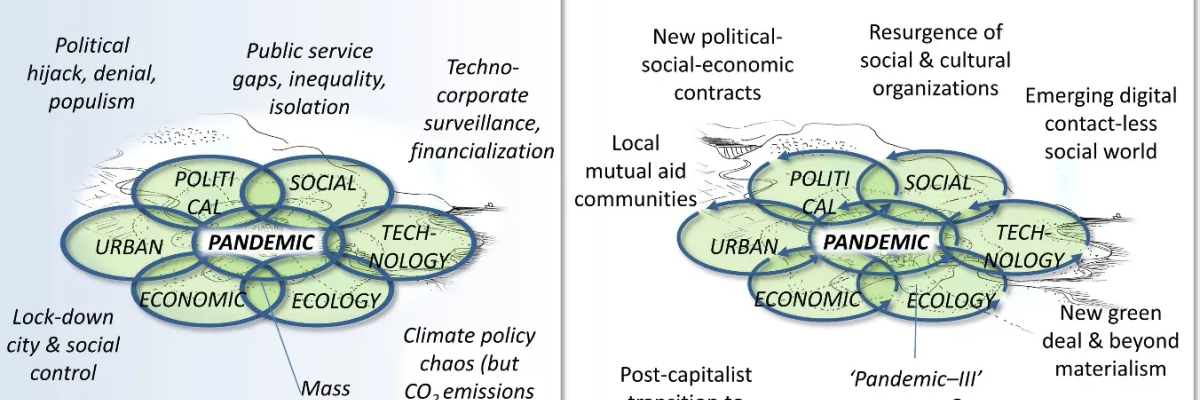
We used Ravetz’s framework on ‘nexus of syndromes and connexus of synergies’ between various elements of public life (see FFI below). This allowed us to explore inter-related policy failures/successes in Ghana that contribute to poor public health and lack of pandemic preparedness, particularly as they relate to social, technological, economic, ecological, political issues of not just COVID-19 but any future pandemics. Through a review of the literature on public policy responses to pandemics, we observed that the current urban planning system in Ghana leaves many people behind and exposes the lives of many to current and future disease pandemics.
Our study’s contribution
Planning has been variously defined as the link between knowledge and action, the guidance of future action, storytelling about the future and expectation management.
Our study showed that there have been many successes and failures with regards to the public policy responses to the COVID-19 pandemic.
Our analysis suggests that of importance to both planning policy and practice, is an urban planning agenda that intensifies collaborative working with public health departments and other agencies to safeguard our collective efforts in dealing decisively with public health emergencies.
Impacts for city policy and practice
We propose an agenda for transformation which revolves around the co-evolution and co-creation of new forms of societal values that are less materialistic and individualistic but rather more egalitarian.
In response to the COVID-19 pandemic, the effective collaboration between the private, academic institutions and the public sector should serve as the strategic basis for improving Ghana’s health sector and other sectors of the economy.
We recommend the need for a new urban planning agenda that integrates health in urban planning and harmonises various elements and drivers of urban life is needed.
Further information
For further details of the concepts involved see Joe Ravetz’s paper ‘Pandemic 3.0 from crisis to transformation: exploring the COVID-19 challenge‘, online in Journal of Future Studies (2020). Our diagram is reproduced from that paper.
Full research article:
Urban planning and public policy responses to the management of COVID-19 in Ghana by David Anaafo, Ebenezer Owusu-Addo and & Stephen Appiah Takyi
Related posts

Loneliness impacts hugely on our lives and there is appetite for solutions. Spending time in a place, bumping into one another could be one of them. Can we reframe how we think about spending time in a place? And should we?
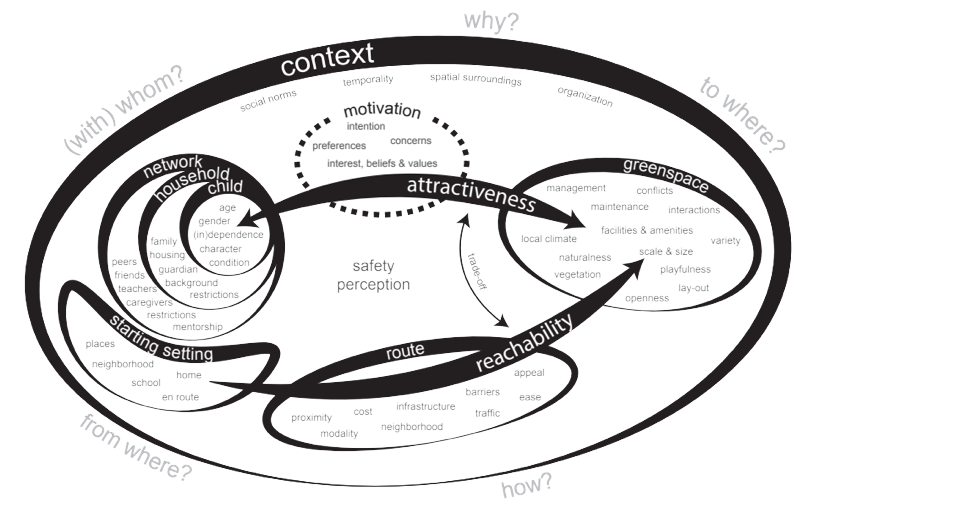
Access to greenspace impacts children’s physical, social, and mental health. While the factors affecting children are different from those affecting the general population, many accessibility measures use the same principles for children as they use for the general population. We present a comprehensive visual overview of factors affecting children’s access, how it can be measured across geographical contexts, and what measures remain to be developed.
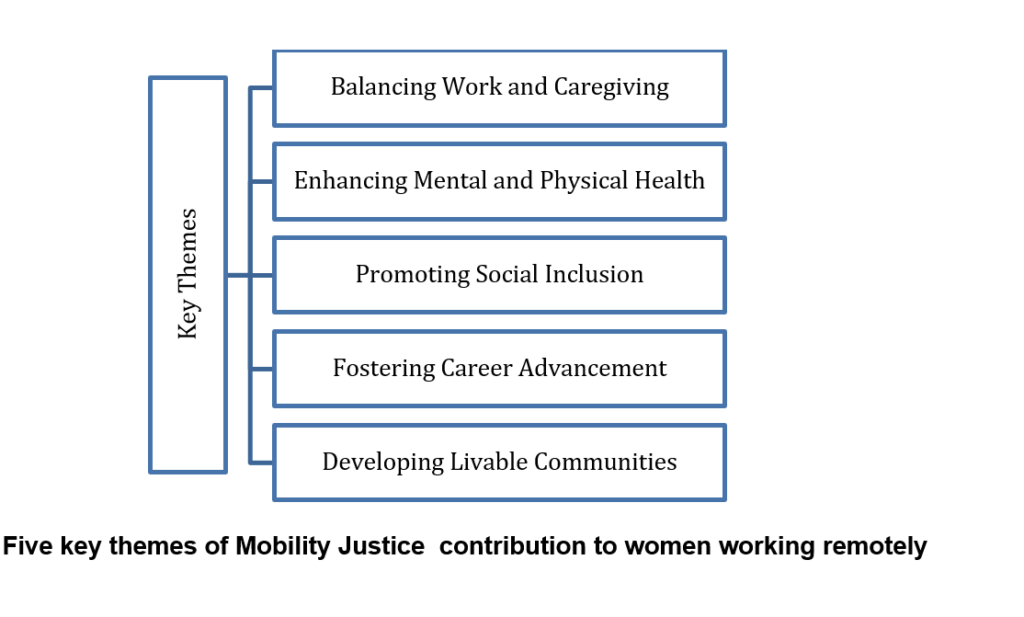
Mobility justice can help ensure that remote-working women have equal access to transportation and urban amenities, supporting their well-being and career advancement. This research explores the unique mobility needs of this growing population and recommends planning strategies to create more inclusive and equitable cities.