City Know-hows
Mobility justice can help ensure that remote-working women have equal access to transportation and urban amenities, supporting their well-being and career advancement. This research explores the unique mobility needs of this growing population and recommends planning strategies to create more inclusive and equitable cities.
Share
Target audience
Urban planners and transportation officials; Workplace diversity and inclusion officers and human resources professionals; Real estate developers and property managers
The problem
Mobility justice became a significant framework for ensuring equal access to mobility networks and services for all. Women working remotely is a growing phenomenon linked to a life choice of staying home and dependence on domestic resources, and the perception that mobility is irrelevant. Yet, there is a significant research gap in the thorough investigation of mobility needs for remote-working women, particularly those balancing caregiving responsibilities and career advancement.
What we did and why
I used a literature review, YouTube content, and semi-structured interviews to investigate the role of mobility in overcoming remote work challenges and supporting women’s social roles, career advancement, health, and well-being. I aspire to fill a knowledge gap by exploring the mobility needs of remote-working women, and contribute to the broader discourse on inclusive and equitable city planning by focusing on mobility justice and feminist urban theory.
Our study’s contribution
The key contribution of my study is the connections I have made between mobility justice, feminist urban theory, and the emerging trend of remote work.
My study additions:
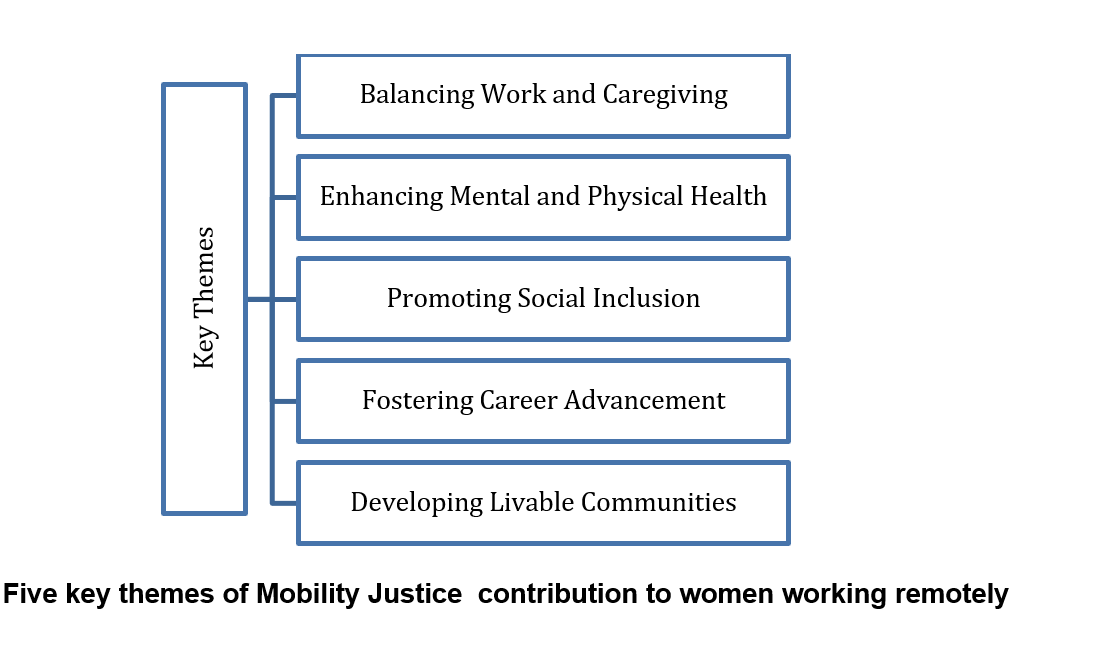
1. Concluding five key themes that reflect the mobility justice role in fulfilling remote working women’s needs, particularly those balancing caregiving responsibilities and career advancement.
2. Highlighting the ongoing shift towards a new paradigm of urban development, where cities are changing to accommodate the diverse needs of remote workers.
Impacts for city policy and practice
The study has implications in urban planning and policymaking to prioritize mobility justice in urban development strategies. This includes guiding existing and newly developed residential neighborhoods for equitable and inclusive environments that consider diverse populations’ needs in mobility. Urban developers should consider creating walkable environments that provide equal access opportunities for social events, physical activities, and essential services for women working remotely. Instead of building more office districts, and longer daily commutes to work, urban planners should prioritize livable communities.
Further information
Full research article:
Mobility justice for remote-working women by Alshimaa Aboelmakarem Farag
Related posts

Health has turned into a number one priority in the present city context (e.g. lower emissions, active transportation, sustainable farming). By integrating it with proximity measures (as in the 15-minute city), we can create even healthier cities. Here is how they do it around the globe.

As the global urban population grows, food production and housing are currently ‘competing’ with each other for land on the edges of cities. Both essential urban components, this research supports town planning and urban design professionals to explore alternative peri-urban land use typologies, where food production and housing co-exist for greater urban health and resilience.

Public health has historically been an important factor driving urban planning policy in England but is currently rarely a priority. We explore the factors behind this, try to explain them in the context of policy developments since COVID-19, and consider what needs to change at national policy level to support healthier placemaking in the future.