City Know-hows

Out-of-home built environment characteristics of urban heritage cores and their impact on age-friendliness

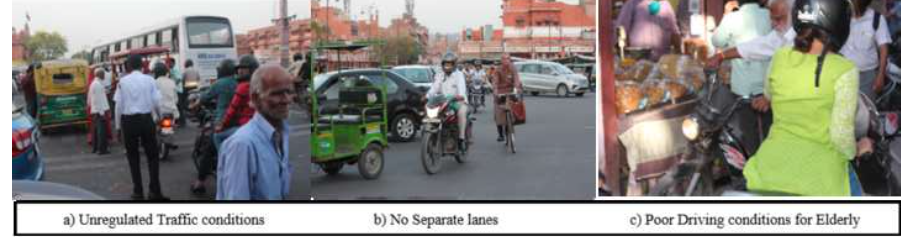
Traffic conditions; highlighting the lack of safety in Jaipur walled city.

The deterioration of the built environment, as well as poor traffic and pedestrian conditions, creates obstacles to active mobility, active ageing and functional abilities among older adults residing in heritage city cores. This has negative impacts on their social inclusiveness, quality of life and well-being. The walled city, which encompasses Jaipur’s heritage neighbourhood, is one of the few planned cities in India, extending back to the 18th century, and is considered a tourist attraction. With an in-depth study, we use Jaipur’s walled city to examine how supporting a better quality of life for an ageing population can have co-benefits for the tourism economy.

Share

Target audience

Planners, Architects, Local councils, Academicians and Researchers

The problem

Population ageing projections, as a demographic future, are set to pose stresses on developing nations and point to the need for creation of age-friendly infrastructures. However, rapid urbanisation and deterioration in out-of-home built environments in cities, particularly in heritage cores, create challenges. Specifically, to the functional abilities and social inclusion of older adult residents. With threatening traffic conditions, poor pedestrian conditions, and cash-strapped amenity provision, the opportunity for active mobility for physical activity and performance of activities of daily life gets compromised.

What we did and why

We have tried to identify critical challenges experienced by older adult residents to active mobility in out-of-home environments, particularly in heritage city cores in the walled city of Jaipur. Qualitative data was collected through semi-structured interviews, and an observational visual analysis verified the issues.

Our study’s contribution

Our study finds that poor traffic conditions and uncontrolled vehicle volumes have deteriorated pleasant, comfortable walking experiences among older adult residents in the heritage city cores of the Walled City, Jaipur. Despite a rich heritage environment, the opportunity for active mobility in out-of-home environments is often marred by congestion arising from local obstructions, poor pedestrian quality and amenities. Unregulated parked vehicles result in the loss of valuable public and open spaces.

Impacts for city policy and practice

Given the foreseeable demographic trend of population ageing, it is imperative to address the age-specific built environment needs of older adult residents. Though heritage city cores in walled city Jaipur inherit a built environment rich in culture and heritage, the creation of amenity-rich, safe and comfortable pedestrian prioritised linkages between home and destination environment and streamlining parking problems could help to enhance both the aesthetics of the public realm and at the same time enhance age-friendliness.

Further information

Full research article:

Related posts

Creating age-friendly parks: Insights from machine learning analysis on qualitative user data

any parks and public spaces are not designed with seniors in mind, lacking features that encourage physical activity and social interaction. This can lead to isolation, decreased mobility, and poor health outcomes. Unlock the potential of urban parks to promote healthy ageing. Our research identifies the essential design elements that encourage seniors to stay active, providing a roadmap for cities to create an inclusive and supportive environment.

Read More »

How do high-rise communal spaces shape residents’ social interactions?

High-rise apartment buildings are increasingly popular in large cities, however, urban land availability for outdoor communal spaces is limited. Creating communal spaces for high population density is a challenging task. Past research indicates the importance of the immediate environment in stimulating social interaction and the spatial organization for social activities can play an important role. One may ask whether the design of communal spaces within high-rise buildings can stimulate social interaction among residents.

Read More »

Navigating autism in public transport: WHO’s International Classification of Functioning, Disability and Health (ICF) as a framework to investigate the spatial and physical barriers

Among the factors impacting functioning and quality of life in autism, aspects of the built environment have recently gained increasing attention. However, the opportunity of proposing a universal framework for cross-scalar examination of these factors remains largely unrealized.
By narrowing the focus to public transport, a key component of urban spatial structure and urban mobility, this study explores the applicability of the World Health Organization’s International Classification of Functioning, Disability, and Health (ICF) in examining the built environmental factors that influence autism.

Read More »