

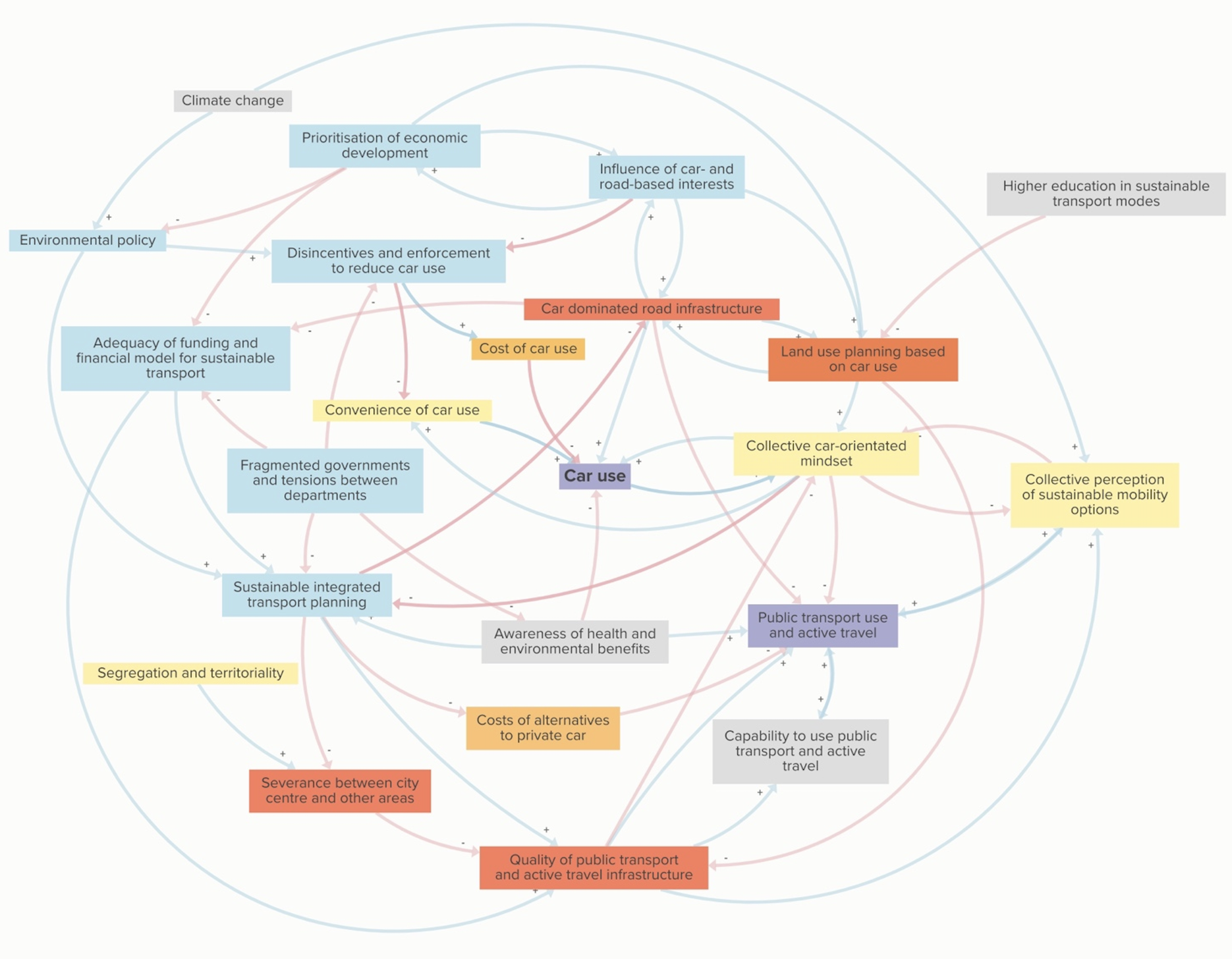

Belfast has very high levels of car use. Working with stakeholders we tried to understand what factors influence this. System-wide factors, such as financial models for transport, a collective car-orientated mindset and car-dominated road infrastructure, have the strongest influence on individual behaviour.

Share

Target audience

Local and regional authority leaders; Transport planners; City planners.

The problem

Car dependency is a problem worldwide. It is of particular concern in Belfast and Northern Ireland, said to be one of the most car-dependent regions in Europe. This is a concern since car dependency can lead to negative impacts on air quality, increase in noise pollution, poor neighbourhood accessibility, reductions in active travel and increases in car-related injuries and deaths. In addition to public health impacts, car dependency also widens inequalities and has economic, environmental and social development implications.

What we did and why

We aimed to understand better the factors that influence the high levels of car dependency in Belfast. We brought together a group of stakeholders from a range of sectors with an interest in the city. We worked with these stakeholders to co-design a conceptual diagram of the system, reflecting some of the factors that influence car dependency. We then explored the relationship between these factors.

Our study’s contribution

Our findings showed that despite a strong car-orientated mindset at the individual level, individual behaviour in relation to travel mode choice is influenced by system-wide factors. In the Belfast context, this meant that car use was the easiest and most convenient choice for the majority.

We found that there were influences through policy, infrastructure, economics, transportation norms and mindset, which all worked together to lead to these high levels of car dependency.

Impacts for city policy and practice

In Belfast, as with many other cities, car use is still the easiest and most convenient choice for the majority. Working with practitioners and stakeholders is critical. Future change starts with the development of shared understandings. Our method of co-designing outputs, together with stakeholders working in the city, is a successful way of bringing everyone together and starting to talk about the existing issues and, most importantly, how to solve them.

Further information

Full research article:

Group model building for developing systems-oriented solutions to reduce car dependency in Belfast, United Kingdom by Holly Weir, Brendan Murtagh, Iraklis Argyriou, Claire Cleland, Conor Meehan, John Barry, Alberto Longo, Gary McKeown, Frank Kee, Ruth Hunte and, Leandro Garcia.

Related posts

Can child-friendly walkability be improved in a two-wheel traffic-saturated city like Ho Chi Minh City, Vietnam?

Ho Chi Minh City’s motorbike-dependent traffic, severe congestion from overloaded infrastructure, high accident rates among children and pedestrians, and a doubling of overweight and obesity rates among children over the past decade have driven a comprehensive study on children’s walkability. This study serves as a foundation to encourage more walking among children as an initial step toward addressing these critical issues.
Read More »

Maximising the health-promoting potential of public urban green spaces for sustainable urban development and public health, evidence from COVID-19

Prior studies have highlighted the vital role of urban green spaces in human health, showcasing benefits like stress reduction and improved well-being. Yet, the Covid-19 pandemic sparked increased interest in these spaces without any examination of how research priorities shifted. Understanding these changes is crucial as it may bias perspectives and policies, potentially affecting public health. Thus, uncovering shifts in research focus during and after the pandemic is imperative for informed planning and management.
Read More »