

Cities urgently need systemic health checks. Without them, they keep fixing symptoms, wasting scarce budgets… while hidden risks grow. Our proposed approach helps cities understand their true health and activate their self-healing capacity instead of constantly ‘firefighting’.

Share

Target audience

Urban planners, mayors, international city networks

The problem

Today, cities assess “urban health” mainly as the health of people living in cities. This ignores the city itself as a complex living system. As a result, cities may appear healthy while exporting pollution, resource depletion, and social costs beyond their borders. This blind spot weakens urban resilience and overlooks the city’s immunocompetence—its ability to adapt, self-organise, and recover from shocks—especially under tight public budgets.

What we did and why

We propose a systemic health check for cities. It identifies the city’s overall health condition before choosing actions. The method combines a rapid health check, a deeper systems analysis, and a capacity assessment. Together, these steps reveal whether a city should optimise existing systems or transform them—helping decision-makers invest wisely, avoid costly mistakes, and strengthen resilience under real financial constraints.

Our study’s contribution

The paper moves beyond outdated approaches that fix urban “pain points.” Instead, it builds on the new science of cities that understand cities as complex, adaptive systems. This reveals unused potential, hidden risks, and leverage points for change. Improving health by constant repairs is no longer affordable. Understanding and activating a city’s self-organising and self-healing capacity is a smarter, economically sound alternative.

Impacts for city policy and practice

Cities should team up with science and conduct regular systemic health checks. This enables evidence-based prioritisation, cross-sector coordination, and smarter use of limited budgets. Rather than reacting to crises, cities can build resilience proactively—strengthening governance, partnerships, and learning capacities. Systemic health checks help cities decide when to optimise and when to transform, safeguarding wellbeing for people and the planet.

Further information

Full research article:

A Systemic Health Check for Cities by Franz W.Gatzweiler, Gabriele Harrer-Puchner, Mark Nieuwenhuijsen, Graham Alabaster, Felix Fuders, Hany Ayad, Yonette Thomas, Saroj Jayasingheh, Nicolas Youi, Lin Jianyij, Mari Vaattovaarak and Rumiana Jeleva.

Related posts

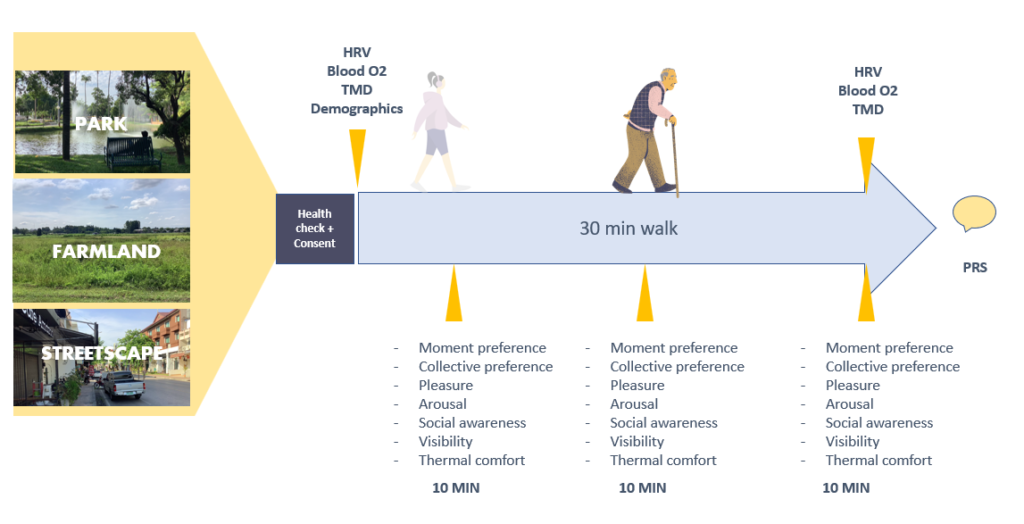
Where to walk when we are old: experiments in Taiwan and the USA

Our study highlights the importance of green spaces in urban areas for enhancing the well-being of older adults. It reveals significant benefits of nature walks over urban street walks and underscores the need for gender-sensitive urban design.
• Green spaces improve mood and perceived restorativeness.
• Women benefit more from nature walks, especially in urban streets.
• People from different cultures may benefit from nearby nature slightly differently.

Read More »

Cooler kids need greener spaces

Heat exposure and greenness influence health and learning outcomes. Satellite images show schools on the Coast have strong heat stress levels and low vegetation; schools in the Andes have the largest solar radiation. Reforming school infrastructure standards is urgently needed in Ecuador. To describe environmental conditions in nine Ecuadorian schools, we analyzed three variables: temperature, vegetation, and solar radiation derived from satellite images that we downloaded from Google Earth Engine. We compared schools across three ecoregions to see differences in range and average values.
Read More »