
City Know-hows

A holistic perspective in health-supportive design of future homes as informal offices

The expected rise of ‘working from home’ necessitates a deeper understanding of the cause and effect of home environment on physical, mental, and social health. By examining possible combination, we identified the pivotal role of improving architectural characteristics correlated with mental health, especially indoor environmental quality and socio-spatial features, prior to other indicators.

Share

Target audience

Architectural designers, policy makers, urban planners.

The problem

The expected rise of working from home after the COVID-19 pandemic necessitates a deeper understanding of the cause and effect of home environment on physical, mental, and social health. Existing research primarily focuses on physical and psychological health, with less attention given to social health. Incorporating social health is emphasized by various researchers during the pandemic. Moreover, the interconnected nature of health components suggests the possibility of mediation, requiring a model selection to represent the working from home situation.

What we did and why

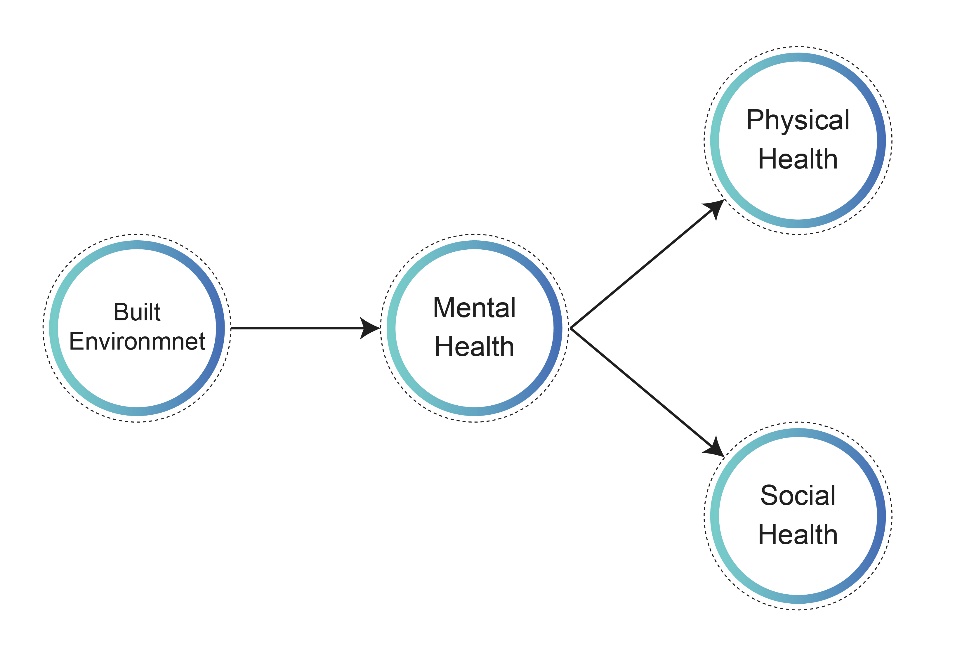
We aimed to identify the working from home model and explore the direct and indirect effects of the built environment on health components. To accomplish this goal, we used three steps of analysis, including bivariate, multivariate, and PLS-SEM, to select the architectural characteristics specifically for the situation of working from home. Therefore, not only our results indicate the effect of the built environment on health, but also reveals the primacies in causation through exploring mediation models.

Our study’s contribution

We identified a combination that offers the most robust model for linking built environment features to health dimensions. Our findings showed the full mediation and sequential precedence of mental health prior to physical and social health in the working from home situation.

Impacts for city policy and practice

We have further elaborated the architectural design implications and the importance of creating health-supportive environments, primarily through improving indoor environmental quality and socio-spatial features. We also discussed how various features impact each health indicator.

Further information

Full research article:

Related posts

Healing the city: a diagnostic approach to decoding stress in urban public spaces

This newly developed methodological approach aims to identify the underlying causes of stress in urban environments. To this end, it analyses a broad spectrum of perception-related factors from various fields to capture the full complexity of human perception in a more holistic manner. The evaluation of five case studies using the so-called ‘Stressor Matrices’ serves as the basis for deriving initial hypotheses about the triggers of urban stress.

Read More »

How much research is there on environmental exposures and cognition?

It is known that environmental exposures can have negative effects on brain health. We reviewed all the literature examining the effects of environmental exposures on cognitive health. There is a paucity of research on the effects of urban planning, particularly regarding things like active travel and green space accessibility.

Read More »