
City Know-hows
The study highlights the potential of residential gardens to contribute to London’s ecological goals. Collaboration with conservation organisations focusing on those with larger gardens who are older could enhance urban rewilding efforts.
Share
Target audience
City sustainability and biodiversity officers and leads; Urban wildlife interests.
The problem
Gardening for wildlife supports local ecosystems, enhances urban green spaces, and creates wildlife corridors, however, little is known on the demographic factors that potentially influence this behaviour. To influence behaviour, it is important to first understand behaviour.
What we did and why
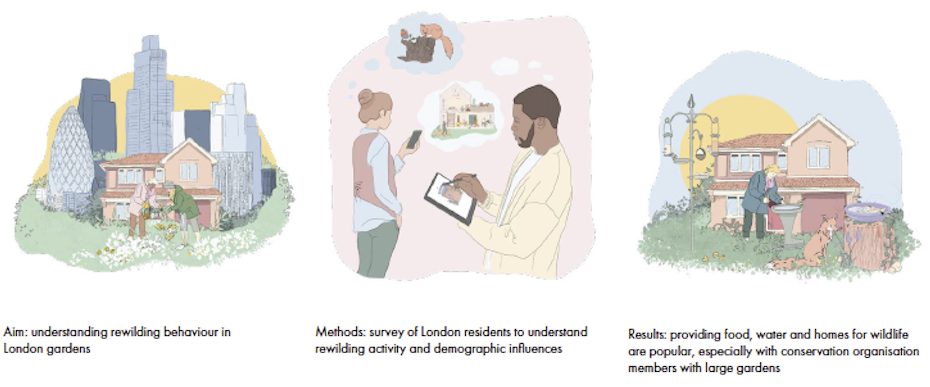
We wanted to understand the types of gardening for wildlife taking place in London’s private gardens and the influence of demographic factors on the likelihood to garden for wildlife. We sent out a digital questionnaire to ask Londoners about their gardening for wildlife practices and their age, gender, ethnicity, religious beliefs, occupation, household income, accommodation type, home ownership status, garden type, shared garden or not, dependents, and conservation-organisation membership status.
Our study’s contribution
Our study advances understanding of gardening for wildlife by residents with privuiate gardens n the city. Providing food (53%), water (50%), and homes for wildlife (47%) are common practices. Creating habitat corridors (29%) and nature-friendly gardening (37%) are less common. Note that conservation organisation membership and garden size are significantly associated with gardening for wildlife.
Impacts for city policy and practice
This study advances understanding of the behaviours related to gardening for wildlife. Our findings highlight the role of specific demographic factors. By aligning interventions with the study’s insights, local-decision makers such as city officers and urban leaders with relevant remits can harness the potential of residential gardens to enhance biodiversity, mitigate climate change, and foster deeper connections between city residents and nature, bringing health benefits.
A focus on conservation organisation members with larger gardens could enhance biodiversity, help to mitigate climate change, and foster deeper connections with nature, bringing health benefits.
Further information
Full research article:
[OPEN ACCESS] Wild ways: a cross-sectional study investigating gardening for wildlife in London’s private residential gardens by Justin Webb, Siân Moxon and & Alexandros Semertzi.
Related posts

The ‘runnability of cities’ as a novel spatial planning approach can enhance healthier and more enabling environments for everyone.

The future of workplaces now includes ‘remote’ for many, which has many health benefits. The future of ‘the office’ needs to evolve too and bringing more nature into the workplace is a healthy place to start.

Exploring complete streets implementation in knowledge production territories, this research examines the potentials and limitations of using campuses as living labs, applying tactical urbanism. It identifies the opportunities for enhancing walkability and inclusivity and the challenges, e.g. regulatory issues and limited funding, stressing the role of governance and community engagement.