City Know-hows

Integrating nature and workplaces in a post COVID-19 world: Building Back Better

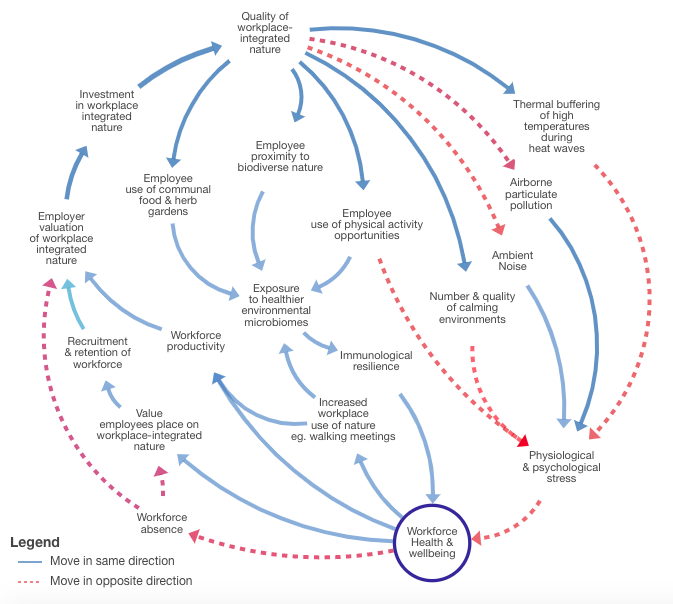
Systems map of the reinforcing loops. Prrocesses that should encourage employers to integrate more nature into their workplaces. This map can be best read starting with the increases in ‘quality of workplace-integrated nature’ leading to the intended health outcome – ‘workforce health and wellbeing’. The feedback loop is ‘closed’ by connecting increasing workforce health and wellbeing with the value attributed to workplace-integrated nature, which in turn is used to bring more nature into the workplace.

Target audience

Urban planners, public health professionals, property management professionals

The problem

Increasing urbanisation in the developed world has been linked to a concomitant rise in non-communicable disease. Despite this, research suggests we can intervene by improving access to, and the quality of surrounding nature in order to improve health and wellbeing.
As work commitments often limit people spending more time in nature, we explore whether bringing more nature into our workplaces could positively influence the health and wellbeing of employees and the local population.

What we did and why

We explore the health benefits of being ‘in nature’, the barriers and benefits of bringing ‘nature’ into the workplace, and whether workplace nature-based solutions could improve the health and wellbeing of the workforce. We focused on ‘workplace-integrated nature-based solutions’ because of the well-established link between nature and health and the additional benefits this has in improving climate resilience of communities.

Our study’s contribution

The literature we have reviewed suggests that the expected outcomes from pursuing nature-based solutions in the workplace include:

  1. Improved health and well-being of the working-age population
  2. Improved health and well-being of the surrounding local population
  3. Reduced social inequalities in health and wellbeing
  4. Reduced cost to the health and social care system
  5. Fewer sick days and greater work productivity
  6. Environmental benefits and climate resilience

In addition to recommending key areas for future research, we have identified 18 perceived or real barriers that need to be addressed in the process of improving the integration of nature into the workplace. 

We encourage employers to extend this method in order to develop a shared understanding of barriers specific to your workplace and to work on systemic solutions that work for you in your setting.

Impacts for city policy and practice

Our findings are relevant to several city-wide processes; including office district planning, policy around building approvals, policy-relevant to street furniture, greenspace policy and policy about active travel and access to greenspace.

Further information

Healthy Urban Microbiome Initiative; understanding the hidden value of nature in urban environments.

Resilience Frontiers Programme, UNFCCC; understanding why bringing nature into our cities is the future of resilient urban environments.

C40 Cities; understanding what the major cities of the work think is the future.

Full research article:

Related posts

Uncovering the evidence base of the COVID-19 pandemic in informal settlements

In informal settlements, the impact of COVID-19 can be alarmingly severe due to the lack/limited access to infrastructure, densely populated living conditions, and pre-existing socio-economic inequalities. There are limited studies that synthesise evidence from the literature on the COVID-19 lived experiences of informal settlement dwellers, often overlooked in scientific studies and policy-making initiatives. There any knowledge gaps that require further research to enhance the development of context-specific policies towards effective pandemic planning and response. How can we build resilience and sustainable livelihoods in informal settlements during public health emergencies?

Read More »