City Know-hows
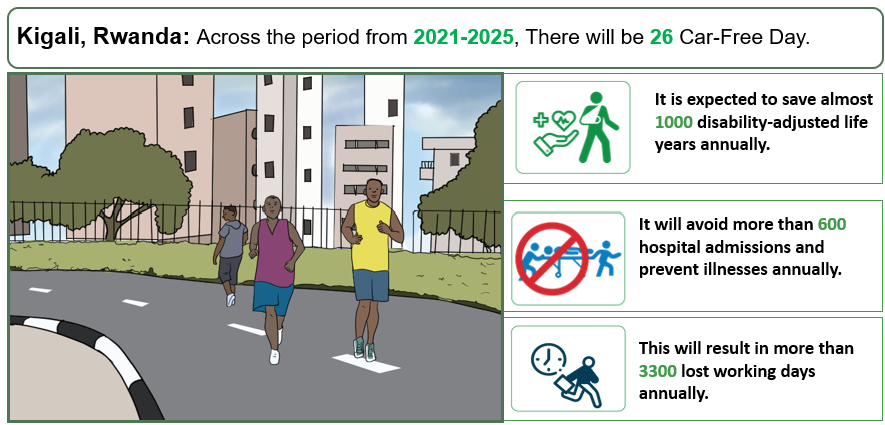
The health impact of non-motorized transport events in Kigali, known as ‘Car-Free Days,’ goes beyond just mass physical exercise. Importantly, it has reduced air pollution by 15%, this is expected to save more than 200 disability-adjusted life years annually.
Share
Target audience
City councils, epidemiologists, transport sector, communities.
The problem
Fast-growing cities and rising traffic congestion lead to declining air quality in Sub-Saharan Africa. This will also lead to declining growth in fuel imports, congestion, vehicle collisions, and GHG emissions. Due to the lack of data, evidence of transport and air pollution impact from Sub-Saharan contexts such as Rwanda is lacking. However, it is very valuable to understand traffic as a source of air pollution.
What we did and why
A lack of long-term air quality monitoring data in African countries such as Rwanda poses a significant challenge as urbanization and economic development lead to declining air quality. To understand the current drivers of air pollution, we used two natural experiments (Car-Free Day and COVID-19 Lockdown) to examine their impact on air pollution using particulate matter air pollution data in Kigali City. We also quantify the benefits of reduced air pollution.
Our study’s contribution
We found clear evidence that the transport sector is a major contributor to urban air quality in Kigali.
• Using the COVID-19 lockdown, we find that reduced travel activity of over 80% led to PM2.5 levels declining by 33%.
• We also found that a program to encourage non-motorized transport in Kigali called ‘Car-Free Days’ reduced PM2.5 by 15%.
• This reduction is expected to have resulted in more than 200 disability-adjusted life years saved in Kigali annually.
Impacts for city policy and practice
We provided policies for the City of Kigali to consider in order to improve air quality and overall public health;
• Prioritise public transport,
• Facilitate transport sector data sharing to support planning, coordination, and research,
• Focus on vehicle maintenance, testing and enforcing vehicle standards,
• Ban engine idling,
• Invest and promote e-mobility transport,
• Develop a framework for using carbon credits to stimulate finance for e-mobility firms without double-counting emissions.
Further information
Full research article:
[OPEN ACCESS] Natural experiments in urban air quality: lessons from car-free days and COVID-19 lockdowns in Kigali, Rwanda by Egide Kalisa, Andrew Sudmant, Remy Ruberambuga & Jonathan Bower.
Related posts

Our study shows that young autistic adults and older adults face similar patterns with walking, particularly at night or for leisure activities. These findings highlight a very poor health prospects for autistic adults as they age due to lack of physical and social activity. These findings underscore the need to rethink urban spaces for diverse needs. By identifying these patterns, we provide a foundation for creating urban environments that are more inclusive, accessible, and supportive of sustained physical activity and better health outcomes for autistic individuals as they age.

This study contributes to the broader discourse on urban design for children, offering insights into how cities can create more inclusive, engaging, and health-promoting environments. It supports and adds to existing literature, finding that the alignment of play initiatives with public health goals, and strong collaboration between local government departments are effective in supporting children’s play on the strategic level. It identifies barriers to play in policy, namely budget constraints and deprioritisation of play.

To improve health and wellbeing in cities, municipality employees, urban planners, architects, politicians, citizens, NGOs and funders can benefit by using the collective impact model for working effectively together.