City Know-hows
The elderly should be able to travel and have fun like everyone else and use urban spaces easily, and on this basis, it is necessary to identify dimensions of an age-friendly city that provides the possibility of planning for such environments.
Share
Target audience
Urban managers, Urban planners, Urban designers, Age-friendly networks
The problem
The rapid growth of the elderly population is one of the challenges in the world. Accordingly, cities should be planned based on the needs of these groups. In this regard, various institutions, including the World Health Organization, developed the Age-Friendly City Program in 2005. However, there are considerable criticisms on the complexities of this framework and its application in practice: (1) inclusivity; (2) ‘top-down’ and ‘bottom-up’ approaches; and (3) interrelated features. Based on this, using the principles of this framework and completing and correcting it according to the conditions of each society is a necessity.
What we did and why
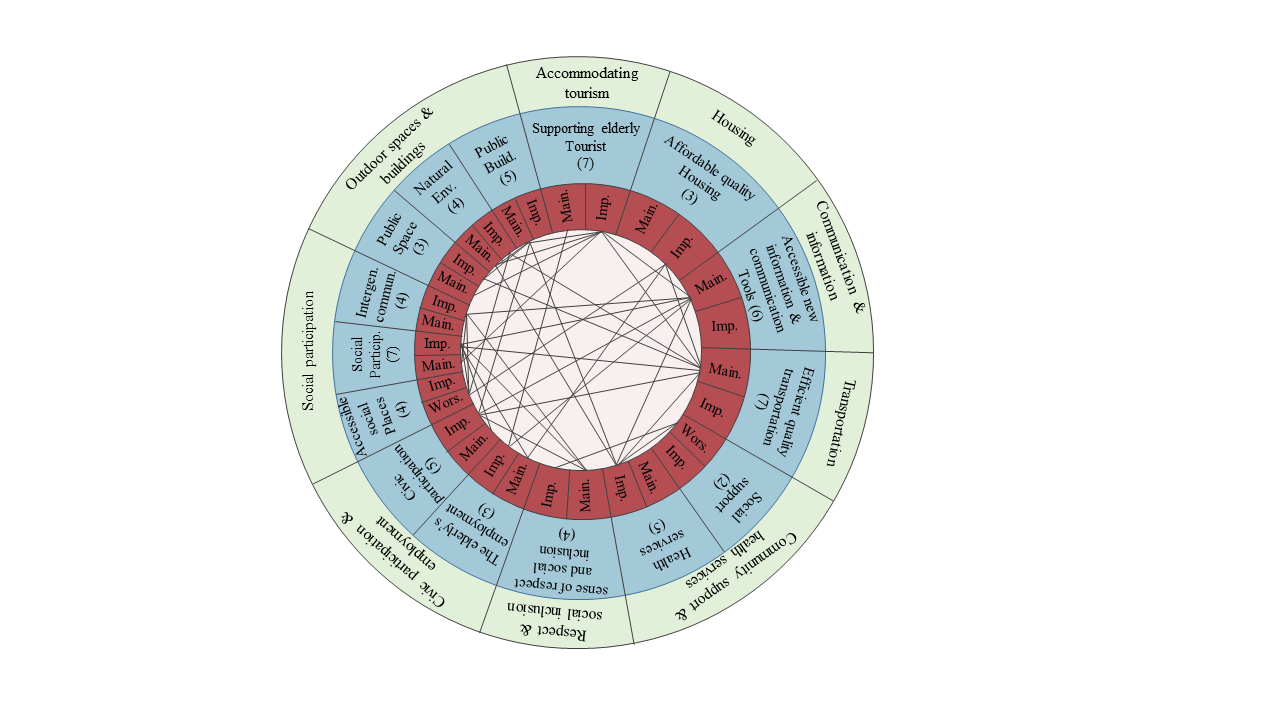
We present an approach of bringing the WHO Age-Friendly City framework into urban planning strategic decision-making by using the AIDA (Analysis of Interconnected Decision Areas) model. For this purpose, we focused on a historical tourist city of a developing country (i.e. Isfahan, Iran) and followed two goals:
(1) To identify the elderly users’ needs in the city for developing a context-specific age-friendly city framework;
(2) To present the application of the AIDA model and the WHO Age-Friendly City framework to develop new strategic policies for improving the age-friendliness of the city.
Our study’s contribution
We found one new domain (accommodating tourism) of the age-friendly city framework of Isfahan, besides the eight domains of the WHO Age-Friendly City framework; we also showed how to use six steps of the AIDA model to deal with the complexities of WHO Age-Friendly City framework in developing two hierarchical levels of urban planning decisions on improving age-friendliness of the city.
Impacts for city policy and practice
We provide the possibility of using urban spaces by the elderly citizens whose population is increasing. City managers, planners, and designers should simultaneously take advantage of the age-friendly city framework, and add dimensions to it that are appropriate to the environmental conditions or change some dimensions. For example, we found that in tourist cities, to add benefit from urban spaces, we should add accommodating tourism to this framework
Further information
Full research article:
Applying the analysis of interconnected decision areas model to the strategic planning of the age-friendly tourist city of Isfahan by Ahmad Shahivandi, Razieh Zandieh, Afsaneh Talebi Varnosfaderani, Kambiz Kabiri & Hesamuddin Allameh
Related posts

Residential segregation by socioeconomic status in Chilean cities is not well described by classical dimensions developed in USA in terms of race. We suggest that

Assessing the impact of walking in different urban spaces during the pandemic highlights the positive effects of high-quality green spaces for mental health.

Park access is about more than just distance to get to the park.