
City Know-hows

Internal housing layout as a determinant of mental health

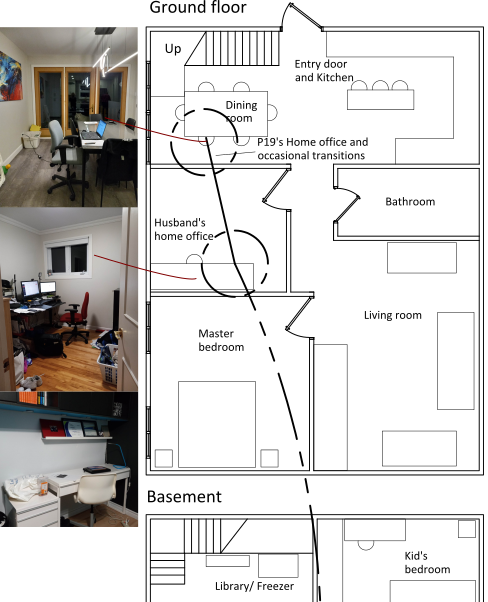
Partial detail from an analysis of a residential situation. See paper futher details Floor plans by the author, dwelling images provided by study participants.

For a long time, architecture and housing policy have been viewed through the lens of providing a product. But the pandemic showed that for certain people lacking space, with small children, or with complex families, housing can add to their ailments and cause ill mental health.

Share

Target audience

Architects and housing providers

The problem

It is necessary to know what elements of housing and its interaction with family activities generate mental health problems, and how it connects with people’s feelings of home.

What we did and why

We created an empirical mixed-method study focusing on working mothers during their adaptation to COVID-19 restrictions, reflecting on the three years of the pandemic and its relationship to housing. The first section, quantitative, allowed us to identify which social groups were included in the sample. The second part was the qualitative analysis process of these groups.

Our study’s contribution

Quantitative explorations and thematic analysis revealed conditional associations linking vulnerable residential situations to adaptation difficulties, low mental health scores, and negative feelings toward home, especially among women in blended or single-parent families, in small dwellings, or self-employed. Our project innovates in several areas:
1. It shows that there is a link between mental health, residential situations, and feelings of home.
2. It shows that single mothers, recomposed families, and families with small children, can suffer adaptation problems during crises that affect their mental health if the housing does not have a minimum of space and flexibility.
3. The self-employed are also among the families where housing plays a crucial role.

Impacts for city policy and practice

Implications:
1. When designing residences, the needs of different families and new ways of working from home should be taken into account.
2. For future residential projects, we should consider layouts with the potential for more multifunctional areas and modular partitions.
3. In terms of housing policy: Tiny homes are enormously risky for some populations, and help should be given to those who, because of their income or family structure, need more flexible and spacious housing.

Further information

Full research article:

[OPEN ACCESS] Mental health and residential adaptations during the pandemic: a mixed-methods study of working mothers by 
Pablo Garcia de Paredes, Thierry Ramadier, Marie Baron, Annie LeBlanc & Carole Després

Related posts

Enhancing children’s play in high-density urban environments: A systematic review of current insights

High-density urban environments significantly affect children’s play and well-being. This study provides current insights and explores potential solutions for enhancing play spaces in compact cities, aiming to promote a healthier and more sustainable urban future for children. Our goal was to synthesize current knowledge and provide guidance for improving play spaces in compact cities, ultimately contributing to more sustainable and liveable urban environments for children.

Read More »

Comparative analysis of urban sprawl drivers and impacts across the globe with a special focus on Asian Cities

This comparative study of 10 cities across the globe aims to understand the major factors that drive the sprawl conditions and their impact on the outer edges of the cities. Land is a very potential natural resource that has been exploited over the past few decades. Migration of people in search of better living conditions has led to the formation of cities, which are deemed to provide better quality of life. However, the rate of influx has become very high, leading to saturation in cities and forcing people to move towards the outskirts.

Read More »