City Know-hows
Amid global crises, this study unveils a renewed framework to help researchers, practitioners, and communities turn health knowledge into urban planning action. It urges continuous collaboration among disciplines and sectors, new training opportunities, and engagement with local communities, addressing local challenges and resources to shape locally bound “healthy city” visions.
Share
Target audience
City-makers across disciplines wishing to implement evidence-based solutions for healthy cities; knowledge brokers; local communities.
The problem
Current global crises and their health impacts unveil an urgent need to take a transversal approach and support urban practitioners and decision makers with the best available knowledge on how to implement healthy cities. Despite this growing agenda, knowledge translation efforts have not been comprehensively and effectively incorporating the health perspective in the urban planning practice. Public health and urban planning experts have recurrently noted gaps between health-related knowledge and implementation actions, and stressed the need to improve the research translation processes as a key action to promote healthier cities
What we did and why
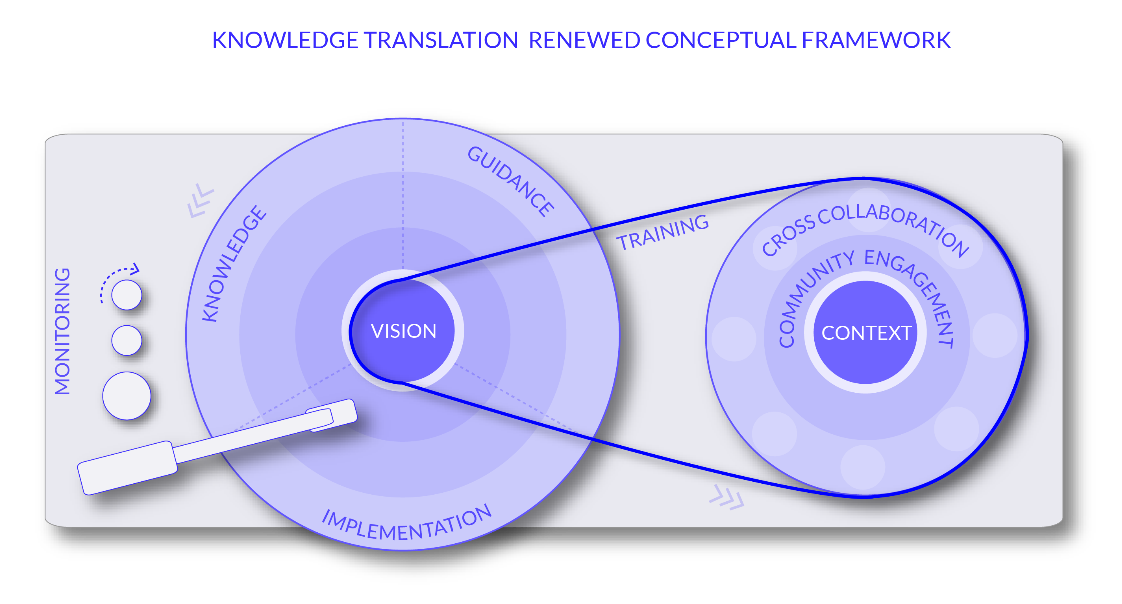
Departing from a basic knowledge translation framework, we delved into its main components (knowledge, guidance, and implementation), as well as cross-cutting factors, through a literature review. From this in-depth approach, we developed a renewed conceptual framework that visually represents the complexity of a meaningful knowledge translation process for promoting healthy cities. Additionally, we explored its practical implications with support from an expert team representing diverse sectors, disciplines, and regions.
Our study’s contribution
We took a significant step in identifying the existing gaps in knowledge translation for healthy cities and adopting a proactive approach to laying out opportunities for improvement. By developing a visual representation for a renewed conceptual framework, we provide a clear and insightful tool for planners, designers, and policymakers aiming to enhance knowledge translation processes. As a result, this study not only elevates knowledge translation as a field of study for urban professionals but also reinforces its importance in public health.
Impacts for city policy and practice
Discussing the proposed framework with experts, our study urges all stakeholders involved in creating healthy cities to begin an incremental transition towards a new culture of knowledge translation through: (i) embedding context-based knowledge and approaches, aligning knowledge translation efforts to local conditions, which is especially relevant in the Global South; (ii) institutionalizing cross-sector knowledge exchange and collaboration; (iii) establishing formal participation processes that prioritize and amplify the needs and perspectives of local communities; (iv) providing new cross-disciplinary training; (v) monitoring and evaluating knowledge translation efforts.
Further information
Full research article:
Healthy Cities: A visual conceptual framework for moving health knowledge into urban planning practice by Anna Gabriela Hoverter Callejas, Giselle Sebag and Pere Vall Casas.
Related posts

Health is rarely prioritized in urban decision making. Requiring Health Impact Assessment obliges developers to focus on questions of health. Some local authorities require this, but not all. This is the first paper to undertake a comprehensive review of when and where Health Impact Assessment is required in England, and to set out ways to make the process more effective.

To understand the current drivers of air pollution, we used two natural experiments (Car-Free Day and COVID-19 Lockdown) to examine their impact on air pollution using particulate matter air pollution data in Kigali City. The health impact of non-motorized transport events in Kigali, known as ‘Car-Free Days,’ goes beyond just mass physical exercise. Importantly, it has reduced air pollution by 15%, this is expected to save more than 200 disability-adjusted life years annually.

As cities age, are we ready to meet the needs of aging residents? This review shows how rethinking urban planning, green spaces, and better accessibility can make cities healthier and more inclusive for older adults. It highlights what’s working, what’s missing, and what cities can do better.