City Know-hows
Target audience
Regional and local-level urban planners. Health impact assessment practitioners.
The problem
The use of health impact assessments is rapidly growing and can benefit from the integration of a wide variety of available data sources; however, integration of several different sources of data can be a challenge.
There are so many factors that determine the health of neighbourhoods that:
What we did and why
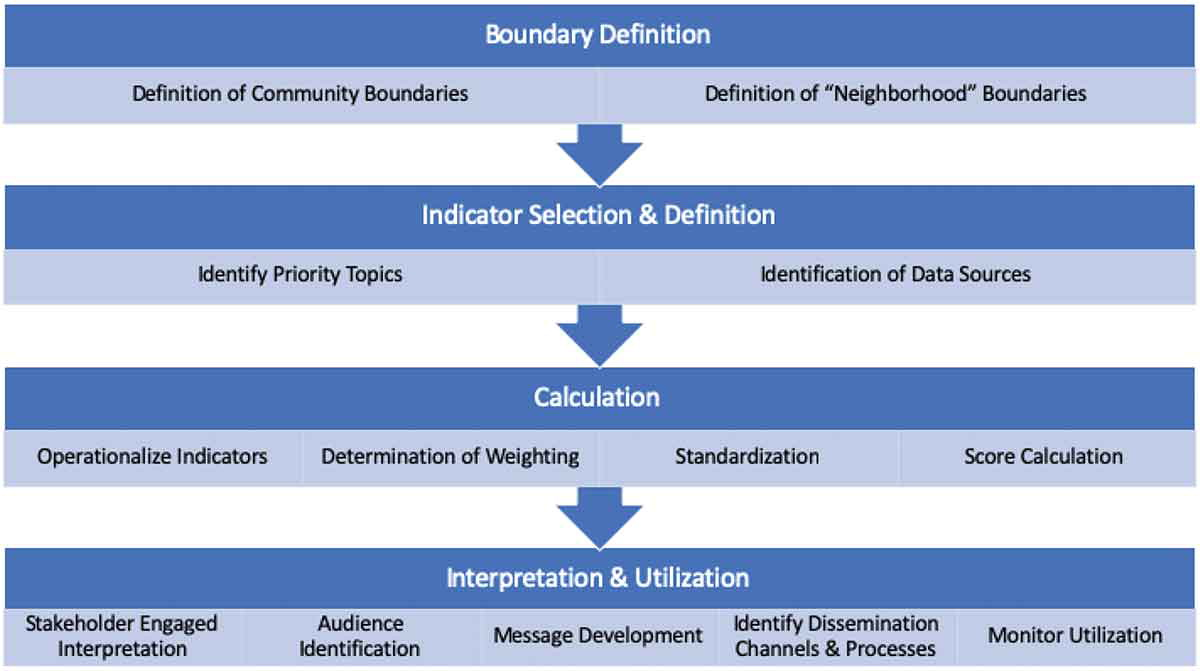
Our work presents a method of integrating several different sources of health impact data to create a single score of potential health impacts of an area within a given community relative to other areas within that community.
We first put different data sources into common units of measure using a standardization technique. Next, by taking into consideration the strength of available evidence, input from community stakeholders, and other sources of data, we individually weighted the diverse range of variables related to documented sources of health impacts, both positive and negative. We then combined these weighted quantities of impact into a combined health impact score, which provides a relative score (compared to other areas within the study area) for a given location.
Our study’s contribution
This study adds a tool that decision makers, planners, and health impact assessment practitioners can use to better understand the drivers that are impacting the health of their neighbourhoods.
The scores allow identification of what factors in a neighbourhood are most relevant in driving health impacts in a specific locality. This can help decision makers set priorities for which issues to address.
Impacts for city policy and practice
Practitioners seeking to better understand the sources of potential health impacts, either when using a health impact assessment or some other approach to integrate multiple sources of data into the decision making or planning process, could benefit from using this method/tool. This tool helps to further integrate health into broader decision-making processes, such as health in all policies.
The tool can be used to inform plans for healthy development, health impact assessments, and can provide a health-oriented evidence-base for decision makers to consider when deliberating and setting priorities.
Further information
https://sophia.wildapricot.org/https://www.pewtrusts.org/en/projects/health-impact-project
Authors: John D. Prochaska (@DrJohnProchaska), Robert N. Buschmann and Daniel Jupiter
Full research article:
Related posts

What if urban health went beyond human wellness? Through our more-than-One Health conceptualization, we explored urban wild spaces as places where the health and flourishing of humans, animals, and ecosystems intertwine. This approach provides new insights into designing cities that are not just green, wild, but interconnected as restorative habitats for human and non-human health.

How has the pandemic changed how we use and perceive our home? Many were working, eating, living, playing, sleeping, and learning in the same space. Has changed perceptions influenced ideas of the design of our homes, and potential for happiness and wellbeing?

Urban planners, economists, health and community policymakers and practitioners share insights in a new study on creating healthy food environments using urban planning policy and governance levers.