
City Know-hows
Target audience
Urban planners, city and regional planning organizations, urban policy makers
The problem
The physical structure and layout of urban environments can have a significant impact on COVID-19 spread. There is little research being conducted on how such development condition may have different outcome during different phases of COVID-19.
What we did and why
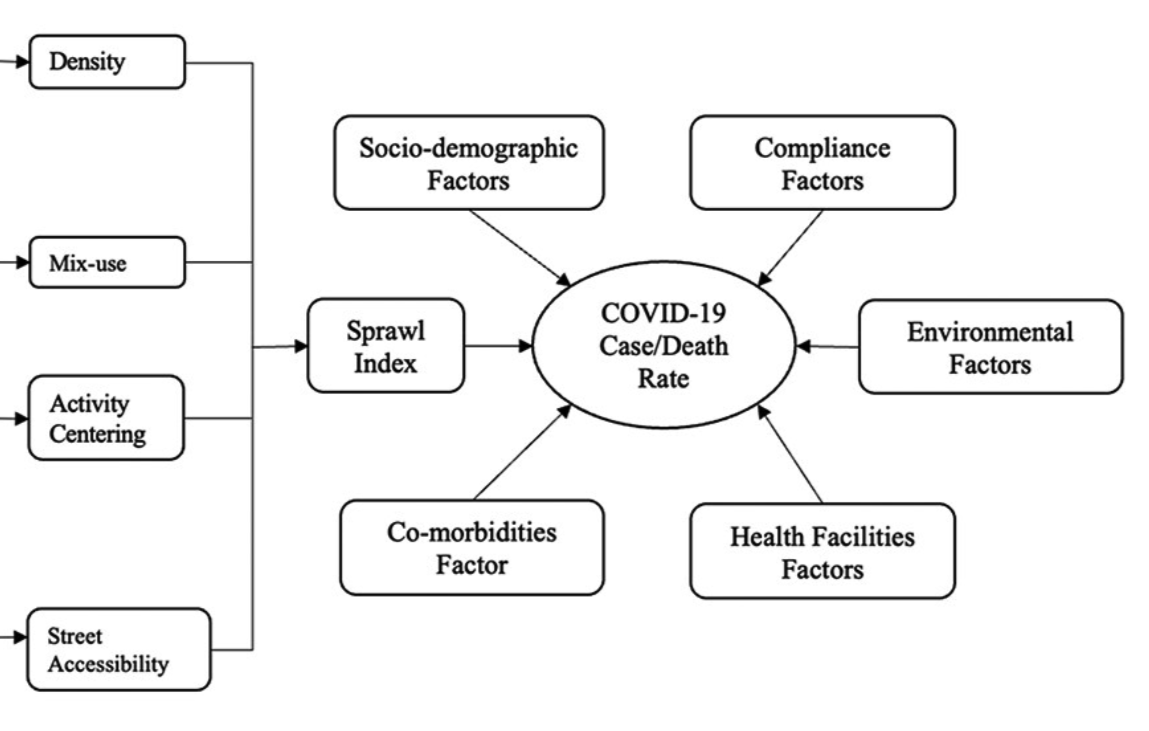
We conducted a research study that employed multivariate regression analysis to investigate the impact of demographic characteristics, social distancing measures, healthcare capacity, and urban form indicators on COVID-19 infection and death rates. The purpose of the study was to explore the associations between these variables and COVID-19 rates to gain insights into the role of urban form in the pandemic’s outcomes.
Our study’s contribution
Our result reveal significant associations between several variables and COVID-19 rates. Notably, the compactness index, used as a measure of urban sprawl, showed mixed results, with a positive relationship observed during the lockdown phase and a negative relationship during the post-lockdown period. Additionally, a higher percentage of the black population, older age, and lower educational attainment were found to be positively correlated with case and death rates.
Impacts for city policy and practice
The research highlights the importance of considering both demographic and urban form factors when analysing the impact of COVID-19 on urban areas. City authorities and policymakers can use this information to make informed decisions about strategies for urban growth, housing policies, social distancing measures, and healthcare capacity planning.
Further information
Full research article:
Relationship between urban form and COVID-19 severity: impact of compactness during the lockdown and post-lockdown periods by Md Hamidur Rahman & Angela Antipova.
Related posts

Learn how the City of Boston engages local researchers, community residents, and city officials to combat illegal firework activity.

We propose a replicable spatial framework applied at the small geographic scale in Pisa, Italy, to address a methodological gap. We find that both CVI and density predict excess mortality, providing an essential tool for health equity planning.

Our findings revealed that despite the limited play destinations compared to the local child population, children’s outdoor play experiences are predominantly positive. This positive outlook is attributed to their sense of safety within familiar spaces and strong social ties with neighbours beyond their immediate families. Key contributing factors include the proximity of schools and play areas to residential locations, the strategic placement of playgrounds along home-to-school routes, and the hierarchical relationship among neighbourhood open spaces.