City Know-hows
How can we systematically embed health in real estate decision-making to improve health outcomes related to our urban environment? We mapped the system of health consideration in urban development decision-making to identify leverage points and inform interventions that can generate virtuous feedback loops to support better urban health.
Share
Target audience
Urban planners and policymakers, real estate investors and developers, population health policymakers focusing on urban health.
The problem
Evidence shows the links between the quality of our urban environment and health outcomes, such as the effects of housing conditions, air quality, and access to nature on non-communicable diseases including diabetes, cardiovascular and respiratory conditions, cancer, and mental health. We need to understand this complex problem by applying a systems approach that considers the interconnected factors and private and public sector decision-makers that shape real estate development in order to design effective responses.
What we did and why
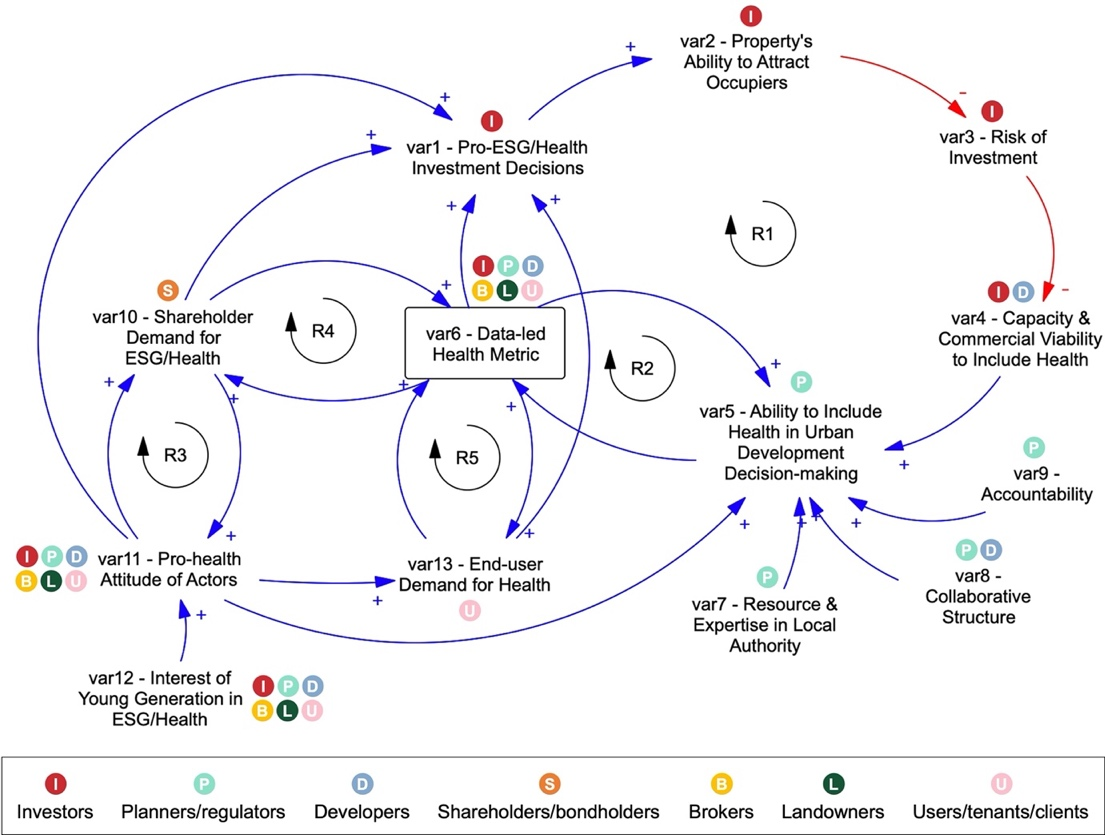
We investigated how health is considered in urban development decision-making from a real estate perspective by creating a system map based on interviews with 21 senior real estate professionals. Through this, we identified the interconnected factors, feedback loops, and decision-makers that influence the extent to which health is considered to inform intervention strategies for public and private urban development stakeholders to build healthier urban environments.
Our study’s contribution
Our study presents a system map and the key feedback loops driving the consideration of health in urban development decision-making from the perspective of real estate professionals. To support our understanding of the model and inform system-led interventions, we add further layers of information including the characterisation of system factors in structural, attitudinal, and transactional dimensions – indicating their potential leverage and speed of change – and identifying the actors involved in the decision-making processes.
Impacts for city policy and practice
Our systems map demonstrates that developing a standardised data-led approach to measuring health outcomes across real estate can leverage improved health standards by increasing users/tenants/clients’ demand for health, shareholders/bondholders’ demand for ESG (Environmental, Social, and Governance) and health, and planners/regulators’ ability to include health in urban development decision-making. We suggest this data-led health metric be developed in collaboration between the real estate industry, planners and policymakers, civil society, and academia through a purposeful institutional structure such as a forum.
TRUUD (Tackling the Root causes Upstream of Unhealthy Urban Development): This provides more information about the wider research on health and urban development decision-making, including a relevant blog post on the relationship between urban planning and public health: https://truud.ac.uk/unravelling-the-relationship-between-urban-planning-and-health/
Further information
Full research article:
 A systems approach to improving health consideration in UK urban development: a real estate perspective by Pablo Newberry, Heeseo Rain Kwon and Neil Carhart.

Related posts

This study measured the effectiveness of stepping stones as an element of landscape design – to make walking a more effective form of exercise for health. The average increase in heart rate due to steppingstones was 17.22%. In conclusion, we estimate that stepping stones can significantly increase peoples metabolic and physiological parameters, and can help the wider population to achieve the recommended government and health guidelines of ‘moderate exercise’ of 150 min/week, improving population health. This new evidence can help designers to implement ‘Active Urbanism’ strategies.

As an urban planner, designer, or manager in a developing country, to what extent and in what ways do you think your decisions can impact the mental health of citizens? How beneficial do you think replicating the urban experiences and knowledge from developed countries could be?

The System for Observing Outdoor Play Environments in Neighborhood Schools (SOOPEN) is a new systematic observation tool to assess children´s play behavior. SOOPEN uses a novel group dynamics approach. The tool has good reliability and is accompanied by a user-friendly protocol.