
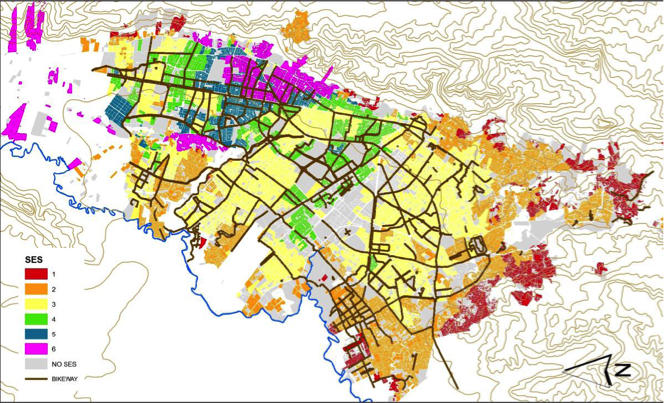

Lack of ‘Ciclorutas’ (bicycle lanes) in Bogota’s neighbourhoods of low socio-economic status shows inequality in the access to active transportation options, potentially increasing health disparities.

Share

Target audience

The mayor of Bogota and the Instituto de Desarrollo Urbano de Bogotá. City transport, cycling and public health interests in all major cities.

The problem

Active transportation such as cycling for commuting purposes can be an ideal mode of access in terms of implications for human health and the environment. Not everyone can have the same level of access; but who does and who doesn’t?

The public network of bicycle lanes (“Cicloruta”) in Bogota, is the largest in Latin America. It has 344 kilometres distributed throughout the city. However, concerns exist about unequal distribution of the routes with reference to communities in areas of lower socio economic status. One potential effect of this unequal access to bicycle road infrastructure is an exacerbation in health disparities in the population of Bogota.

What we did and why

Despite its success, disparities in regards to the distribution of routes by socioeconomic status of neighbourhoods have not been examined. Our exploratory analysis led us to assess the distribution and distance to the city network of bicycle lanes by neighbourhood socioeconomic status in urban blocks located in flat terrain. We conducted a spatial analysis using secondary data obtained through geographic information systems from official databases. We calculated the shortest route from the centre of each urban neighborhood block to the closest access point of the bicycle lane network.

Our study’s contribution

We found an unequal distribution of access to “Ciclorutas” by neighbourhood location and socioeconomic status, with significantly reduced access to cycle lanes in lower socioeconomic status areas. The average distance from the centre of a block to a “Cicloruta” was 444 meters. However the distance to a cycle lane in the most disadvantaged blocks was 1,062 meters compared to 315 meters for the wealthiest blocks.

Impacts for city policy and practice

If the goal is to address the needs of those most dependent on cycling, such as populations living in the most disadvantaged areas, then other cities would benefit from using an analytic approach such as that used in this paper to assess access to cycleways in terms of equity. Improving city-wide health and health equity outcomes through cycling may involve expanding the network of bicycle lanes and cycle lane access for populations living in less advantaged areas.

Further information

Full research article:

Equity in cycle lane networks: examination of the distribution of the cycle lane network by socio-economic index in Bogotá, Colombia by Diana C. Parra, Luis F Gomez, Jose D. Pinzon, Ross C. Brownson and Christopher Millett.

Related posts

Designing and implementing nature-based intervention, for the health of our community

Do we have the potential to combat childhood obesity rates with nature based programs? How does the design of community-based programming play a role?
Our study, analyzing 4,010 articles, reveals nature-based interventions promote healthy living. Focusing on community engagement and program gaps, our research highlights innovative strategies for healthier children. A collaborative approach offers new hope in addressing this global health challenge.

Read More »

The impact of apartment design on changes in housing satisfaction during the COVID-19 pandemic lockdown

Our study investigated whether apartment dwelling and building design attributes influenced residents’ housing satisfaction in the initial stages of the COVID-19 pandemic. Multivariate models showed that residents’ perceptions of their apartment’s internal space and layout and the thermal comfort it afforded them in winter were independently associated with increased housing satisfaction.
Read More »