
City Know-hows

Designing for the ear: How do urban soundscapes relate to physical activity?

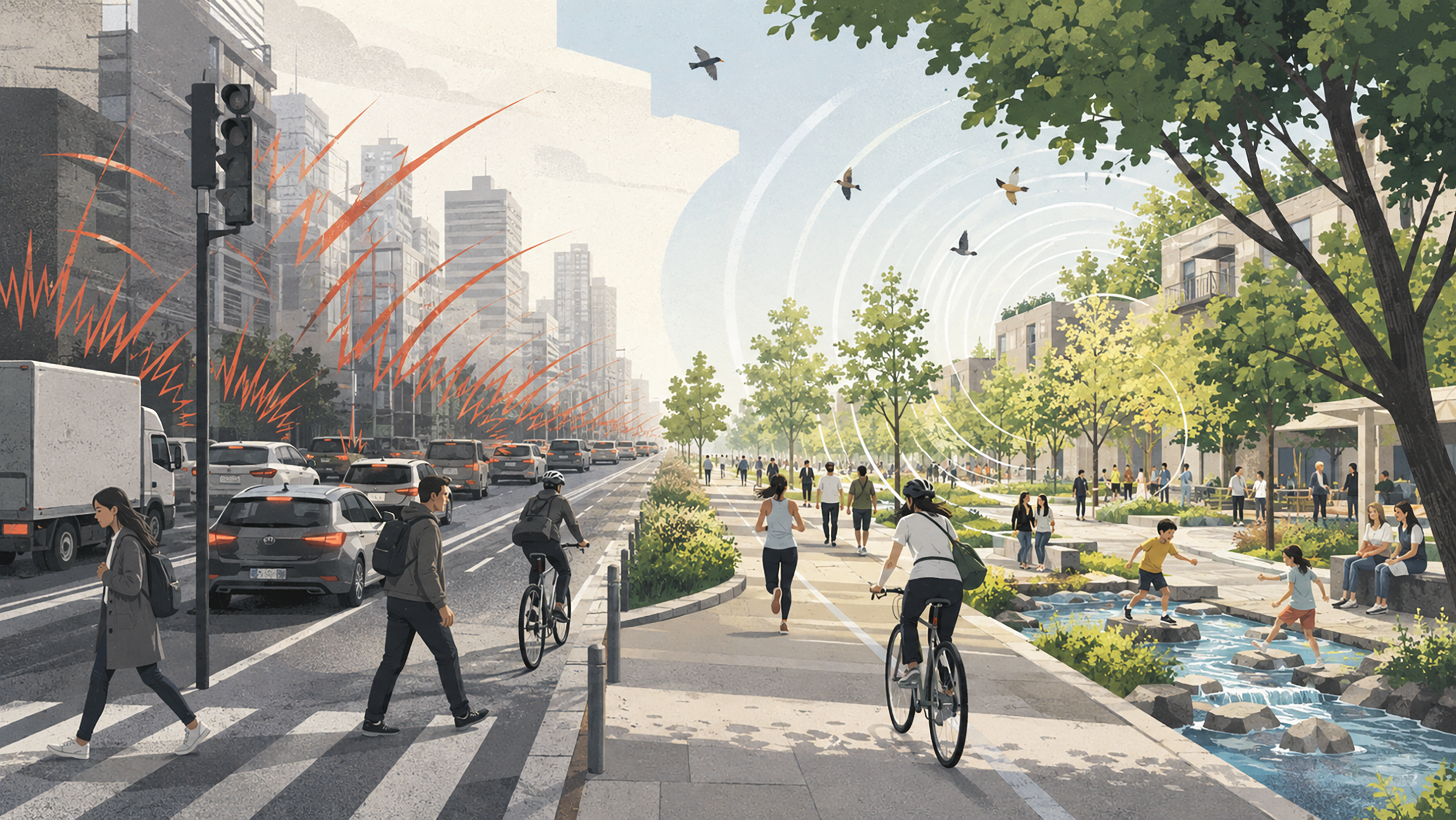
Urban soundscapes are closely linked to how people walk, cycle, and enjoy recreation. (Image generated with GPT Image 1.5, OpenAI, 2026)

The sounds of our streets are closely linked to how people walk, cycle, and play. We reviewed global research showing that while traffic noise is associated with less activity; natural and human sounds often relate to safer and more enjoyable urban movement.

Share

Target audience

City planners, Transport officers, Acoustic consultants

The problem

In many cities, traffic noise dominates streets and often acts as a barrier to outdoor activities. While traffic is known to be detrimental, less attention is paid to how other everyday sounds—such as birdsong or human voices—relate to activity and well-being. Without this knowledge, cities risk designing spaces that look functional but feel uncomfortable, potentially limiting residents’ motivation to move actively in their daily lives.

What we did and why

We reviewed 90 studies that examined the link between soundscapes and physical activity. We sought to understand how different urban sounds, including traffic, human, natural, and other noise sources, relate to walking, cycling, and recreation. By comparing findings across neighborhoods and street scales. We identified gaps and provided guidance for future practice. Our aim is to support healthier city planning where soundscapes are not ignored but seen as essential to active lifestyles.

Our study’s contribution

Our study highlights that:
• Traffic noise is consistently associated with lower levels of walking and cycling.
• Natural sounds, such as water and birdsong, are linked to increased recreation and satisfaction.
• Human sounds show mixed patterns, sometimes relating to safety, other times linked to avoidance.
• Cycling contexts and city-scale dynamics remain largely under explored.
Moving forward; integrating subjective feedback with objective data is key to understanding how acoustic environments support active living.

Impacts for city policy and practice

This review highlights that urban soundscapes are a critical dimension of planning for active cities. Strategies that mitigate traffic noise while preserving positive acoustic features offer opportunities to:
• Support walking and cycling as sustainable transport options.
• Foster environments conducive to residents’ health and well-being.
• Contribute to neighborhoods that feel safer, more enjoyable, and inclusive.
We call on planners and public health officials to integrate soundscape quality into urban design standards for healthier futures.

Further information

Full research article:

Assessing the impact of urban soundscapes on physical activity: insights from a systematic review by Yuting Wang, Yue Wu, Tong Qin, Nico Van de Weghe & Haosheng Huang

Related posts

The first overview of a now deleted federal program planning for climate change and public health: The Climate Ready State and Cities Initiative

Anthropogenic climate change is bringing with it a whole host of deleterious public health impacts. People will die and suffer disproportionately following inequitable societal structures. With every passing year time to mitigate and adapt to anthropogenic climate change slips away. The time is now to deliberately plan for the health impacts that are now ‘baked in’ for centuries to come.

Read More »