
City Know-hows

Enhancing urban micro-lungs: Creating green, health-focused corridors in densely populated Cairo

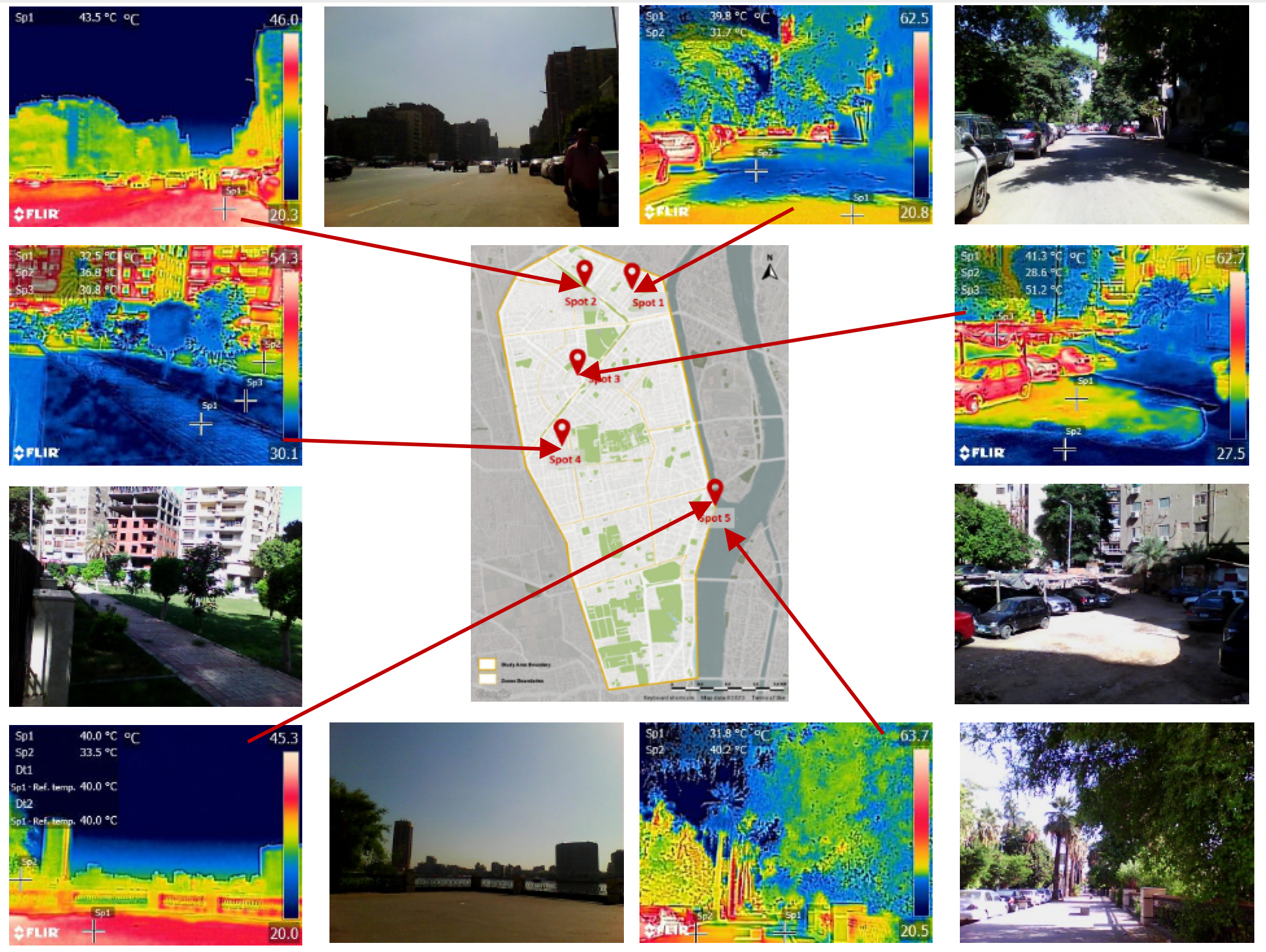
Thermography for five locations in the study area of Greater Cairo. A green median in a secondary street (top left), A wide street with no vegetation (top right), An inner vacant plot temporarily used as parking (middle right), A green square within a residential area (middle left), A waterfront vacant plot (bottom).

This study on Greater Cairo Region, Egypt, addresses urban challenges through “urban micro-lungs.” It explores designing green corridors responsive to local climate and space constraints, emphasizing resilient, public health-focused interventions for hyper-dense cities in the Global South.

Share

Target audience

City officials in the Global South; Public health specialists; Urban Development Agencies

The problem

The COVID-19 pandemic exposed the deep connection between citizens’ health and urban health, revealing the need for cities to undergo transformational action to restore their relationship with nature. Current urban planning results in increased temperatures and the Urban Heat Island effect, exacerbating health risks. Cities like Cairo face compounded issues of pollution, inadequate green spaces, climate change impacts, and water management challenges, necessitating resilient and sustainable interventions to promote public health and environmental resilience.

What we did and why

We conducted this research to bridge gaps in understanding how green spaces impact public health in densely populated cities like Greater Cairo. We reviewed theories, analysed international case studies, and mapped green spaces using remote sensing. Extensive fieldwork, surveys, and questionnaires were carried out to gather data on air quality, noise, and public health. Our goal was to develop evidence-based design guidelines for creating green, healthy urban environments that are resilient and regenerative.

Our study’s contribution

Our study demonstrates the critical need for active green spaces to combat physical and mental health issues exacerbated by minimal activity. We identified correlations between tree presence and improved mental and respiratory health, challenged existing green neighbourhood indicators, and highlighted urban greening’s potential despite socio-economic and environmental challenges in Greater Cairo. Our findings underscore the importance of tailored greening strategies for densely populated cities.

Impacts for city policy and practice

Our findings underscore the necessity for city policies to prioritize active green spaces to mitigate physical and mental health issues. We highlight the need to revise green neighbourhood indicators and advocate for tailored urban greening strategies. Practical implications include integrating urban greening with water management, enhancing public spaces for activity, and addressing socio-economic disparities in green space access to create resilient, health-promoting urban environments

Further information

Full research article:

Activating urban micro-lungs within highly dense cities: creating green and healthy corridors in Greater Cairo region by Heba Allah Essam E. Khalil, Sherin Gammaz, Ibrahim Youssef, Mohamed Haroun, Dina Shahin & Yasmina Ragab

Related posts

How active are public open space users in Asian countries?

Public open spaces (e.g., parks, sports fields) are important for people to be physically active. However, previous studies, mostly conducted in Western countries, show that people are predominantly sedentary in such spaces. We found that public open space users were more active in Asia, suggesting a potential contribution of such spaces to people’s health.

Read More »

How can we reconnect mental and urban health?

Our study found that community place-based initiatives involving the public and private sectors can provide public spaces, such as public parks and communal gardens, that are appropriate for reconnecting mental and urban health using the concept of co-benefit endorsed by the World Health Organization in 2011. We examined this concept in large projects in Seoul and Singapore to show the advantage of intersectoral collaboration for reconnecting mental and urban health initiatives by urban planning.

Read More »