City Know-hows

How active are public open space users in Asian countries?

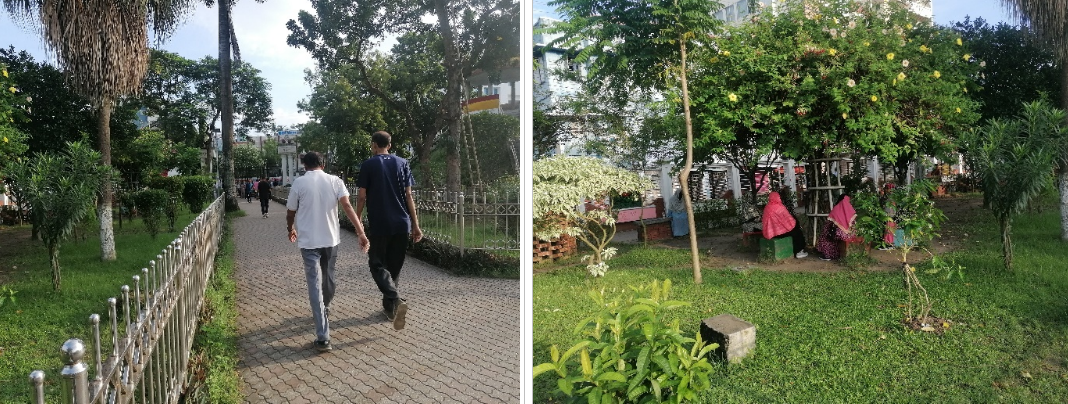
Users’ activity at Shahid Hadis Park in Khulna, Bangladesh. Left photo shows active (walking) and the right photo shows sedentary users. Photo credit: Tapan Kumar Nath)

Public open spaces (e.g., parks, sports fields) are important for people to be physically active. However, previous studies, mostly conducted in Western countries, show that people are predominantly sedentary in such spaces. We found that public open space users were more active in Asia, suggesting a potential contribution of such spaces to people’s health.

Share

Target audience

Urban planners, park managers, health advocates

The problem

We know from existing studies that people spend most of time sitting in public open spaces in Western countries. However, there are just a few studies on public open space use carried out in Asian countries.

What we did and why

We conducted an on-site intercept survey in 10 public open spaces in Bangladesh and the Philippines. We collected data from 804 adult participants who reported the duration of active use (walking, running, sports) and sedentary use (sitting, standing) while they were in public open spaces.

Our study’s contribution

We found that participants on average spent about 70% of the time in public open spaces being active, while 30% was spent being sedentary. The proportion of active use is much higher than that reported in studies from Western countries but similar to that reported in China and Thailand. We also found that women and older adults were less likely to be active compared to their counterparts.

Impacts for city policy and practice

The findings of this study suggest that public open spaces in Asian countries can contribute to public health through promoting physical activity. Public health initiatives to encourage more people to visit public open spaces and environmental initiatives to create more open spaces can help to increase physical activity in these countries.

Further information

Full research article:

Active and sedentary use of public open spaces in Asian countries by Takemi Sugiyama, Masaaki Sugiyama, Elizabeth Carig, Dyanika Nolasco, Walid Hossain, Abdus Subhan Mollick and Tapan Kumar Nath.

Related posts

Co-designing healthy and sustainable cities: what Paris residents teach us about urban environmental health

This study introduces a place-based model of urban environmental health drawn from residents’ perspectives.
• Highlights eight interconnected local parameters of environmental health.
• Demonstrates that residents link environmental health to everyday nuisances like noise, air pollution, and lack of safety.
• Shows that viable and livable environments depend on inclusive governance and infrastructure decisions.
• Offers a replicable approach for other cities to assess urban health from the ground up.

Read More »

Adolescents’ ideal park: Usage, benefits and preferences

Green spaces bring several health benefits. However, adolescents’ infrequent use of green spaces, especially in southern European cities like Porto, can be attributed to cultural and contextual factors, including limited green space, maintenance issues, and equipment scarcity. Thus, there has been a great push to enhance green space provision. However, achieving effective greening interventions requires understanding user perspectives, addressing barriers, and considering various age and socioeconomic groups to ensure universal access and youth-friendly spaces.

Read More »