
Target audience

Policymakers, municipal program managers, public health practitioners, community organizations, and disability advocacy organizations.

The problem

Children with disabilities are often marginalized when they face restrictions in engaging in community life, placing them at risk for unfavourable outcomes in relation to their health and wellbeing. Public health initiatives and public health and social policy must address the needs of this populatio

What we did and why

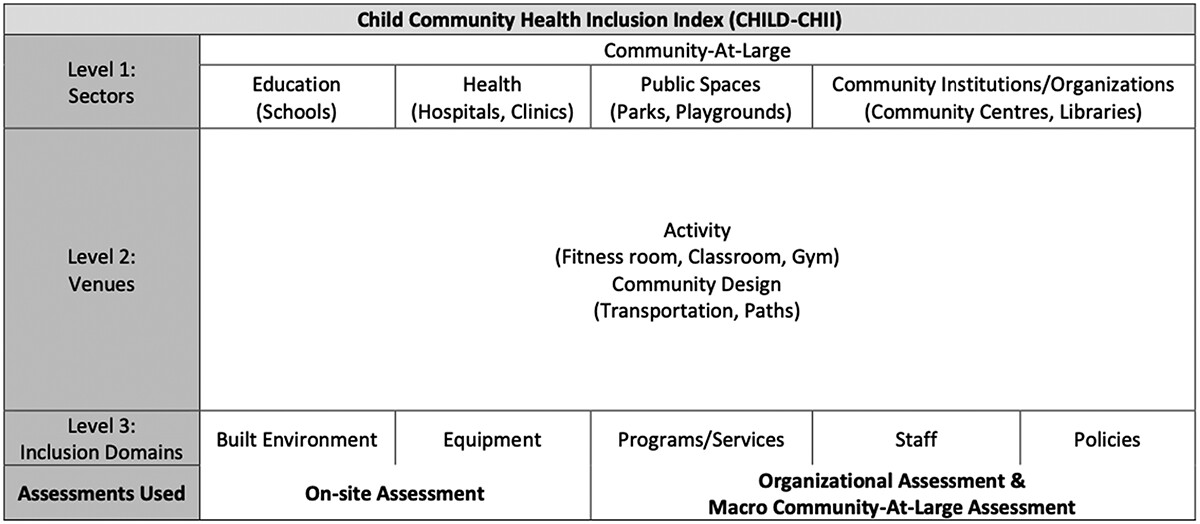
We did a comprehensive review of existing measures and tools that assess the inclusion of children in the community. We obtained expert input to develop the content of the Child Community Health Inclusion Index (CHILD-CHII). The tool addresses the diverse needs of children with various dis- abilities with a generalizable, universal design approach for community inclusion. The content was then validated  through a consensus process with experts, and the items of the tool were further clarified in this study.

Our study’s contribution

This tool evaluates how facilities, public spaces, and municipal policies address the inclusion of children with disabilities in the Canadian context. The validated content highlights the importance of such tool to identify barriers to inclusion, and to inform the development of interventions and initiatives to address these barriers.

Impacts for city policy and practice

The Child Community Health Inclusion Index can contribute to cities to assess all health, community, leisure, and educational facilities and programs, and address improvements necessary to align with higher level frameworks such as the UN sustainable development goals and the Convention on the Rights of Children and on the Rights of Persons with Disabilities.  The use of this tool can support the development of inclusion strategies that can contribute to child and disability -friendly cities.

Further information

Childhood Disability Link: Linking Information and New Knowledge on childhood disability to service providers and families.

Jooay: Jooay is a free app that helps children with disabilities and their families to locate leisure opportunities

Full research article:

 Content validation of the child community health inclusion index: a modified e-Delphi study by Paul Yejong Yoo, Annette Majnemer, Robert Wilton, Sara Ahmed & Keiko Shikako.

Related posts

Where to walk when we are old: experiments in Taiwan and the USA

Our study highlights the importance of green spaces in urban areas for enhancing the well-being of older adults. It reveals significant benefits of nature walks over urban street walks and underscores the need for gender-sensitive urban design.
• Green spaces improve mood and perceived restorativeness.
• Women benefit more from nature walks, especially in urban streets.
• People from different cultures may benefit from nearby nature slightly differently.

Read More »

Navigating autism in public transport: WHO’s International Classification of Functioning, Disability and Health (ICF) as a framework to investigate the spatial and physical barriers

Among the factors impacting functioning and quality of life in autism, aspects of the built environment have recently gained increasing attention. However, the opportunity of proposing a universal framework for cross-scalar examination of these factors remains largely unrealized.
By narrowing the focus to public transport, a key component of urban spatial structure and urban mobility, this study explores the applicability of the World Health Organization’s International Classification of Functioning, Disability, and Health (ICF) in examining the built environmental factors that influence autism.

Read More »

The impact of apartment design on changes in housing satisfaction during the COVID-19 pandemic lockdown

Our study investigated whether apartment dwelling and building design attributes influenced residents’ housing satisfaction in the initial stages of the COVID-19 pandemic. Multivariate models showed that residents’ perceptions of their apartment’s internal space and layout and the thermal comfort it afforded them in winter were independently associated with increased housing satisfaction.

Read More »