
City Know-hows
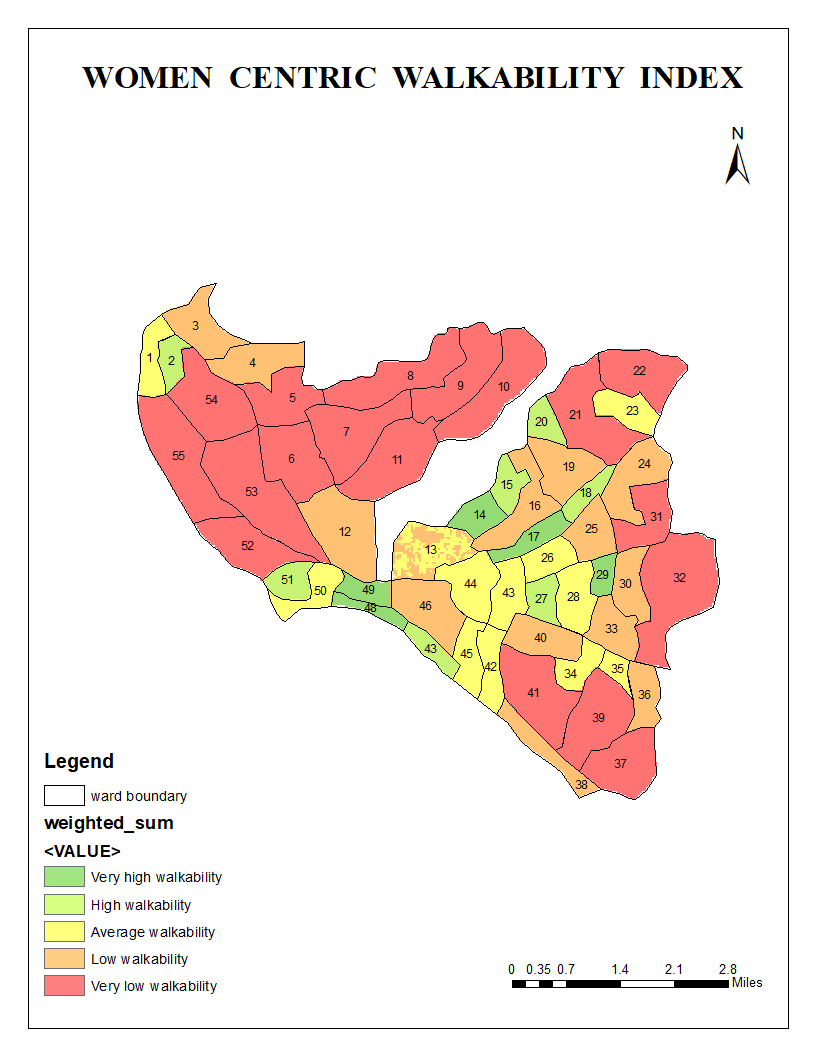
How gender-neutral is your city’s walkability? This study reveals key factors influencing women’s pedestrian experiences and introduces a women-centric walkability index developed through GIS mapping and AHP analysis, offering insights for creating safer, more inclusive urban spaces.
Share
Target audience
Urban Planners and City Officials- Use this study to design safe, accessible walking spaces for women. Public Health Professionals- Promote walking-friendly environments to improve women’s health and well-being. Sex-based advocacy NGOs- Advocate for urban designs that prioritize women’s safety and accessibility.
The problem
The problem we address is the lack of gender neutrality in existing walkability indices like Walk Score or the Global Walkability Index. While these indices effectively measure generic walkability, they fail to consider the specific needs and challenges faced by women. Women’s walkability is influenced by factors such as safety, infrastructure, and accessibility, which are often overlooked. This gap necessitates the development of a women-centric walkability index to create equitable and inclusive walking environments.
What we did and why
We explored walkability, recognizing its gender bias, with existing indices like Walk Score overlooking women’s specific needs. Our goal was to analyze factors affecting women’s walkability and develop a women-centric index. Focusing on 55 wards in Kollam Corporation, Kerala, we used 15 indicators from literature, applied the Analytical Hierarchy Process for weightage, and analyzed secondary data using GIS software. This study emphasizes key infrastructural improvements to enhance women’s pedestrian experiences and ensure safety and accessibility.
Our study’s contribution
This study introduces the Women-Centric Walkability Index, addressing factors influencing women’s walking experiences in urban areas. Analyzing fifty-five wards in Kollam Corporation, Kerala, we identified key indicators like well-maintained sidewalks, street lighting, safety measures, and access to public amenities that enhance women’s walkability. Using the Analytical Hierarchy Process and GIS analysis, our research highlights the need for safer, more accessible, and comfortable walking environments for women, benefiting all pedestrians.
Impacts for city policy and practice
In our study, we propose a women-centric walkability index that focuses on factors enhancing the pedestrian experience for women. Analyzing data from Kollam Corporation, we identified key elements such as well-maintained sidewalks, street lighting, and safety measures that significantly improve walkability for women. Our findings emphasize the importance of incorporating these features into city planning to create inclusive, accessible environments, promoting walking as a safer and more comfortable mode of transportation for all.
Further information
Full research article:
Measuring women-centric walkability in Kollam, India: an indices-based approach by Sruthi Suresh & Arshi Parashar
Related posts

Make the neighbourhoods of your city age friendlier by using tools that support more informed decision-making. Are you an urban planner or a policy maker interested in knowing how age-friendly the neighbourhoods of your city are? Would you like to know how to improve them?

The by-products of urbanisation, such as air pollution and neighbourhood disadvantage, are often overlooked when studying the impact of urban environments on depression. Understanding how these influence neighbourhood-depression relationships can help inform targeted public health interventions and reduce health disparities.

Evidence overwhelmingly suggests that the built environment has an impact on people’s health, particularly in terms of noncommunicable diseases such as asthma, diabetes and poor mental health. However, health is rarely prioritised in urban planning decisions at present, and earlier work by this research group has shown that senior decision-makers feel they lack the power to influence planning and policy decisions in order to improve the situation. This intervention area adds to the wider research programme, which is focused primarily on the delivery of quantifiable socio-environmental and health economics valuations. People make decisions not just based on economic valuation, so an understanding of why people make decisions and how those decisions can change is essential. This paper describes the methodology that will be used to develop this intervention. Findings will be published later.