

City Know-hows

Transforming the urban public realm to children’s play network in a tower neighbourhood in Toronto

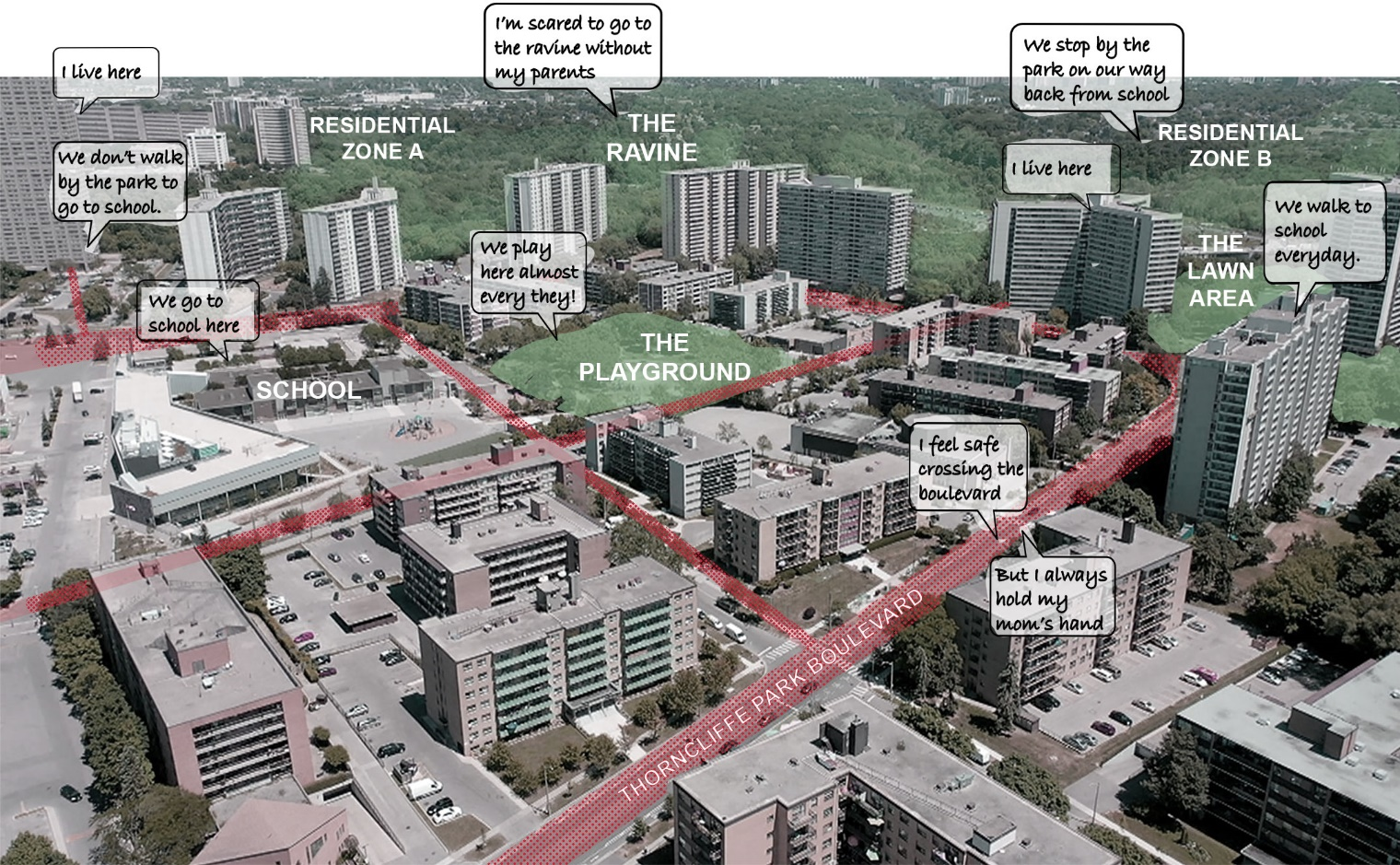
The existing “play network” in Thorncliffe Park Neighbourhood, Toronto, consisting of children’s regular destinations and pathways connecting them. Image: retrieved from Google Maps Street View and annotated by the author.

This study delves into children’s lived experiences in a tower neighbourhood in Toronto. It provides practical recommendations for designers and policy makers about activating the urban public realm surrounding residential towers as a play network for children and their families.

Share

Target audience

Urban designers, urban policy makers, and developers.

The problem

Planning policy in North America, compared to its European counterparts, has often failed to address children’s rights to play in urban environments. Child-friendliness often translates into providing isolated playgrounds and overlooking various play opportunities that the urban public realm has to offer. Current planning regulations provide limited practical child-friendly city guidelines that truly consider children as active citizens and the urban public realm as a site for play.

What we did and why

I investigated the formation of a play network in Thorncliffe Park neighbourhood in Toronto. I observed the pathways connecting home to the schools and neighbourhood parks to identify the types of play happening within the triangle of home, school, and park. I also conducted surveys and interviews with children 7 to 13 years old from the neighbourhood to understand the interplay of physical and socio-cultural factors in the creation of a neighbourhood play network.

Our study’s contribution

Our findings revealed that despite the limited play destinations compared to the local child population, children’s outdoor play experiences are predominantly positive. This positive outlook is attributed to their sense of safety within familiar spaces and strong social ties with neighbours beyond their immediate families. Key contributing factors include the proximity of schools and play areas to residential locations, the strategic placement of playgrounds along home-to-school routes, and the hierarchical relationship among neighbourhood open spaces.

Impacts for city policy and practice

This study advocates for having access to a play network as a way of improving child-friendliness of urban neighbourhoods. A few practical implications concerning high-density, high-rise urban neighbourhoods are:
• Providing walkable child destinations (e.g., schools, playgrounds) near residential buildings.
• Reducing child-traffic interactions along the pathways with traffic-calming measures and proper animation.
• Positioning playspaces along the pathways to regular destinations to encourage play on the way.
• Providing immediate access to intergenerational open spaces.

Further information

Full research article:

Related posts