City Know-hows

Turning schoolyards into temporary open spaces in Nakuru’s informal settlements, Kenya

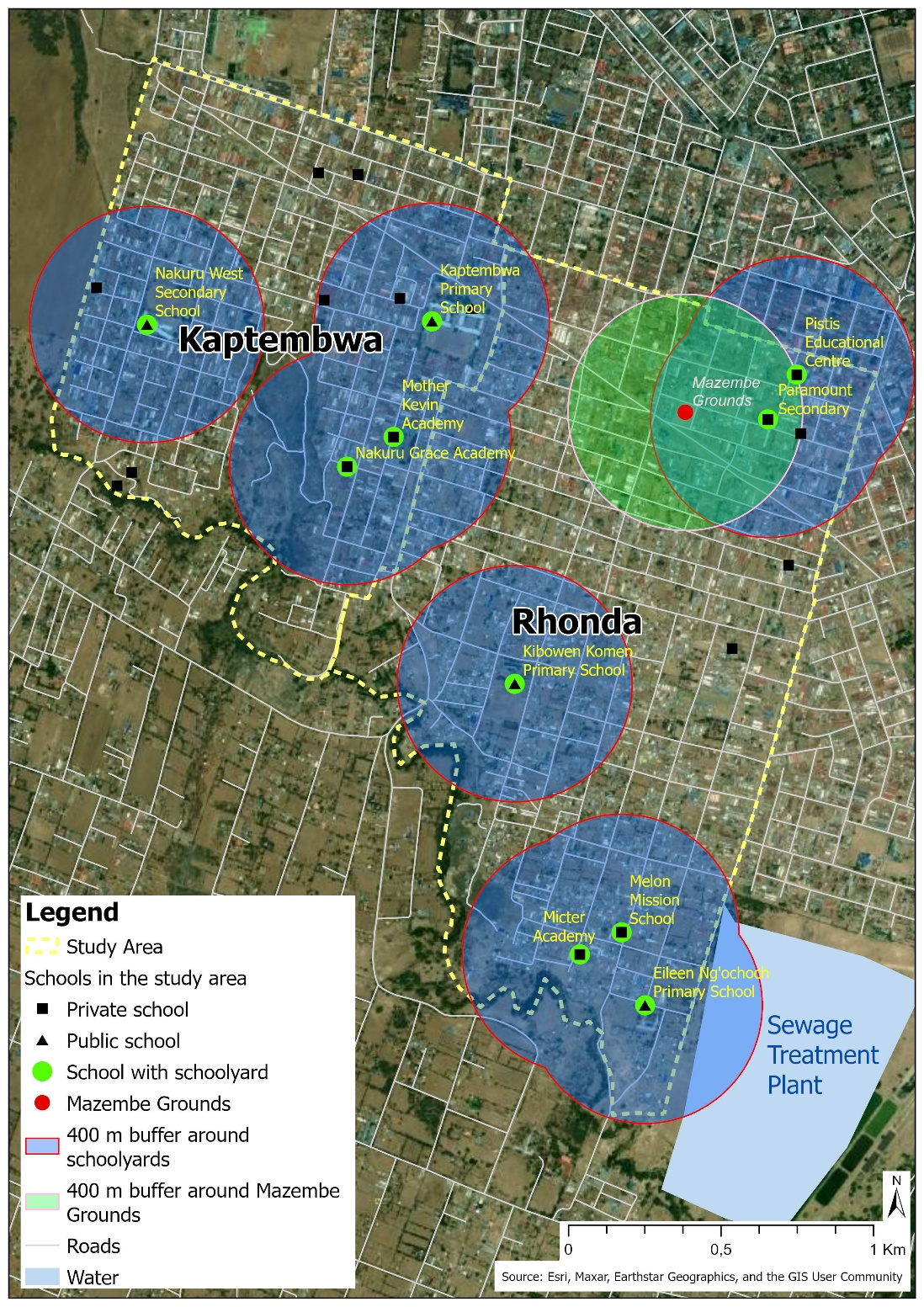
400m walking catchments of schoolyards and the Mazembe Grounds in Nakuru’s Kaptembwa and Rhonda. If schoolyards open after hours, these catchments would cover 283.8 hectares, representing 60.5% of the two settlement; bringing play and recreation within a short walk for many residents. Credit: Authors; GIS analysis in ArcGIS 10.8 using OpenStreetMap, Google Maps, and County Government of Nakuru (2022) data.

Across many cities, residents of informal settlements lack safe, nearby green space. Using Nakuru, Kenya, as a testbed, we show how opening schoolyards to communities outside school hours can rapidly expand walkable access at minimal cost. With basic security and governance measures, this dual-use model can advance health equity and resilience.

Share

Target audience

We recommend our findings primarily to professionals within UN-Habitat and UNICEF who work on public space, urban health, and child-friendly cities; secondarily to the County Government of Nakuru (urban planning and education departments), the headteachers and boards of public schools in Kaptembwa and Rhonda, and NGOs/CBOs focused on safe public space and community health in informal settlements.

The problem

The residents of Kaptembwa and Rhonda have almost no usable public green space. The only sizable open area—the Mazembe Grounds—is dusty, poorly maintained, and not health-promoting. Per-capita open space is about 0.073 m², and formal parks are distant or fee-based, limiting access for low-income households. Yet nearly 90% of residents said they would use more local open spaces if available, underscoring unmet demand and inequity in green provision.

What we did and why

We mapped existing green areas and all schoolyards in the two settlements using GIS, measured yard areas, and modelled 400-meter walking catchments. We complemented this with field observation and three surveys among residents, teachers, and experts. We focused on whether controlled, after-hours access to schoolyards could cost-effectively increase local recreation space and how stakeholders perceive benefits, risks, and the preconditions—especially governance and safety—needed for implementation.

Our study’s contribution

We provide quantified, place-specific evidence that a dual-use model is viable in informal settlements:
• Opening 10 schoolyards would raise accessible open space to ca. 86,000 m² (15 times the current level), or ca. 1.12 m² per person.
• Even with only public schools, gains remain substantial (ca. 0.90 m² per person).
• Two-thirds of residents endorse after-hours access; teachers and experts support pilots, emphasizing security, maintenance, and clear responsibility frameworks.

Impacts for city policy and practice

We recommend a pilot program in selected public schools, co-designed with communities and aligned with county policy. There are three steps to take:
1. Establish MOUs defining liability, opening hours, supervision, and upkeep; pair “soft” measures (community watch, stewardship) with “hard” measures (lighting, surveillance).
2. Seek small-grant upgrades; integrate schoolyards into green-space standards and local plans.
3. Monitor use, incidents, and health/social outcomes to inform scale-up.

For associated information:
UN-HABITAT (Nakuru slum vulnerability mapping): Evidence base on open spaces in slums.
Trust for Public Land — Schoolyards to Playgrounds:  Case for after-hours access.
NYC Parks — Schoolyards to Playgrounds:  Large-scale urban precedent.
Barcelona “Open playgrounds” programme:  European precedent.
Nakuru Vision 2050 (FES):  The city’s just and green vision.

Further information

Full research article:

Related posts

Association between perceived quality and access to urban green spaces and loneliness in India

Our study explores how perceptions of urban green space quality and accessibility relate to loneliness in urban India. Findings show that subjective experiences, design features, and feelings of social exclusion shape engagement with green spaces. Inclusive, safe, and emotionally responsive green space design is crucial for reducing loneliness.Important to note; our study advances urban health and planning research by demonstrating that loneliness is shaped more by perceived quality and emotional experience of green spaces than by their physical presence alone.

Read More »