City Know-hows

Understanding the community and social determinants in mental health inequity: the impact of mass social distancing during COVID-19, USA

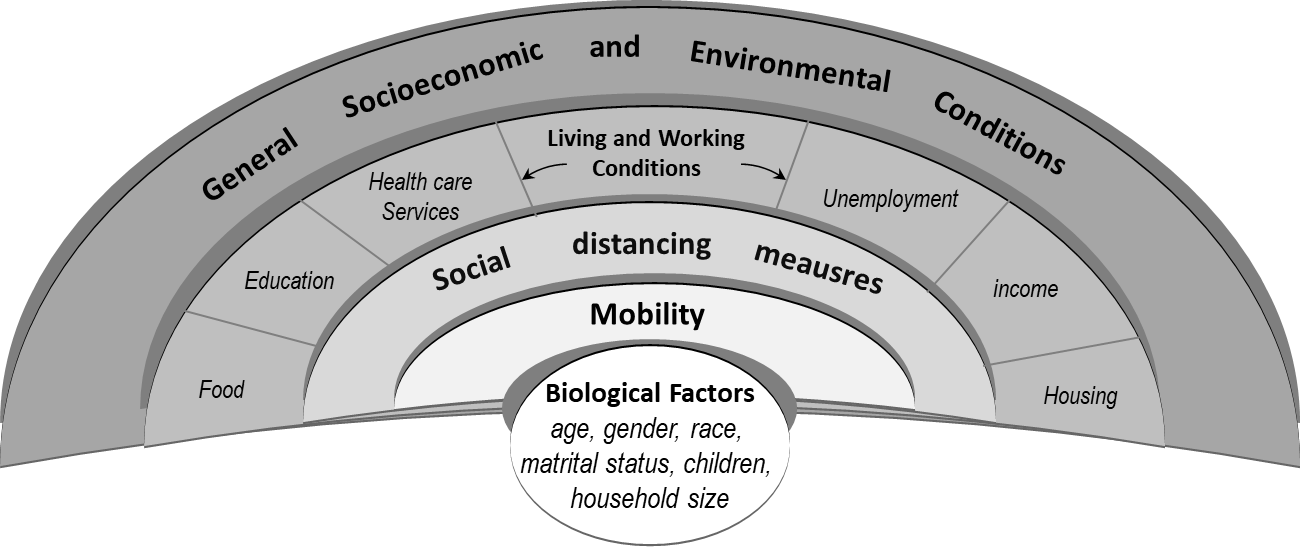
Main determinants of mental health during the COVID-19 pandemic

Target audience

World Health Organization; National public health officials; Local and community public health experts.

The problem

Early COVID-19 studies found relationships between social distancing and mental health problems (anxiety and depression) but their complexity in the contexts of unequal individual capacity and uneven community attributes remains untested.

What we did and why

To reveal the complexity in terms of health inequity, we used a series of statistical models, plus nationally representative and COVID-19-specialized data from the Household Pulse Survey administered by the U.S. Census Bureau between April 23, 2020, and June 7, 2021.

Our study’s contribution

We found that:

  • Lack of community capacities during the pandemic (e.g. poverty and transit use) and individuals’ economic vulnerabilities (e.g. income loss, food insufficiency, housing instability) exacerbated mental illnesses as social distancing measures were prolonged

  • A more stringent stay-at-home order was found to be related to an increased risk of experiencing anxiety, depression, and their comorbidity.

  • The negative impact of the stay-at-home order on mental illnesses is unequal across subpopulation groups of different ages, races and ethnicity, income, and household size

Impacts for city policy and practice

Our findings suggest that:

  • the psychological impact of social distancing order can be determined by combining the effects of both individual and community capacities.

  • Our study, which supports others, demonstrate the need to improve the physical environment to implement more sustainable health policies in different communities and cities across the world

Further information

U.S. Centers for Disease Control and Prevention (CDC): Official indicators of anxiety and depression during the COVID-19 pandemic in the U.S.

Full research article:

Leave a Reply

Your email address will not be published. Required fields are marked *

Related posts

Understanding gardening for wildlife in London’s private residential gardens

We wanted to understand the types of gardening for wildlife taking place in London’s private gardens and the influence of demographic factors on the likelihood to garden for wildlife. We sent out a digital questionnaire to ask Londoners about their gardening for wildlife practices and their age, gender, ethnicity, religious beliefs, occupation, household income, accommodation type, home ownership status, garden type, shared garden or not, dependents, and conservation-organisation membership status.

Read More »

City design must respect young people’s rights and consider their lived experiences. Meaningful participation is a powerful protective factor!

Violence and abuse by and among youth are critical public health issues. Building equitable cities requires centring the voices of marginalised young people, whose experiences provide vital insights into safer urban spaces. Supporting marginalised youth in shaping safer cities is a delicate balance, like the porcupine’s dilemma; —nurturing participation while ensuring protection. Together, we can create safer, more equitable spaces for all.

Read More »