City Know-hows
Our study focuses on active and independent mobility of children in a car-free settlement which can be promising for developing policies for a child-friendly urban future and mobility justice for children. The outputs of this study can bridge the gap between vehicle-oriented and non-vehicle-oriented settlements and enable the transfer of good experiences.
Share
Target audience
Urban planners and transportation experts in municipalities or private sector, decision makers in local governments who aim to create child friendly cities and promote independent mobility of children, NGOs advocating mobility justice for children.
The problem
In our cities, motor vehicle-oriented transportation and traffic problems are affecting the environment and all of us, especially children. As the dominance of motor vehicles and highways increases in our cities, the areas where our children can safely walk, play, and freely experience the city are decreasing day by day. Whereas settlements that our children can move safely and freely are important for the healthy development of children who will be adult urban residents of the future.
What we did and why
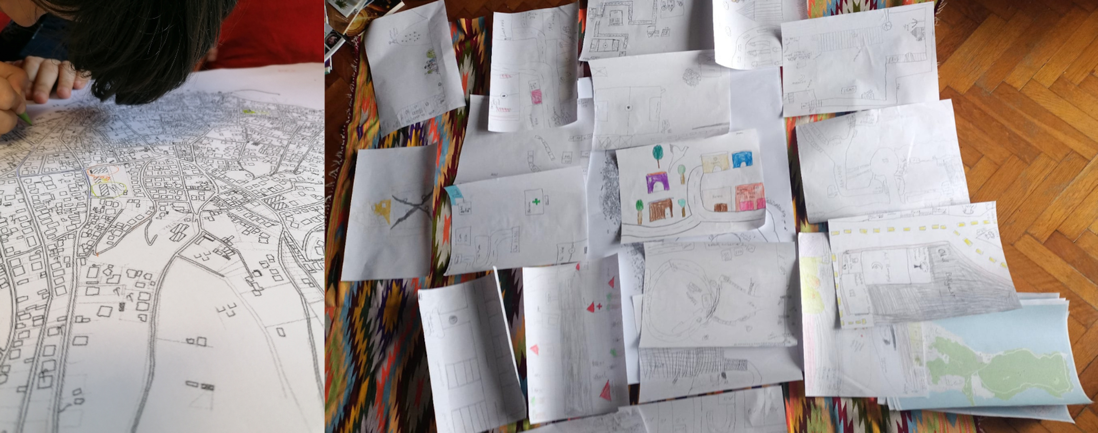
We believe that we can learn from children’s independent mobility in a car-free urban area. For this reason, we conducted a study with children on Büyükada, a car-free island in Istanbul. In this study, we aimed to explore urban mobility and spatial perceptions of children by producing mind maps with them. We hope this study can bridge the gap between vehicle-oriented and non-vehicle-oriented settlements and enable the transfer of good experiences.
Our study’s contribution
This study shows that eliminating vehicle pressure supports the creation of child-friendly cities by encouraging children to move independently and play freely. Children’s independent mobility allows them to establish more connections with nature and the urban space they live in, and to spend time and play in diverse urban areas. Children can develop social connections in the physical environment and create a real urban network of their own when traffic hazards are removed. These lessons from a car-free urban environment can translate into other areas where car dominancy in limiting children’s active and independent mobility.
Impacts for city policy and practice
This study has some significant insights for developing child-friendly urban policies.
Further information
Full research article:
Independent and active mobility of children in a car-free environment: insights from Büyükada Island by Arzu Erturan & Bahar Aksel
Related posts

How does everyday mobility shape local social cohesion in cities? Our study shows that walking and cycling in the neighborhood create spontaneous, low-threshold encounters – and that these everyday interactions are vital for building healthier, more connected urban communities.

How do people conceptualize pathogen transmission risk in cities using visible cues?

The study investigates critical issues and strategies for the regeneration and valorisation of small historical villages through interviews with opinion leaders. The debate is strengthened by the analysis of scientific literature and concrete cases in Italy.