
City Know-hows

Using a liveability index as a mechanism to appraise city quality for healthy ageing

Urban health is a complex system that involves several indicators acting together, there is no single solution to the health-related issues in cities. We wanted to promote healthy ageing in urban living. Our strategy was to take people’s needs and demands into account, when evaluating, monitoring and proposing feasible changes in built, natural and social environments.

Share

Target audience

City managers; Urban planners; Policymakers; Health professionals

The problem

There are several challenges to making a place more age-friendly. These include: allowing people’s health to thrive through adequate urban conditions throughout life; providing opportunities to live actively; and being healthy in the city. One way to improve citizens’ lives is better to understand urban issues. This means evaluating and monitoring these issues using robust methods. Then to propose feasible changes in built, natural and social environments. The aim is to enable active behaviour and mitigate non-communicable diseases.

What we did and why

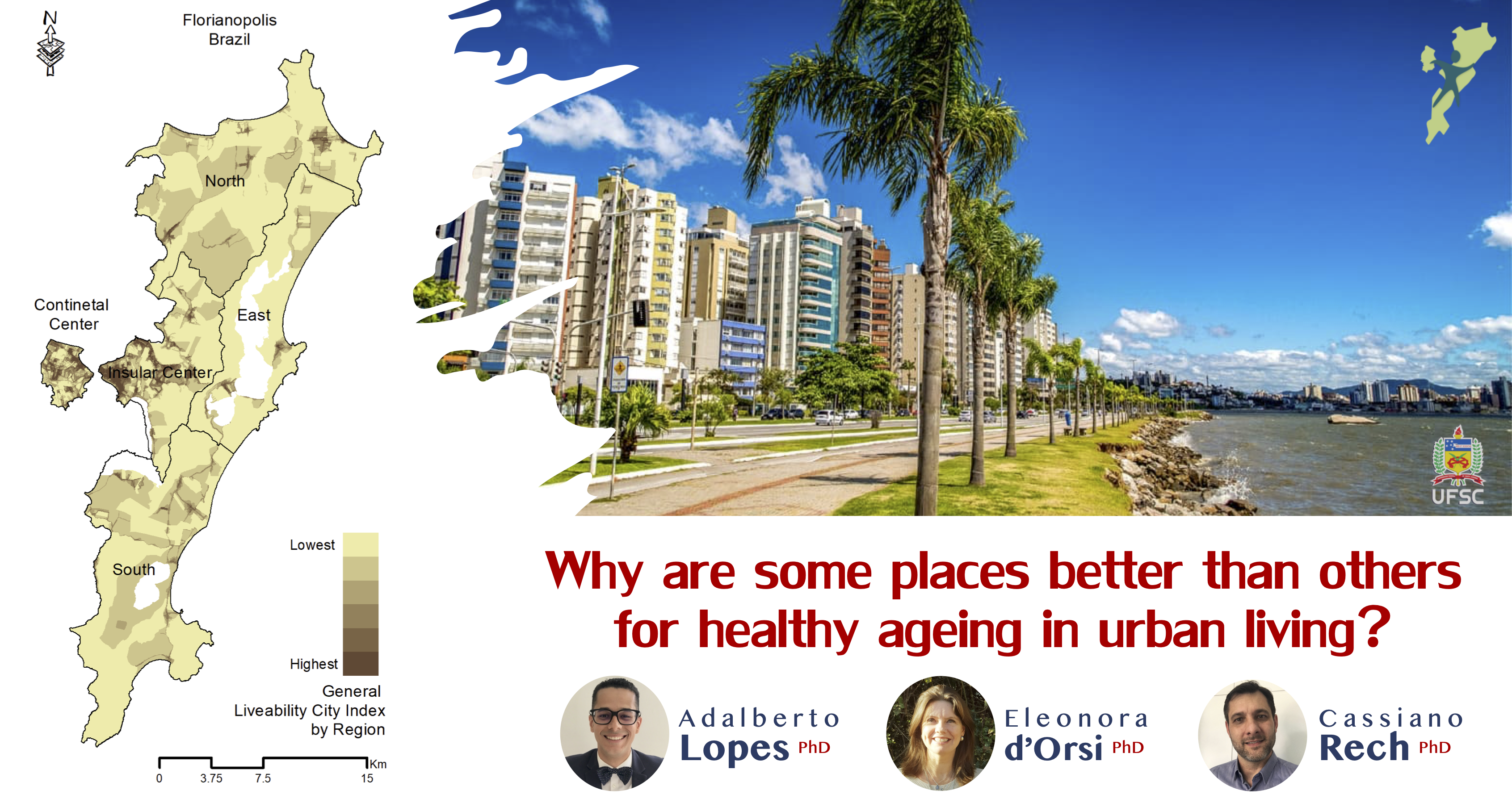
First, we created a Liveability City Index, through geospatial-derived macroscale based on safety, economy, built environment, education, health care, transport, recreation, and population indicators. The objective was to appraise city quality for healthy urban living. Next, from the third wave of EpiFloripa Ageing Cohort Study we computed a 500-meter movement zone around participants’ residences to determine, what we called ‘neighbourhood liveability-income clusters’. We were then able to investigate these and their association with physical activity, walking for transport and morbidity.

Our study’s contribution

Our study provides in-depth urban insights for older adults. We found that liveable age-friendly places, usually found in high-income neighbourhoods, are associated with physical activity and non-communicable diseases; while less liveable places provide poorer outcomes for older adults’ in terms of active travel, especially in high-income neighbourhoods.

Impacts for city policy and practice

Our findings could help promote places essential for liveable age-friendly cities, guiding city planning/managing and policymakers in delivering:
• Well-maintained urban infrastructure, especially those related to built environment’s pedestrian street-level amenities, excelling at traffic safety and against criminality;
• Reductions of distances and travel times (increasing their quality) and encouraging active transport as part of the daily routine;
• Broad coverage and access to health care, promoting population well-being and reducing non-communicable disease;
• An environment in which the diversity of land use integrates high population and commerce/service densities simultaneously, organically increasing access to recreation, work and study destinations, stimulating the local economy.

Further information

EpiFloripa Ageing Cohort Study: Official Webpage.
EpiFloripa Ageing Cohort Study: Technical-scientific report of 3rd wave.

Full research article:

Why are some places better than others for healthy ageing in urban living? by Adalberto Lopes, Eleonora d’Orsi and Cassiano Rech

Related posts

Health impact assessments for healthier urban planning projects

Health impact assessments are a key tool to bridge the worlds of planning and health, but there’s a risk they become a ‘tick box’ exercise with little real-world benefit. Learning from recent practice in English local authorities can help maximise their effectiveness in producing healthier developments.

Read More »

The benefits of green infrastructure on campus for student and visitor health

For city planners and policymakers, increasing the tree canopy coverage stands out as the most promising green infrastructure planning/management strategies to contribute to health of campus communities/users. The tree canopy data are also more widely available than most other green infrastructure variables, making its use for the purpose of monitoring, intervention, and assessment feasible for various stakeholders.

Read More »