City Know-hows
The ‘runnability of cities’ as a novel spatial planning approach can enhance healthier and more enabling environments for everyone.
Share
Target audience
City planners, majors, politicians, local governments and sports agencies
The problem
The significance of healthy environments is gaining greater prominence, especially since the recent Covid-19 pandemic that enhanced the importance of safe and accessible spaces for urban residents. Yet, urban spaces are under pressure and dedicated approaches are needed in order to prioritise space for healthy communities.
What we did and why
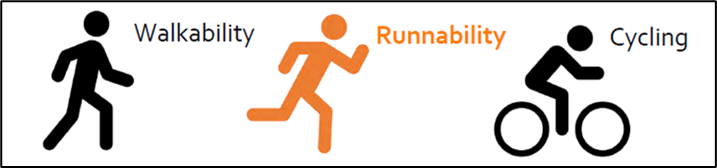
We investigated the concepts of healthy environments, healthy cities, contemporary challenges of our cities, healthy communities, and runnable cities to unpack the notion of ‘runnability’ within the spatial planning context. We introduced the notion of ‘runnability’ in context of the perceived attractiveness and qualify of the urban environment. We call for a global runnable cities approach.
Our study’s contribution
This study positions the ‘runnability of cities’ as a spatial planning approach and as a result:
• Enhance global progress towards healthier, enabling environments for all.
• Provides a new perspective to spatial planning and healthy communities
• Showcase case studies where various elements (social, environmental and economic) relevant to runnable cities have been explored.
Impacts for city policy and practice
This research provides a novel approach to city planning through the lens of runnability. By positioning “runnable cities” as a spatial planning objective, significant progress can be made towards the development of healthier and health enabling environments worldwide.
Further information
Full research article:
Towards healthier, enabling environments for all: positioning the ‘runnability of cities’ as a spatial planning approach by Jua Cilliers and Slawomir Ledwon
Related posts

Public health has historically been an important factor driving urban planning policy in England but is currently rarely a priority. We explore the factors behind this, try to explain them in the context of policy developments since COVID-19, and consider what needs to change at national policy level to support healthier placemaking in the future.

Our study sheds light on the evolving dynamics of the Greater Cairo Region, adding depth to the understanding of whether gated communities act as true remedies or reflections of concrete houses. By incorporating a model based on critical factors for mental health, we offer insights into the nuanced dimensions of well-being in the context of urban development. This research contributes to a more comprehensive understanding of the complex interplay between city structure and residents’ overall well-being.

Urban environments in many cities, both those found in Mexico and many other countries, can be called obesogenic – they are prone to promote obesity. Relevant factors are that they foster sedentary behaviour, poor dietary choices, and elevated stress levels; thus contributing to higher obesity rates. Urban planning, design, and practices offer opportunities for upstream public health interventions to mitigate these negative health impacts. These findings are especially relevant given the role of neighbourhood environments in encouraging children’s physical activity and reducing obesity.