City Know-hows
This newly developed methodological approach for the integrated exploration of urban spaces strongly emphasises human perception and stress’s underlying causes.
Share
Target audience
Urban planners and researchers, Public health policy makers, City administrators
The problem
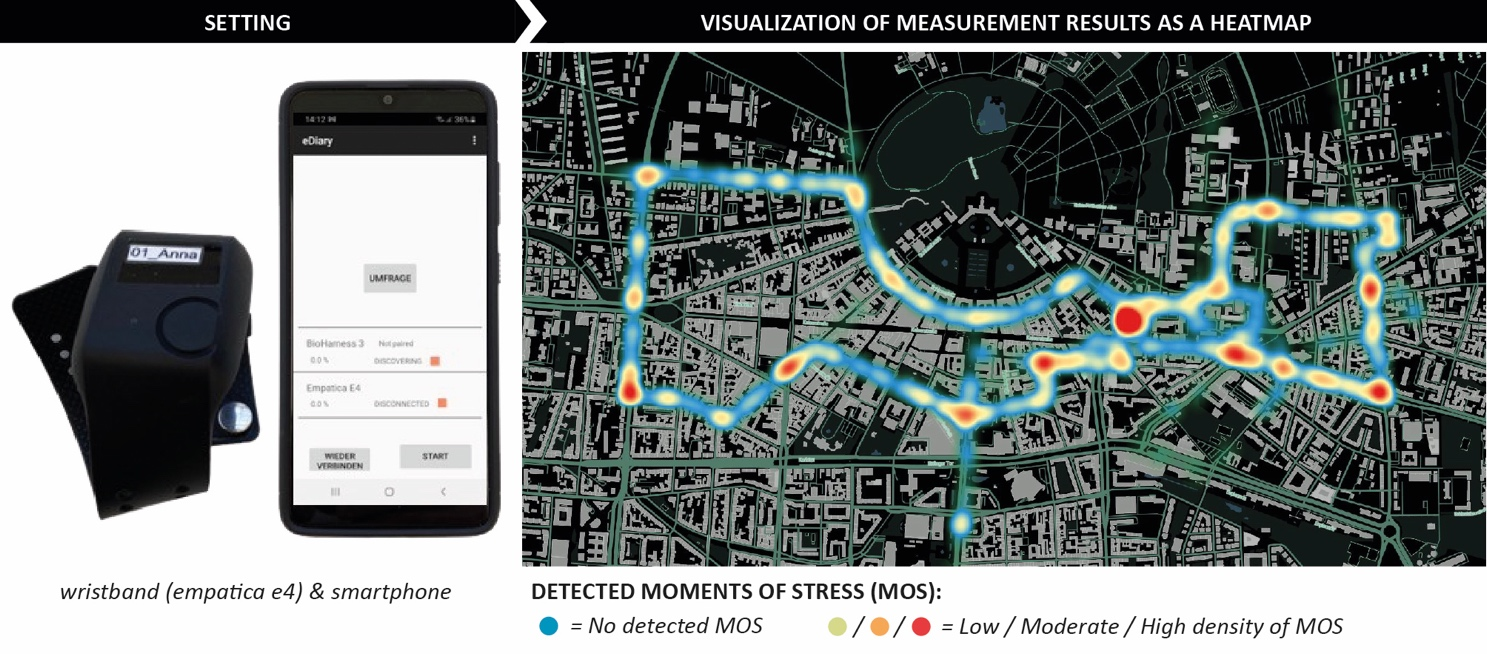
In recent decades, public space has experienced a significant decline in both importance and quality. In many urban spaces—originally designed to promote well-being and vibrant public life—negative emotions and stress have become part of everyday experience. With the help of Emotion Sensing measurements, detecting and mapping these negative urban emotions is now possible. However, their underlying causes remain largely unexplored.
What we did and why
This newly developed methodological approach aims to identify the underlying causes of stress in urban environments. To this end, it analyses a broad spectrum of perception-related factors from various fields to capture the full complexity of human perception in a more holistic manner. The evaluation of five case studies using the so-called ‘Stressor Matrices’ serves as the basis for deriving initial hypotheses about the triggers of urban stress.
Our study’s contribution
This research expands the previously narrow focus on isolated, measurable factors in the investigation of urban stress phenomena into a more integrative approach. For the first time, it explores a wide range of perception-related factors rather than concentrating on individual aspects alone. Furthermore, the methodological design integrates qualitative and quantitative analytical approaches into one coherent framework.
Impacts for city policy and practice
Our research contributes to integrating human perception of urban spaces into the current planning discourse. The presented methodological approach enables the early evaluation of urban spaces from a human-centred, user-oriented perspective. It allows not only for the assessment of existing conditions but also for the evaluation of different planning scenarios during design processes. Ultimately, this may support the human-centred transformation of our cities.
Further information
Full research article:
[Open Access] Healing the city: a diagnostic approach to decoding stress in urban public spaces by Nina Haug, Hannes Taubenböck, Peter Zeile & Markus Neppli.
Related posts

Understanding decision-making for active living infrastructure in a middle-income country: Aspirations and pressures for development may not support creation of good quality walking and cycling

How can we systematically embed health in real estate decision-making to improve health outcomes related to our urban environment? We mapped the system of health consideration in urban development decision-making to identify leverage points and inform interventions that can generate virtuous feedback loops to support better urban health.

Implementing community participation in planning of public open spaces is one of the most useful and effective means to encourage a higher sense of community.