City Know-hows

Transforming the urban public realm to children’s play network in a tower neighbourhood in Toronto

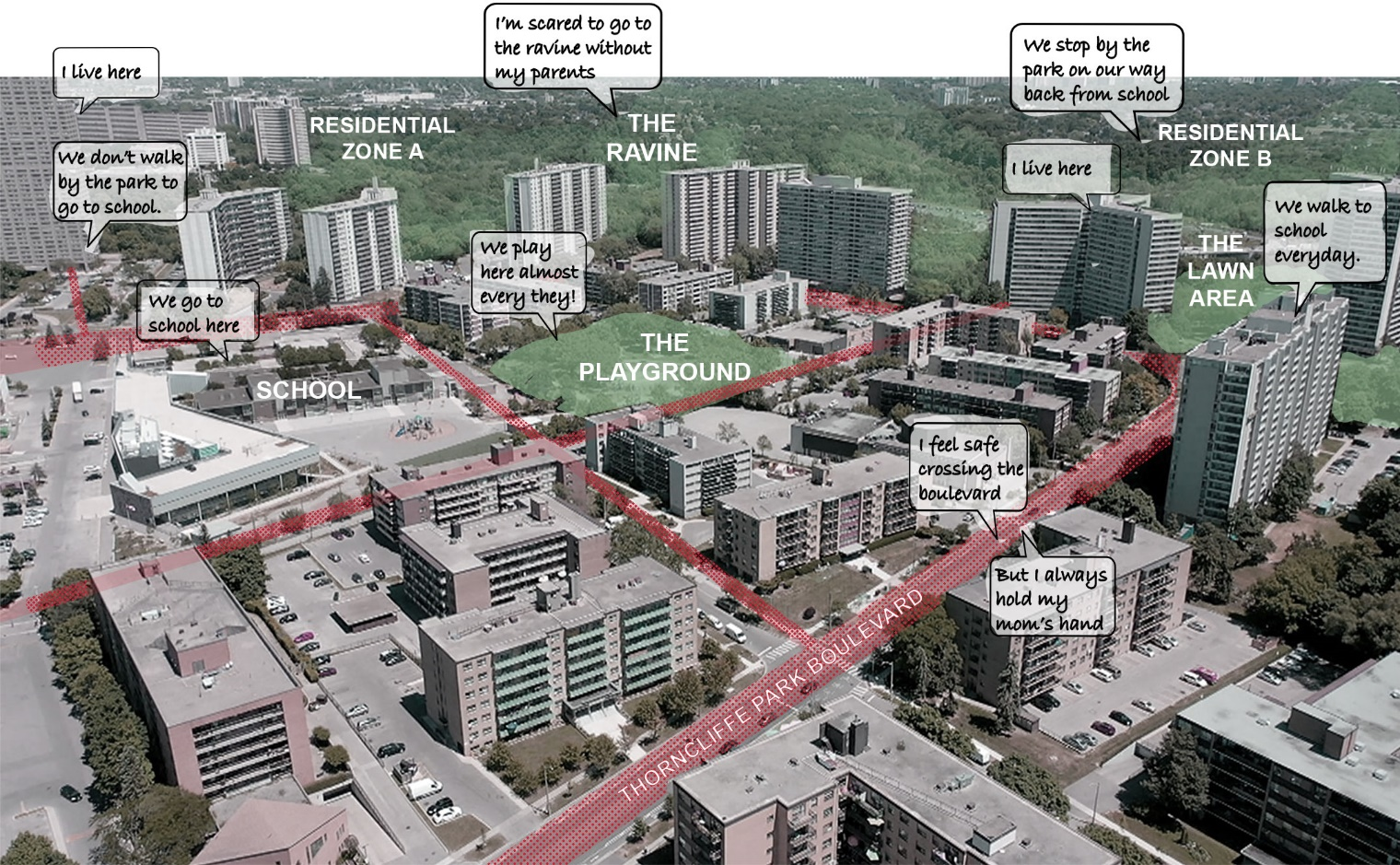
The existing “play network” in Thorncliffe Park Neighbourhood, Toronto, consisting of children’s regular destinations and pathways connecting them. Image: retrieved from Google Maps Street View and annotated by the author.

This study delves into children’s lived experiences in a tower neighbourhood in Toronto. It provides practical recommendations for designers and policy makers about activating the urban public realm surrounding residential towers as a play network for children and their families.

Share

Target audience

Urban designers, urban policy makers, and developers.

The problem

Planning policy in North America, compared to its European counterparts, has often failed to address children’s rights to play in urban environments. Child-friendliness often translates into providing isolated playgrounds and overlooking various play opportunities that the urban public realm has to offer. Current planning regulations provide limited practical child-friendly city guidelines that truly consider children as active citizens and the urban public realm as a site for play.

What we did and why

I investigated the formation of a play network in Thorncliffe Park neighbourhood in Toronto. I observed the pathways connecting home to the schools and neighbourhood parks to identify the types of play happening within the triangle of home, school, and park. I also conducted surveys and interviews with children 7 to 13 years old from the neighbourhood to understand the interplay of physical and socio-cultural factors in the creation of a neighbourhood play network.

Our study’s contribution

Our findings revealed that despite the limited play destinations compared to the local child population, children’s outdoor play experiences are predominantly positive. This positive outlook is attributed to their sense of safety within familiar spaces and strong social ties with neighbours beyond their immediate families. Key contributing factors include the proximity of schools and play areas to residential locations, the strategic placement of playgrounds along home-to-school routes, and the hierarchical relationship among neighbourhood open spaces.

Impacts for city policy and practice

This study advocates for having access to a play network as a way of improving child-friendliness of urban neighbourhoods. A few practical implications concerning high-density, high-rise urban neighbourhoods are:
• Providing walkable child destinations (e.g., schools, playgrounds) near residential buildings.
• Reducing child-traffic interactions along the pathways with traffic-calming measures and proper animation.
• Positioning playspaces along the pathways to regular destinations to encourage play on the way.
• Providing immediate access to intergenerational open spaces.

Further information

Full research article:

Related posts

Four-walled or fourfold? Well-being in gated cities

Our study sheds light on the evolving dynamics of the Greater Cairo Region, adding depth to the understanding of whether gated communities act as true remedies or reflections of concrete houses. By incorporating a model based on critical factors for mental health, we offer insights into the nuanced dimensions of well-being in the context of urban development. This research contributes to a more comprehensive understanding of the complex interplay between city structure and residents’ overall well-being.

Read More »
Huge crowd and its shadows

Walkability for all in our cities

To work for the Right to Walk the City is to advocate for health and social justice. Public Health as a multidisciplinary action is fundamental to achieve that goal. The ‘15-minute city’ model exemplifies this approach but remains hindered by barriers such as inadequate infrastructure and social discrimination, limiting walkability for underserved communities.

Read More »

The urban health crisis: How city living is quietly fueling the world diabetes crisis

We present a novel conceptual framework called the Urban Stress Model, which intentionally crosses disciplinary boundaries. We suggest that the unique physical form of cities contributes to an increased stress burden through the interacting influences of daily urban hazards and social disadvantage. We use New York City as a case example because of its high diabetes rates and its legacy of unequal healthcare in the context of concentrated wealth. Therefore, New York City can provide valuable insights for newly developing urban centers worldwide confronting similar challenges and growing social and health inequality.

Read More »