City Know-hows
While cities offer unprecedented opportunities for social mobility, their distinctive physical form can generate significant stress on residents. We propose the urban stress model which reorients urban public health approaches by emphasizing how chronic stress disrupts biological functions and leads to poor health with an application to the global diabetes crisis.
Share
Target audience
Urban planners, city political leaders, city mayors, city departments of health, city transportation leaders, urban labor unions, city housing agencies, city parks and recreation agencies
The problem
The world is experiencing an escalating diabetes crisis. It is well-known that diabetes is associated with both urbanization and stress. However, causal explanations for these associations are not well-understood. Comprehensive conceptual frameworks are needed to outline why and how urban living increases risk of diabetes and how stress plays a causal role. This knowledge is the foundation for the design of cities that promote health and support the development of sustainable interventions that can curb the growth of diabetes worldwide.
What we did and why
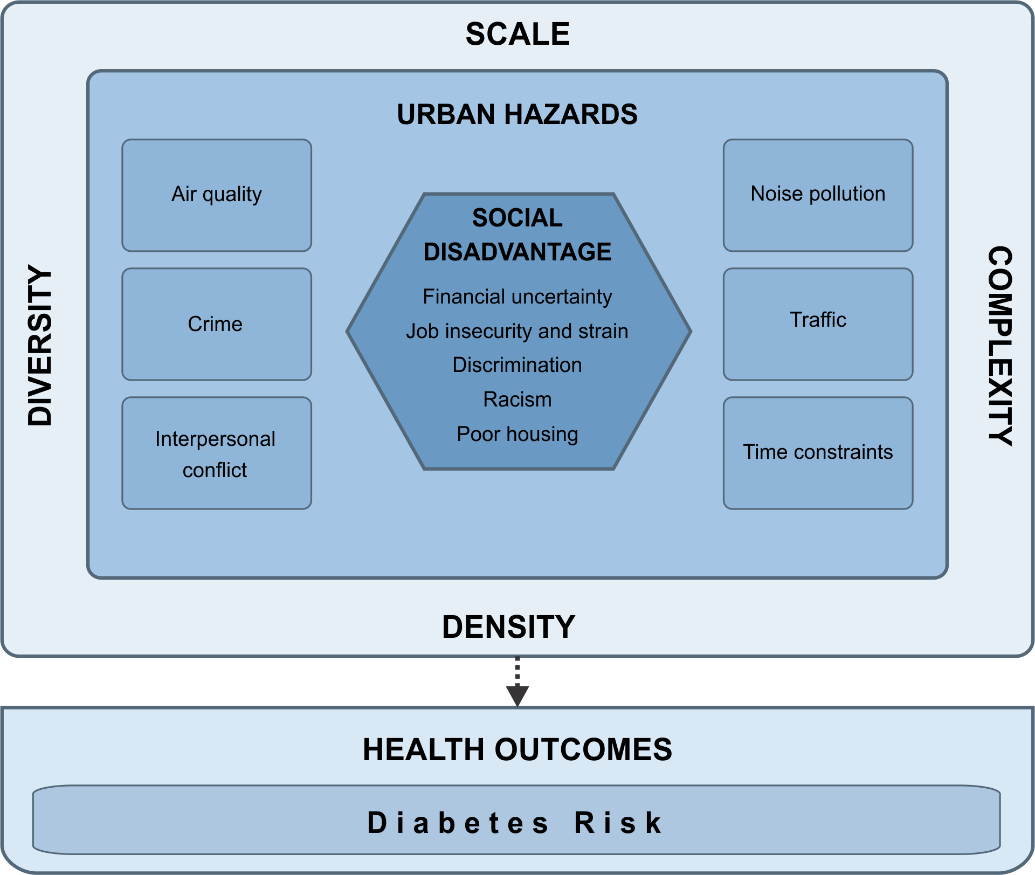
We present a novel conceptual framework called the Urban Stress Model, which intentionally crosses disciplinary boundaries. We suggest that the unique physical form of cities contributes to an increased stress burden through the interacting influences of daily urban hazards and social disadvantage. We use New York City as a case example because of its high diabetes rates and its legacy of unequal healthcare in the context of concentrated wealth. Therefore, New York City can provide valuable insights for newly developing urban centers worldwide confronting similar challenges and growing social and health inequality.
Our study’s contribution
The Urban Stress Model is novel because we provide a specific mechanistic framework that explains how urban form translates into biological dysfunction through stress pathways.
Impacts for city policy and practice
The Urban Stress Model highlights that stress reduction should be a central consideration in urban health equity initiatives, as disadvantaged populations often face compounding stressors that contribute to health inequities, including the unequal burden of diabetes. Future public health and city improvement initiatives must approach the major urban health challenges of our time with multi-level strategies—from workplace policies to neighborhood design—that target stress reduction alongside traditional risk factors.
For further information, visit the Centre for Urban Design and Mental Health
Further information
Full research article:
[OPEN ACCESS] The Urban Stress Model: a framework for understanding the persistence of health disparities in cities by Aimee Afable, Greg Rybarczyk, Bianca D. Rivera & Paul Landsbergis
Related posts

This study measured the effectiveness of stepping stones as an element of landscape design – to make walking a more effective form of exercise for health. The average increase in heart rate due to steppingstones was 17.22%. In conclusion, we estimate that stepping stones can significantly increase peoples metabolic and physiological parameters, and can help the wider population to achieve the recommended government and health guidelines of ‘moderate exercise’ of 150 min/week, improving population health. This new evidence can help designers to implement ‘Active Urbanism’ strategies.

Our research highlights how some groups in London, like children, ethnic minorities, and lower-income residents, experience hotter areas due to the Urban Heat Island effect. We provide a clear approach for local governments to make climate action fairer and more effective.

My study shows that simple ‘Happy to Chat’ benches successfully encourage spontaneous conversations, leading to positive feelings and new social connections. I found these benches can:
• Create welcoming spaces for casual and meaningful interactions.
• Promote emotional well-being and social bonding.
• Act as a subtle ‘social nudge’ to encourage interaction.