City Know-hows

Comparing 30 km/h speed limits in Canada and Australia: Lessons in implementation

30 km/h speed zones have the potential to transform safety and liveability of local streets. However, there are numerous barriers to implementation. Leveraging a cross-country policy comparison between the state of Victoria, Australia, and British Columbia, Canada, we identified that despite significant appetite for change in Victoria, Australia, implementation was hamstrung by modifiable limitations in policy and policy reform is urgently needed.

Share

Target audience

Policy Officers within State/Provincial and Local/Municipal Governments; State/Provincial Ministers in relevant fields (e.g. Transport, Health, Planning, Road Safety).

The problem

30 km/h speed zones are one of the most cost-effective road safety interventions to enhance safety and liveability of local streets. In the state of Victoria, Australia, only two have been implemented on a trial basis, and there is limited adoption across Australia.

What we did and why

We interviewed key government partners across Victoria, Australia and British Columbia, Canada (where 30 km/h speed zones have been implemented at scale) to identify critical barriers and enablers to successful implementation of 30 km/h. We used qualitative methods (interviews) to enable a deeper understanding of the relationships between barriers, and to explore new topics not previously considered through quantitative methods.

Our study’s contribution

This study provides critical insights into the complexity of implementing 30 km/h speeds, and opportunities to enhance systems to catalyse change. Specifically, we found that:
• There is appetite across levels of governments for 30 km/h speeds in Victoria, Australia, and this is hamstrung by amenable policy-barriers that only enable 30 km/h speeds to be implemented on a complex, resource intensive, trial basis.
• Limitations in existing policy create additional barriers, including limited local evidence about 30 km/h speeds.

Impacts for city policy and practice

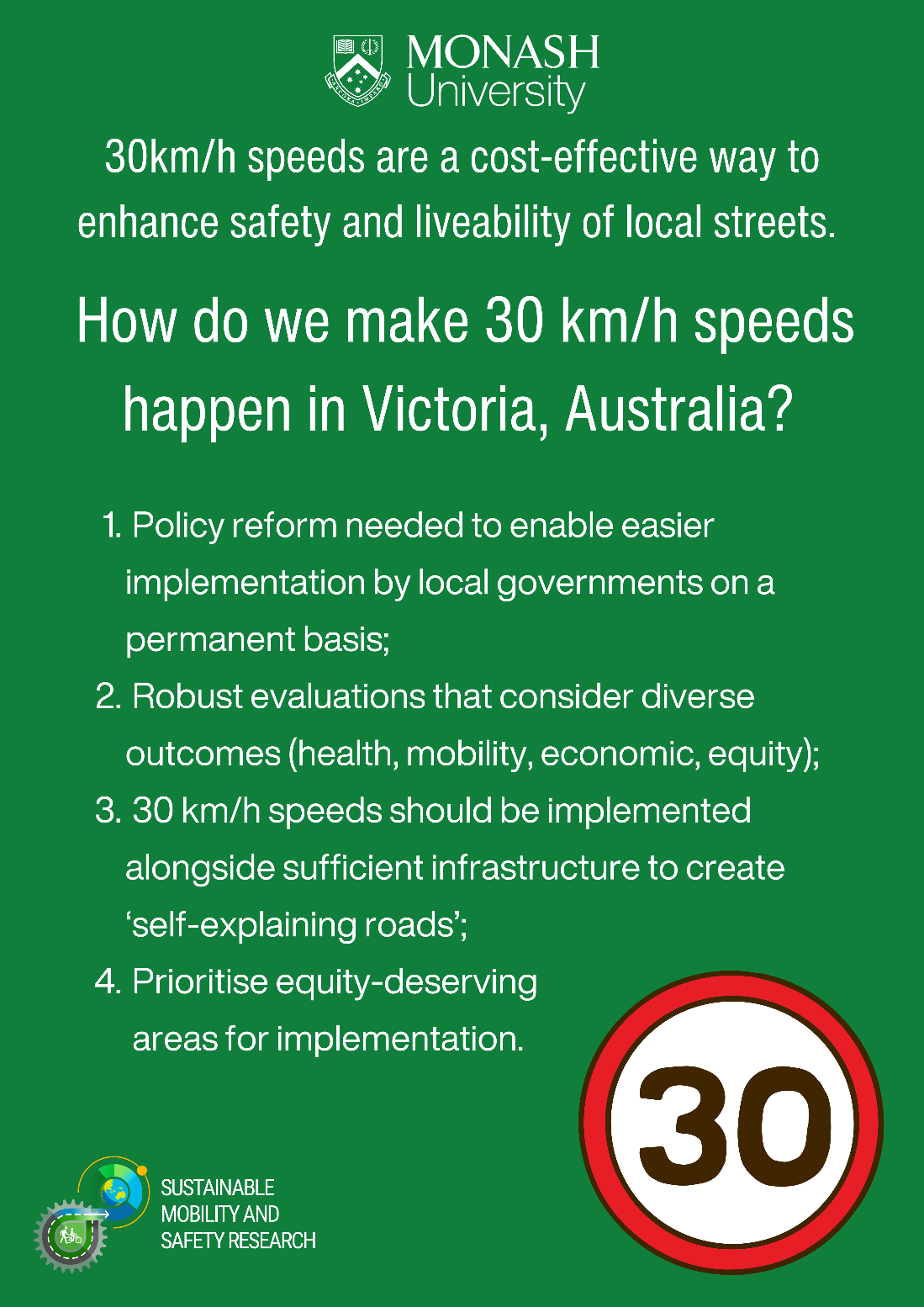
There is significant potential for widespread uptake of 30 km/h speeds in Australia, and resulting health, mobility, environmental and equity outcomes. To enable this:
• Victorian state government policy reform is needed to enable easier implementation by local governments;
• Robust evaluation of 30 km/h speed zones that consider the wider potential outcomes (for example, on equity) would support further scaling;
• Implementation of 30 km/h speeds without infrastructure and other measures to create roads that look and feel like the implemented speed limit may cause tensions between enforcement and community sentiment;
• Equity-deserving areas should be prioritised for 30 km/h speed zones.

See also: 6th UN Global Road Safety Week – Streets for Life on the WHO website.

Further information

Full research article:

Cross-country policy comparison of 30 km/h speed limits by Lauren Pearson, Megan Oakey, Breanna Nelson, Mojgan Karbakhsh, Shazya Karmali & Ben Beck

Related posts

Biophilic design for walkable streets: Health-centred insights for urban action

How can we design walkable streets that promote health through nature?
This scoping review synthesises international and cross-cultural research—drawing from English and Chinese studies—to clarify intervention types and health mechanisms, offering an essential evidence base for healthier, more connected urban environments. Our findings reframe streets as inclusive, restorative spaces for health—not just transport infrastructure.

Read More »