City Know-hows
We explored the influence of third places on walking habits across life stages. Our study demonstrates the unique goal structures for students, workers, and retirees, identifying key patterns shaping walking behavior in cities. Integrating these findings into urban planning can revolutionize cityscapes and promote healthier, more active communities.
Share
Target audience
This research is particularly relevant for urban planners, city officials, and community health organizations worldwide.
The problem
Third places play a crucial role in urban environments, acting as social spaces distinct from the home (first place) and workplace (second place), contributing to our social and physical health. However, we still do not know how they could contribute to the formation of healthy walking habits.
What we did and why
Therefore, we explore the role of third places for students, workers, and retirees. Building upon past studies that utilized Cognitive Chrono-Ethnography, a mixed-method approach examining people’s in-situ behaviour and decision-making processes, in-depth interviews questioned the role of third-place activities in the process of forming walking habits.
Our study’s contribution
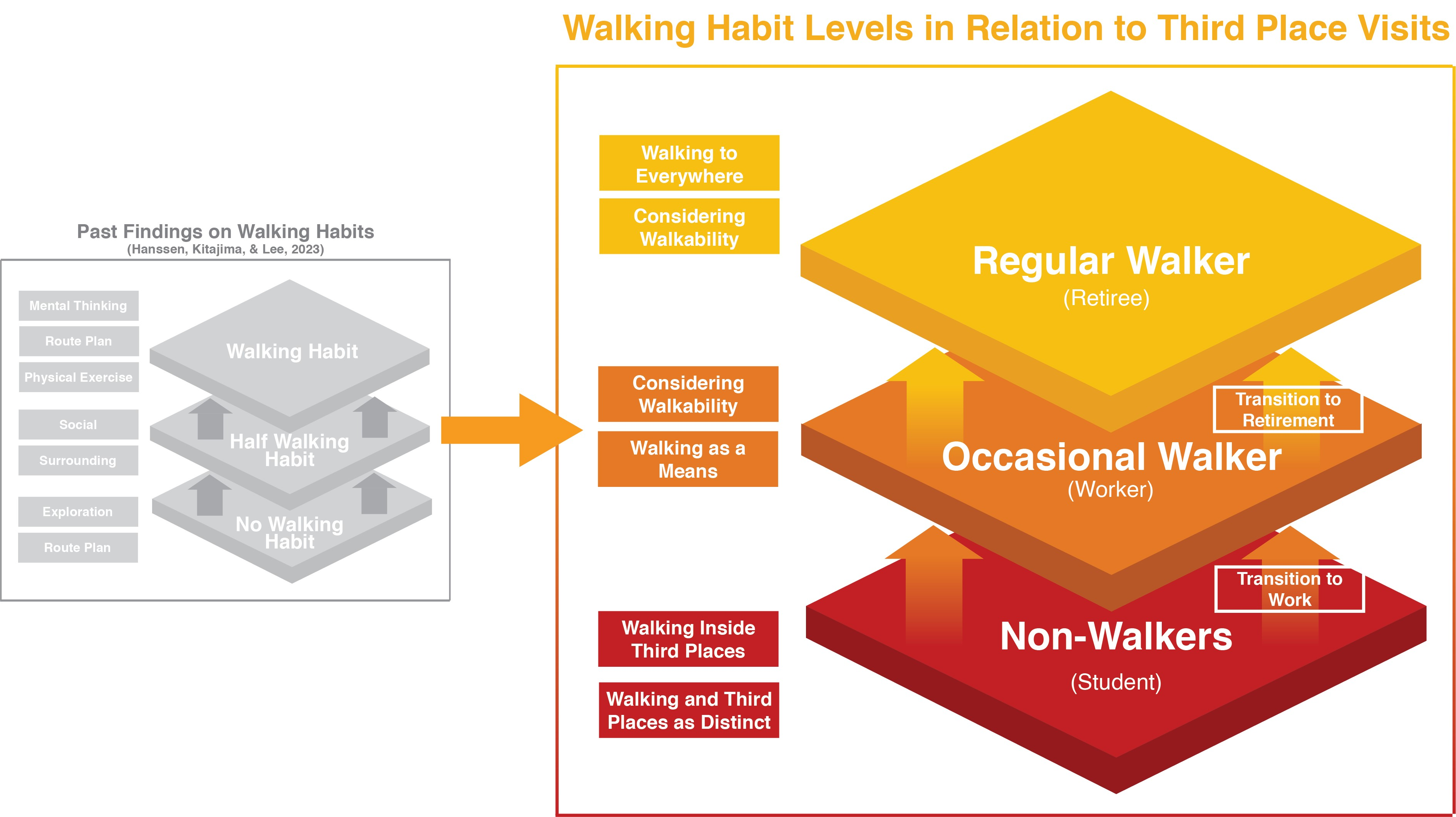
Our findings revealed that students, workers, and retirees displayed distinct levels and patterns of walking habits. Moreover, we identified three goal structures, with either walking, third-place visits, or both together forming the primary goal.
Impacts for city policy and practice
Our study underscores key considerations for city policy and practice. City officers responsible for urban development, urban leaders shaping policy, and health-focused organizations seeking innovative approaches to community well-being will find valuable insights in understanding how third places impact walking habits across diverse populations. Three key considerations:
Implementing these insights can foster healthier, more active communities and guide future urban planning initiatives.
Further information
Full research article:
Third place visits and associations with walking habit formation: an exploratory study extending Cognitive Chrono-Ethnography by
Max Hanssen, Naoko Fujita, Muneo Kitajima & SeungHee Lee
Related posts

From data to policies: let the data speak! Making local policies more evidence- informed about health and health inequalities. Developing a community engagement toolkit to address health inequalities in urban settings.

Our study focuses on active and independent mobility of children in a car-free settlement which can be promising for developing policies for a child-friendly urban future and mobility justice for children. The outputs of this study can bridge the gap between vehicle-oriented and non-vehicle-oriented settlements and enable the transfer of good experiences.

Why only plan for children’s play in cities? Play could support the health and wellbeing of older adults. Let’s reimagine age-friendly planning with play in mind.