

City Know-hows

How neighbourhood design influences older adults’ driving patterns

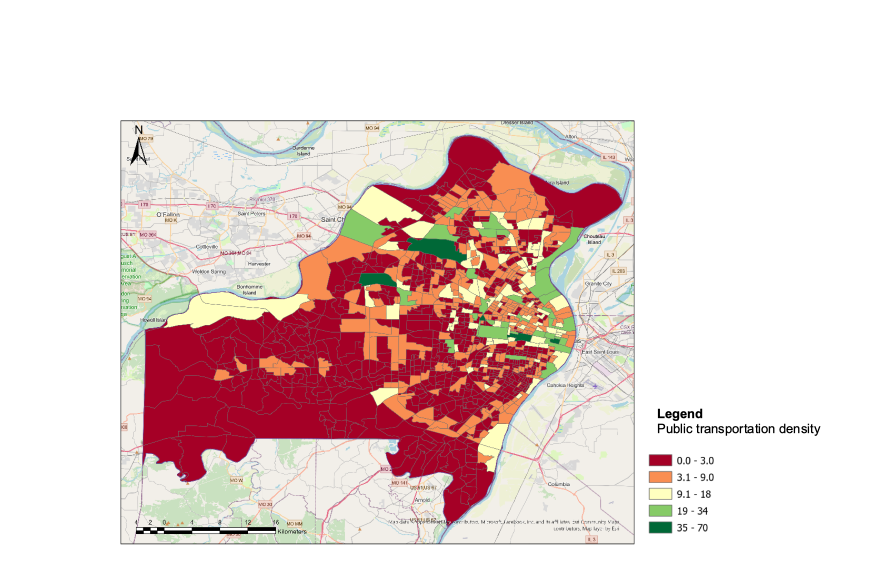
Detailed visualization of public transportation density in each census block in St. Louis City and St. Louis County.

Older adults’ driving patterns reveal how the design of our neighbourhoods impacts mobility and independence in later life. This research highlights actionable insights for urban planners to design age-friendly communities by balancing transit access, land use diversity, and safe road networks.

Share

Target audience

Urban planners, transportation policy makers, and age-friendly community advocates.

The problem

Older adults face unique challenges in maintaining their driving independence due to cognitive and physical changes. Built environment factors like road network design and transit accessibility can either enhance or hinder their ability to drive safely and efficiently.

What we did and why

We analyzed GPS driving data from 134 older adults in St. Louis, paired with Geographic Information Systems and machine learning techniques. Our goal was to understand how neighborhood characteristics—like land use diversity, transit accessibility, and road design—impact driving distances and trip types.

Our study’s contribution

We demonstrate the strong influence of neighborhood transit access and land use on driving behavior. We highlight thresholds where built environment factors significantly impact driving patterns and provide evidence for integrating age-friendly design into urban planning.

Impacts for city policy and practice

Urban planners should consider:

  • Increasing land use diversity near older adults’ residences to support local trip-making.
  • Improving transit accessibility within a 1 km radius to reduce dependence on long car trips.
  • Ensuring safe road designs with moderate intersection density to promote mobility while minimizing risks.

Further information

Full research article:

The neighbourhood built environment affects driving behaviours of older adults: a combined geographic information systems and machine learning method by Rayeheh Hafezifar, Shahab Alizadeh, Anne Dickerson, Brenda Vrkljan, Ganesh M. Babulal & Sayeh Bayat

Related posts

Prioritizing residents’ experiential knowledge in public housing redevelopment programs to promote community health

Despite historic disinvestment and stigmatizing portrayals of public housing, residents often describe their place as a source of refuge. We explored the ways residents of a predominately Black public housing complex undergoing redevelopment construct meanings of place, emphasizing their place-making efforts to challenge their social marginalization and foster community health.

Read More »

A fresh framework for moving health knowledge into urban planning action

We took a significant step in identifying the existing gaps in knowledge translation for healthy cities and adopting a proactive approach to laying out opportunities for improvement. By developing a visual representation for a renewed conceptual framework, we provide a clear and insightful tool for planners, designers, and policymakers aiming to enhance knowledge translation processes. As a result, this study not only elevates knowledge translation as a field of study for urban professionals but also reinforces its importance in public health.

Read More »

Making streets safer for women: A women-centric walkability index for Kollam’s urban future, India

This study introduces the Women-Centric Walkability Index, addressing factors influencing women’s walking experiences in urban areas. Analyzing fifty-five wards in Kollam Corporation, Kerala, we identified key indicators like well-maintained sidewalks, street lighting, safety measures, and access to public amenities that enhance women’s walkability. Using the Analytical Hierarchy Process and GIS analysis, our research highlights the need for safer, more accessible, and comfortable walking environments for women, benefiting all pedestrians.

Read More »