
City Know-hows

Are we building for health? Food environments in transit-oriented development, New South Wales 

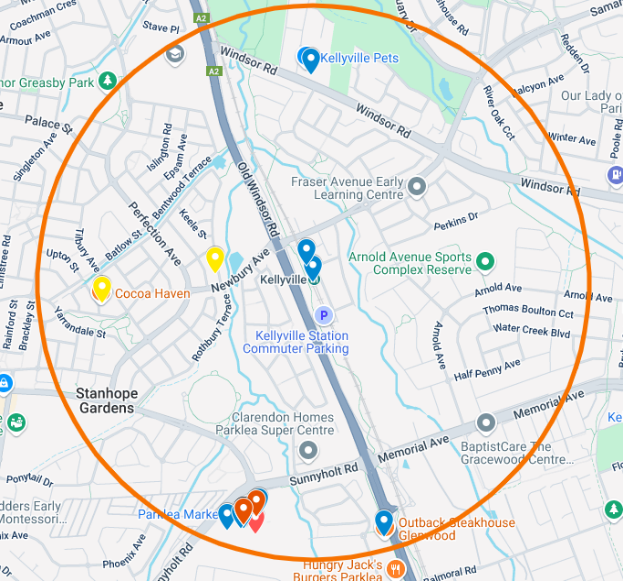
Example of a food desert within 1200m radius surrounding the Kellyville metro station, one of the eight accelerated precincts selected for transit-oriented development under the NSW government’s plans. There are minimal food outlets available, offering no healthy foods.

The built food environment has a significant influence on population health, for better and for worse. Evidence shows that urban planning can play a major role in creating food environments that support healthy food choices; however current transit-oriented developments have not yet considered access to healthy food outlets. We found evidence that a high proportion (79 – 84%) of food outlets could be classified as ‘unhealthy’ across eight transport hubs identified for accelerated development in New South Wales.

Share

Target audience

City planning officers, Urban planning academics, Public health advocacy groups

The problem

Research shows that density of unhealthy food outlets is associated with poorer diets and obesity, the latter are responsible for over 11 million deaths annually. Therefore, it is important to increase access to healthier food options, near where people ‘live, work and play’. This presents potential conundrums for urban planning and design, where intensification of existing urban places and development of new ones tend to be premised on the idea of vibrant places activated by out-of-home eating opportunities.

What we did and why

To evaluate the healthfulness of current food environments surrounding eight transport hubs identified for accelerated development, we identified the number and type of food outlets within a 1,200-metre radius of the rail or metro station for each transport hub. Food outlets were categorised as unhealthy, less healthy and healthy using an adapted version of the Food Environment Score which was developed by Australian nutrition and public health experts.

Our study’s contribution

We found evidence of a high proportion of food outlets classified as unhealthy across ALL transport hubs. The proportion ranged from 78.7% to 93.8% of total food outlets. The most prevalent food outlet type was restaurants/cafes (49.5%), followed by specialty foods (8.4%), and independent takeaways (7.6%) . Across all transport hubs, 64.1% of food outlets identified offered an online food delivery service(s). 

Impacts for city policy and practice

This study provided us with the evidence that current food environments are predominantly unhealthy in transport hubs selected for further development. This warrants further attention from city planners. We suggest that further research is needed to understand ways that healthy food environments can be prioritised, especially in areas identified for re-zoning and intensified development. This will ultimately help combat the ubiquity of diet-related non-communicable diseases in increasingly urbanised cities.

For more on the transit-oriented development actioned by the NSW state government: See https://www.planning.nsw.gov.au/policy-and-legislation/housing/transport-oriented-development-program

For infromation about students’ experiences with ground-truthing for this study: See https://www.youthwelllab.com/post/reflections-from-the-field-ground-truthing-healthy-food-outlets

Further information

Full research article:

[OPEN ACCESS] Evaluating the food environment in eight transport hubs identified in the New South Wales transport oriented development program by Suet Ching Yuen, Milijana Pavlicevic, Thomas Astell-Burt, Ian Woodcock, Alice Gibson, Stephanie Partridge, and Sisi Jia.

Related posts

Wild Ways: influencing ‘rewilding’ behaviour in urban gardens

We reviewed the existing research on influencing rewilding behaviour by city residents in their gardens. We used a behaviour-change model to identify intervention and policy strategies that affect residents’ rewilding behaviour. We found that all intervention and policy categories were effective, requiring action across many organisations and areas to drive change.

Read More »

Adolescents’ ideal park: Usage, benefits and preferences

Green spaces bring several health benefits. However, adolescents’ infrequent use of green spaces, especially in southern European cities like Porto, can be attributed to cultural and contextual factors, including limited green space, maintenance issues, and equipment scarcity. Thus, there has been a great push to enhance green space provision. However, achieving effective greening interventions requires understanding user perspectives, addressing barriers, and considering various age and socioeconomic groups to ensure universal access and youth-friendly spaces.

Read More »