
City Know-hows
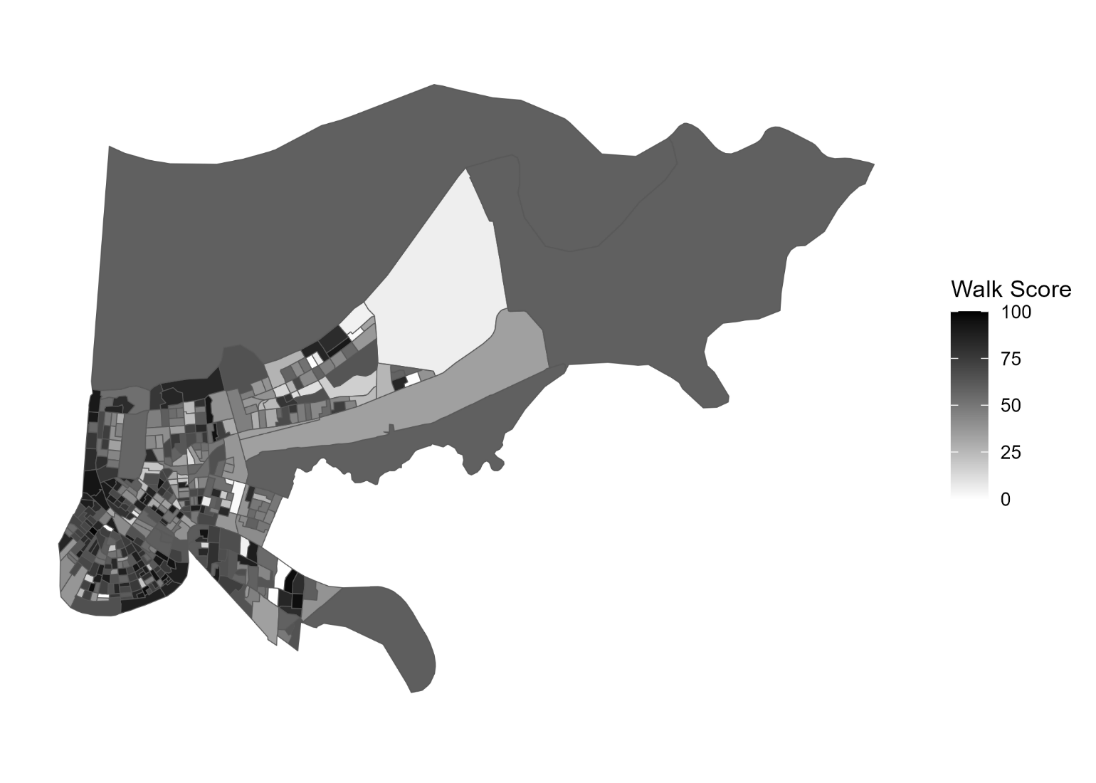
Our study wanted to know more about the relationship between neighborhood walkability and crime in New Orleans, generally finding that the relationship between the two depends on the level of walkability, type of crime, and socioeconomic conditions of the neighborhood. Walkability was related to less crime in economically impoverished neighborhoods. Improving walkability in economically disadvantaged areas may help reduce crime.
Share
Target audience
Urban leaders, city planners and community safety advocates
The problem
We wanted to know if there is a relationship between neighborhood walkability and crime, including if that relationship depends on the type of crime or level of poverty in the neighborhood. New Orleans, Louisiana, is an important setting for this research because it is diverse across levels of walkability, crime, and poverty. Knowing more about the relationship between neighborhood walkability and crime could be informative for researchers, urban leaders, and city planners.
What we did and why
Background research on this topic has found mixed results, sometimes finding that more walkable neighborhoods have more crime, and sometimes that they have less crime. To address this gap in the knowledgebase, we gathered publicly available data on walkability, crime, and different measures of poverty in New Orleans. We tested to see if walkability was associated with crime, and if this relationship was contingent on the level of concentrated disadvantage in the neighborhood.
Our study’s contribution
Walkability does have a relationship with crime, but it depends on the level of walkability, type of crime, and level of concentrated disadvantage within the neighborhood.
• Robbery, aggravated assault, general theft, and motor vehicle theft had significant associations with walkability, but it depends on the level of walkability.
• Burglary was not associated with walkability.
• Neighborhood concentrated disadvantage matters, with high walkability having a protective impact against crime in socioeconomically disadvantaged neighborhoods.
Impacts for city policy and practice
Urban planners and policy leaders should invest in ways to make neighborhoods more walkable, particularly community areas that have more poverty.
• Urban planners should consider the socioeconomic context while developing new public spaces.
• Improving walkability may help prevent most crime types in more socioeconomically disadvantaged neighbourhoods.
Further information
Full research article:
Neighborhood walkability, concentrated disadvantage, and the spatial distribution of crime by Xiaojin Chen, Patrick Rafail, Katherine Theall, Andrea DaViera & Julia Fleckman
Related posts

The involvement of citizens in nature placemaking processes can have a positive impact in the psychological health and wellbeing. The connection with the natural environment and community is grounded in five core principles recognized as the 5Gs: Gracious, Green, Giving, Grounded and Grateful, as conveyed through the activities.

How can we design walkable streets that promote health through nature?
This scoping review synthesises international and cross-cultural research—drawing from English and Chinese studies—to clarify intervention types and health mechanisms, offering an essential evidence base for healthier, more connected urban environments. Our findings reframe streets as inclusive, restorative spaces for health—not just transport infrastructure.

Solid waste production is rapidly increasing in Kenyan cities. However, the implementation of available policies to address the canker leaves much to be desired.