City Know-hows
Cities often invest in infrastructure while overlooking what residents say truly shapes health. Drawing on community voices from Regina, this study shows that belonging, meeting basic needs, and valuing lived and Indigenous knowledge are essential for building healthier and more equitable cities.
Share
Target audience
City (urban) planners and city administrators responsible for community development, housing, transportation, and engagement; Public health leaders and regional health authorities working with municipalities; Community and Indigenous organizations engaged in urban policy, service delivery, and advocacy.
The problem
Cities play a major role in shaping health, yet those most affected by inequitable urban conditions are often excluded from decision-making. Municipal (urban) planning frequently prioritizes technical expertise while undervaluing lived experience and Indigenous ways of knowing. As a result, policies may miss the everyday realities of housing insecurity, racism, transportation barriers, and social exclusion, limiting cities’ ability to advance health equity and public trust.
What we did and why
We convened an equity-centered World Café roundtable in Regina, a mid-sized Canadian city, bringing together 39 participants from government, community organizations, Indigenous and newcomer-serving agencies, youth groups, the private sector, and people with lived experience. Through facilitated dialogue, we asked what makes a healthy city, who is left out, and what knowledge should guide decisions. This approach centered community expertise, explored participants’ own definitions of a healthy city, and surfaced shared priorities for healthier, more inclusive urban governance.
Our study’s contribution
This study adds community-grounded insight into healthy city planning from a mid-sized city context. It shows that:
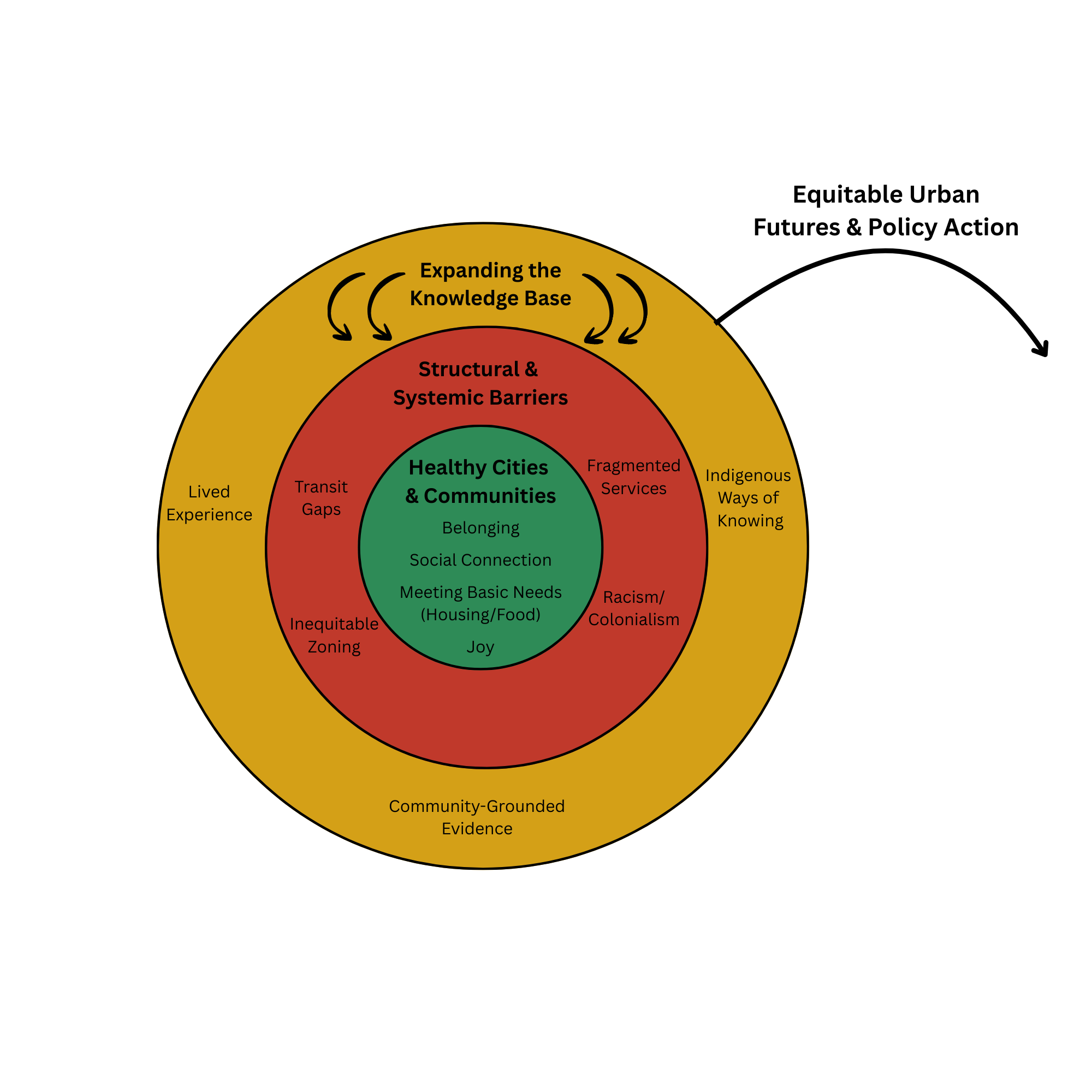
• Healthy cities are rooted in belonging, social connection, and meeting basic needs.
• Structural inequities such as racism, transportation barriers, and uneven neighbourhood investment undermine health.
• Many groups, particularly marginalized and equity-seeking communities, are often excluded from decisions that shape urban health.
• Lived experience and Indigenous knowledge are essential forms of evidence for urban decision-making.
These insights challenge narrow, infrastructure-focused approaches to urban health and highlight the importance of inclusive engagement.
Impacts for city policy and practice
We are sharing this work to support city actors who want practical, community-informed guidance for advancing health equity in mid-sized cities. This work suggests that cities can strengthen population health and equity by:
• Designing policies that prioritize housing, food access, safety, and social connection
• Supporting accessible, reliable, and inclusive public transportation to improve mobility and reduce inequities
• Fostering belonging and community participation alongside social connections to enhance collective well-being
• Embedding meaningful, compensated participation of people with lived experience
• Expanding what counts as evidence to include Indigenous and community knowledge
• Using participatory approaches, like World Cafés, to inform planning and build trust
These actions encourage cities to adopt a holistic, multidimensional understanding of health and move from tokenistic engagement to inclusive, responsive governance.
Further information
Full research article:
[OPEN ACCESS] What makes a healthy city? Collective insights from an equity-centered World Café roundtable in Regina, Saskatchewan by Akram Mahani & Emily Duncan
Related posts

The meaning, measurement, causes and consequences of social connectedness in cities. A useful primer and pragmatic framework for healthy cities, urban futures and public health.

Air pollution threatens public health globally. Our exposure to air pollution is influenced by transport. Transport is both a prominent source of air pollution and an important determinant in our exposure to it. The built and natural environment also dictate how, when and where we travel, and what we are exposed to. We provide a comprehensive review of these relationships and their interactions.

Our ‘adaptive bubble strategy’ illustrates how older adults protect themselves from virus transmission and maintain healthy living activities and psychological wellbeing with the support of the built environment during COVID-19.