
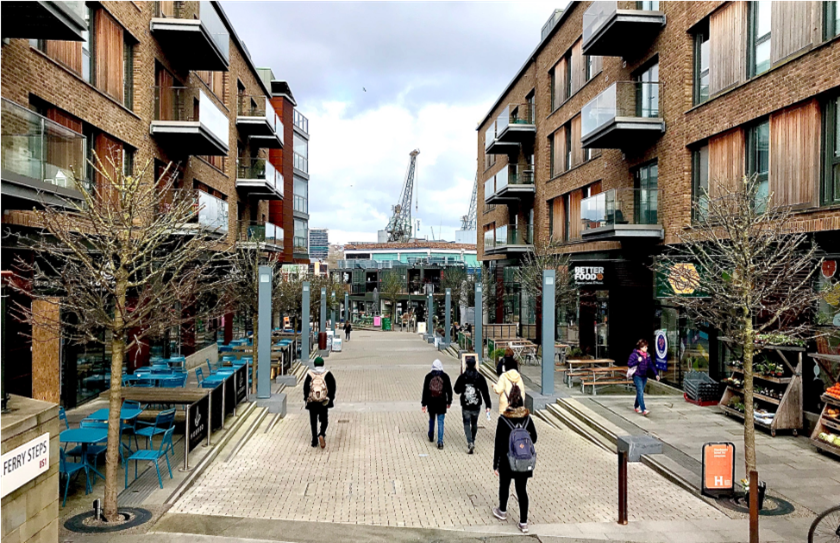

This paper investigates how the project development of Wapping Wharf in Bristol impacted the dwellers’ well-being. It finds that the relationship between urban placemaking and dwellers’ wellbeing is not just constitutive, but also mutually reinforcing. Sincere communications between the producers and the users of urban places have promoted better placemaking and resident wellbeing enhancement; the paper thus suggests that factors that can facilitate sincere communications should be prioritized in post-pandemic placemaking.

Share

Target audience

Council officials, planners, developers, community managers, and the professionals in planning and practice.

The problem

The way in which the living environment is designed has profound influences on inhabitants’ well-being; unfortunately, how exactly new developments should be designed to deliver positive impacts on dwellers’ wellbeing remains unclear. This is happening against the backdrop of the Covid-19 Pandemic, which has exerted more stress on human wellbeing, stimulating greater discussions on how to reframe planning practice to accommodate this assemblage.

What we did and why

We join this discussion using a case study approach to investigate how the project development of Wapping Wharf in Bristol, United Kingdom, has impacted the dwellers’ well-being and to what extent their actions altered the living environment, aiming to provoke more thoughts on how new development should be designed to enhance wellbeing in post-pandemic planning. Qualitative research methods of interviews, site observation and further literature review are employed in this paper to achieve the research aim.

Our study’s contribution

We affirm the significances of some contributors to human wellbeing enhancement in urban placemaking including greenspaces, walkability, and healthy eating, etc. The relationship between urban placemaking and dwellers’ wellbeing is not just constitutive as suggested in existing literature review, but also mutually reinforcing. While previous research on the assemblage of placemaking and wellbeing has largely focused the former (placemaking), we suggest the future assemblage work extend to the later (dweller wellbeing).

Impacts for city policy and practice

We advocate that the format of mix-used property development to enhance walkability, the incorporation of virtual flatforms with physical design, the provision of supportive amenities to enable more and easier access to health eating are good strategies to accommodate the call for better assemblage between urban placemaking and human wellbeing in post-pandemic planning. Fundamentally, factors that facilitate sincere communications between the producers and the users of urban places should be prioritized in post-pandemic place-making.

Further information

Full research article:

Related posts

A wooden planter with some flowers in the middle of a residential street. On the front is a green sign saying 'ROAD OPEN TO', followed by icons representing an adult holding a child's hand, a person on a push scooter, a person using a wheelchair, a bicycle.

Walking and wheeling in Low Traffic Neighbourhoods: A mixed methods study of the impact of schemes on disabled people’s journeys

Low Traffic Neighbourhoods are being introduced in UK cities to reduce motorised through-traffic in residential areas, create better conditions for walking, wheeling and cycling, and change the hierarchy of uses in public spaces. Existing evidence shows that schemes work and generate important public health benefits. However, the experiences of disabled people with these schemes have yet to be explored. This is important because public space and the built environment are important facilitators and barriers in the lives of disabled people.

Read More »

Enhancing green infrastructure within slums can promote residents’ well-being

Green infrastructure has been conceived as something for the well-off in cities of developed countries. How green infrastructure contributes to quality of life and wellbeing in slums and informal settlements is largely unknown. A survey of the residents (sample size = 455) within a slum community (Ikorodu-Ajegunle) in Lagos, Nigeria. The survey was preceded by stakeholder forum where actors from health, urbanism, environmental sectors discussed the links and made inputs to the research instrument used for data collection.

Read More »