

The high risk of death and disability from being struck by a car is unevenly distributed geographically and socially. Our analytics reveal a troubling pattern in that people from Black and Latino neighbourhoods face an especially high risk of crashes, both near and far from home.

Share

Target audience

Vision Zero leaders in the hundreds of participating cities across the world – in planning departments, nonprofits, and community groups.

The problem

The high risk of death and disability from being struck by a car is unevenly distributed geographically and socially.

What we did and why

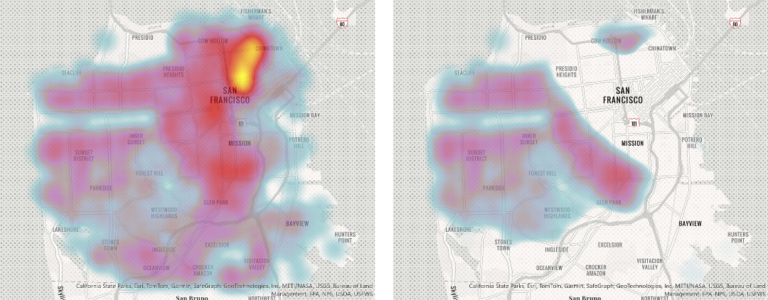
Mostly evidence around health disparity is focused on the amenities and hazards in the neighbourhoods where people live: these are important exposures as well as there exists data to study them. 9-1-1 call (or the national equivalent for an emergency call) records are set up in the opposite way: these are oriented around where the medical emergency happens. We novelly processed and geolocated 9-1-1 call records, to link them back to the neighbourhoods where the individual involved resides. This lets us reveal health disparities by relating risks to not only to the location of their injury but also to the individuals’ home neighborhoods.

Our study’s contribution

We find that communities of colour disproportionally experience traffic crashes in two ways. First, we observe that crashes occur twice as frequently in communities of colour, i.e., those with the lowest two-fifths share of white residents, than predominantly white neighbourhoods with the highest two-fifths shares. Second, while residents from communities of colour account for about nine in ten victims who crash in those neighbourhoods, we reveal that those residents also account for five in ten victims in predominantly white neighbourhoods.

Impacts for city policy and practice

These results identify a need for a specific conversation among academics and policymakers, especially in light of recent popular press and scholarly work on nationwide racial disparities in traffic fatalities, that addresses risk in one’s own home neighbourhood and more distant places. This will allow advocates, along with state and city transportation officials, often working under the Vision Zero framework, to more clearly articulate the parallel goals of reducing crash hazard where people live while also addressing it where people travel through and to.

We urge urban ambulance services’ analytics teams to collaborate with public health teams to leverage fine-grained operational data to lessen health disparities. Note how we innovatively linked emergency call data for medical emergencies back to the home neighbourhoods of the people involved to detect health disadvantage for crash risk.

The Vision Zero Network serves to orient much of the zero-crashes policy work in cities globally.

Further information

Full research article:

Mobility risk: using ambulance operations data to analyze the spatial and social dimensions of health disadvantage
Mark Brennan, Sophia Dyer, Yonah Freemark, James Salvia, Laura Segal, Erin Serino & Justin Steil

Related posts

Health impact assessments for healthier urban planning projects

Health impact assessments are a key tool to bridge the worlds of planning and health, but there’s a risk they become a ‘tick box’ exercise with little real-world benefit. Learning from recent practice in English local authorities can help maximise their effectiveness in producing healthier developments.

Read More »

Why park design matters for everyday social life

Public parks shape how people meet, stay, and interact. This study shows how specific physical features of an urban park influence everyday social life, offering practical lessons for designing public spaces that support social interaction, wellbeing, and inclusive urban vitality. We combined on-site observation of people’s behaviour with surveys of park users and spatial analysis. We did this to move beyond abstract design principles and provide evidence-based insights into how seating, pathways, land use, inclusiveness, and safety shape everyday social interactions in public spaces.

Read More »

Food behaviours vary by dwelling type, and by apartment characteristics

Food behaviours are associated with diet quality, a major risk factor for chronic disease. We compared the food behaviours of house residents and apartment residents, and apartment residents by characteristic. We found significant differences in meal purchasing behaviours and consumption of fruit and vegetables, which have short- and long-term implications for dietary health.

Read More »