City Know-hows

Collaboration for healthier urban development

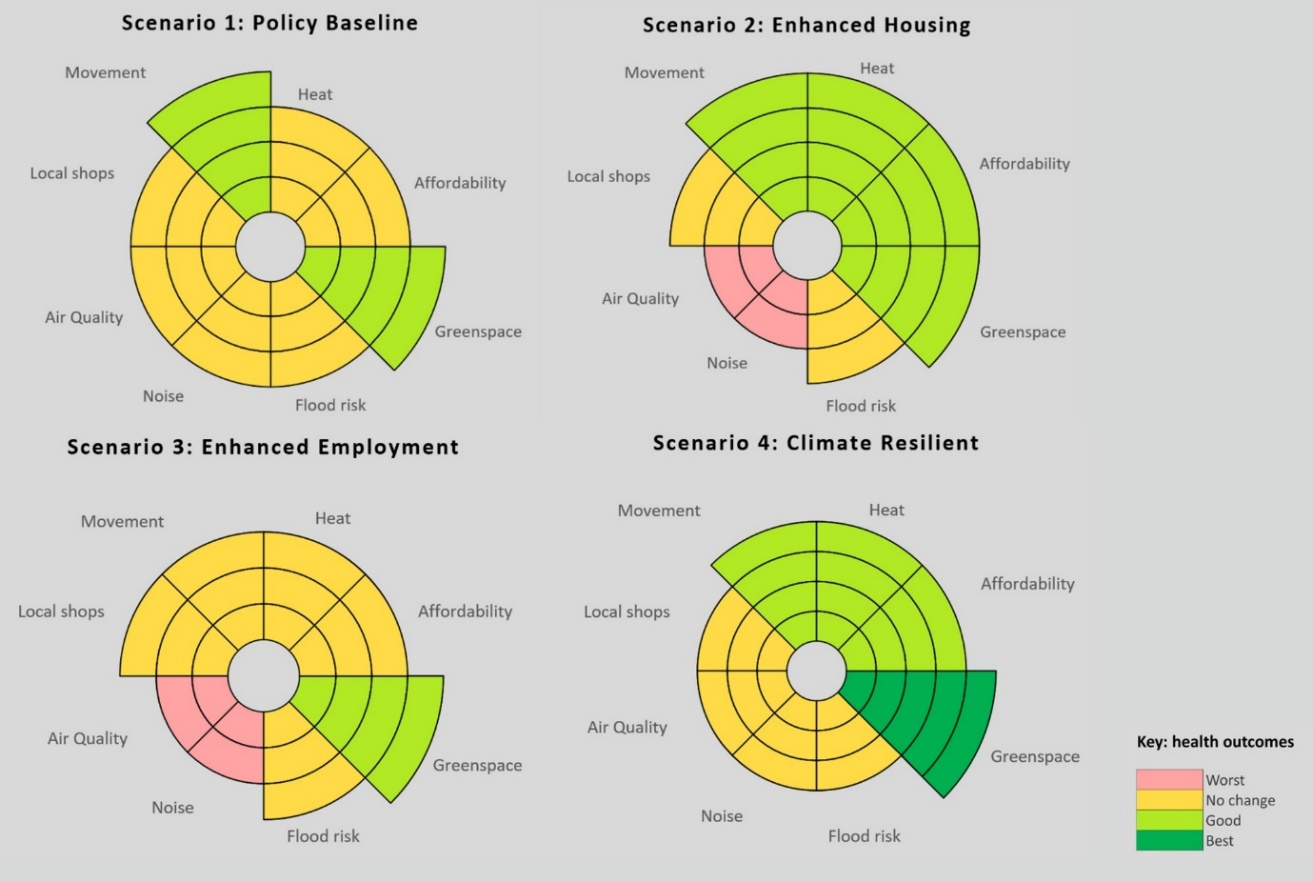
Showing the health impacts of four design scenarios to inform decision-making for a regeneration framework

Health evidence could be used more effectively to influence healthier urban development. We learn from a researcher-practitioner collaboration, involving an embedded researcher in local government working on a regeneration project, which helped to develop a new health modelling tool for environmental change and influence decision-making.

Share

Target audience

Urban development practitioners, academic funders for health and planning

The problem

Health evidence doesn’t effectively influence urban development decision-making. Although there is evidence showing how environmental features can influence health risks, urban development too often results in unhealthy environments.

What we did and why

We used an embedded researcher to collaborate with practitioners on a regeneration project who bridged between academics and practitioners to provide contextually relevant health evidence to influence the development of a regeneration spatial framework. This helped develop a new health modelling tool demonstrating impacts of health from environmental change.

Our study’s contribution

We demonstrate the value of showing contextually relevant health evidence to influence urban development decision-making. Health evidence was used to: highlight problems; support good/aspirational solutions; and consider trade-offs in a complex system. This should be recognised to ensure evidence is appropriate for different purposes.
Embedded research is an emerging approach and this study demonstrates its value to support researcher-practitioner collaborations to understand a complex system and develop impactful, timely interventions for healthier place-making.

Summary briefing notes about this study: Using-health-evidence-to-influence-urban-regeneration-in-Bristol-1.pdf

Summary briefing note about the HAUS modelling tool: Valuing-the-external-social-costs-of-unhealthy-urban-developments-1.pdf

TRUUD study. Research about healthy urban development, which this study was part of: https://truud.ac.uk/

Impacts for city policy and practice

A new health modelling tool was piloted in this study. The academic-practitioner partnership helped academics understand a complex system and provided contextually relevant evidence for practitioners to: highlight problems; support good/aspirational solutions; and consider trade-offs.
It shows its value to demonstrate contextually relevant health evidence to influence healthier urban development. More collaborations between public health and urban development sectors could improve the influence of health evidence on urban development decision-making.

Further information

Full research article:

Related posts

How can indicators support planning for healthier and more resilient cities?

As emerging challenges have made urban areas increasingly vulnerable, jeopardizing the health and well-being of their inhabitants, resilience should be seen as a pathway for healthy cities and integrated into urban planning practices. This study shows if and how existing indicator frameworks can identify urban systemic vulnerabilities and priorities for resilience building to provide local authorities with evidence crucial in planning for healthy and resilient cities.

Read More »

Making streets safer for women: A women-centric walkability index for Kollam’s urban future, India

This study introduces the Women-Centric Walkability Index, addressing factors influencing women’s walking experiences in urban areas. Analyzing fifty-five wards in Kollam Corporation, Kerala, we identified key indicators like well-maintained sidewalks, street lighting, safety measures, and access to public amenities that enhance women’s walkability. Using the Analytical Hierarchy Process and GIS analysis, our research highlights the need for safer, more accessible, and comfortable walking environments for women, benefiting all pedestrians.

Read More »