
City Know-hows
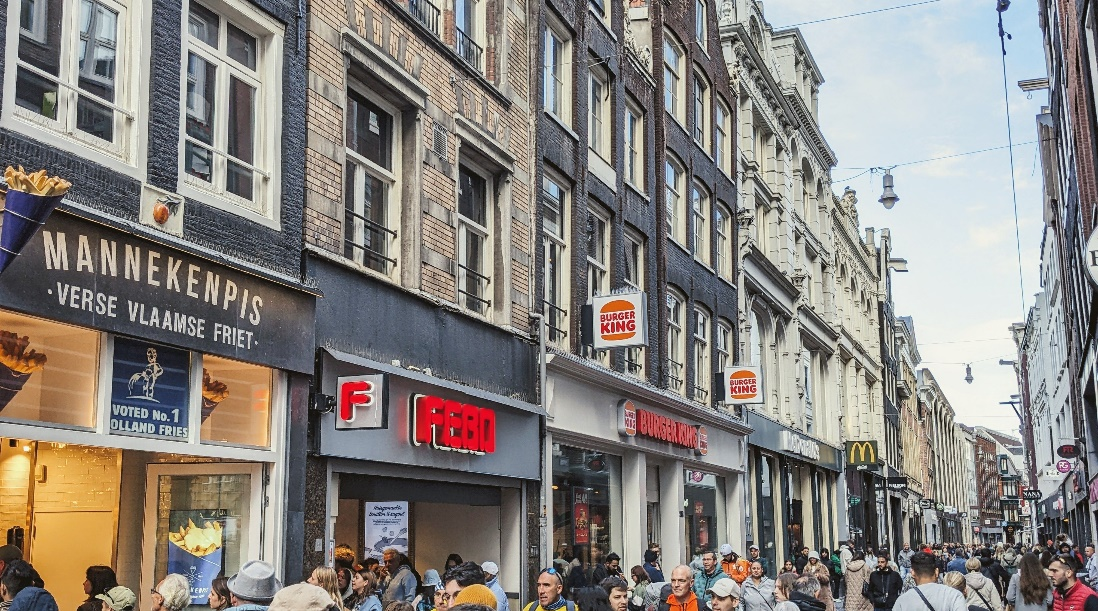
Dutch adults often use different food retailers than the geographically nearest, and distance to food retailers is not associated with snack food consumption. As such, policies to make cities healthier with respect to fast food outlets should perhaps not be distance-based.
Share
Target audience
Community advocates, municipal policy officers, public health and planning policy-makers
The problem
Food retailer access can be defined through distance-based metrics (i.e., distance to the nearest supermarket) or density-based metrics (i.e., number of fast food outlets in a given area). International studies suggest that density-based metrics are typically favoured over distance-based metrics. However, this may depend on the local context and type of food retailer. Local policymakers aiming to make the food environment of their city healthier need such contextual information.
What we did and why
We focused on the Netherlands, one of the most densely populated countries in the world. For a large group of Dutch adults, we compared the location of the nearest supermarket, discount supermarket and fast food restaurant with the location of these food retailer types that they reported to use in practice. We also explored whether distance to the nearest food retailer was associated with snack food consumption, and whether any observed link would be explained by people’s awareness and use of the available food retailers.
Our study’s contribution
In the Dutch context, adults typically use a different food outlet than the geographically nearest. This was most prominently visible for fast food outlets and less so for discount supermarkets and regular supermarkets. While distance to food outlets was not linked to snack food consumption, perceived availability and use of fast food outlets and regular supermarkets was linked to higher fast food consumption.
Impacts for city policy and practice
Cities considering zoning policies may want to distinguish between different types of food retailers, whereby distance-based policies may be appropriate for supermarkets and discount supermarkets, while restrictions on fast food outlets may need to be based on other metrics than proximity.
More information about our research group: The Upstream Team
Further information
Full research article:
[OPEN ACCESS] The importance of availability of, proximity to, and use of food retailers in relation to snack consumption – a cross-sectional mediation analysis in the Eet & Leef study by Mariane de Almeida Alves, Maria Gabriela Matias de Pinho & Joreintje D. Mackenbach.
Related posts

This newly developed methodological approach aims to identify the underlying causes of stress in urban environments. To this end, it analyses a broad spectrum of perception-related factors from various fields to capture the full complexity of human perception in a more holistic manner. The evaluation of five case studies using the so-called ‘Stressor Matrices’ serves as the basis for deriving initial hypotheses about the triggers of urban stress.

A case study in Tokyo reveals how road width, green spaces, and local amenities influence joggers’ route selection, drawn from extensive data analysis. These insights hold significant implications for urban planning strategies, advocating for city designs that prioritize exercise and outdoor activities.

How people use energy affects their health, current approaches focus on behavioral change or interventions in the home. This strategy discounts the influence of healthcare. To integrate healthcare into this issue we need to engage with how it is already understood within healthcare and what the challenges are.