

City Know-hows
This study presents 20 key insights into the walking experiences of people living with dementia, highlighting shared priorities like safety and subgroup-specific needs. These findings offer actionable strategies for designing dementia-friendly neighborhoods that enhance mobility, inclusion, and well-being.
Share
Target audience
• Urban planners and city designers: Professionals responsible for shaping the physical and social fabric of cities, ensuring neighborhoods are inclusive, accessible, and safe for all residents.
• Public health policymakers: Decision-makers focused on advancing health equity and well-being, particularly for aging populations and people living with dementia.
• Community-based organizations supporting aging populations: Organizations advocating for dementia-friendly initiatives, promoting accessibility, and fostering social inclusion at the local level.
The problem
We observed that many urban environments fail to accommodate the mobility and safety needs of people living with dementia. Challenges such as inaccessible infrastructure, unclear wayfinding systems, and a lack of inclusive spaces hinder their independence and quality of life. Our study addresses these gaps by exploring the experiences of people living with dementia, identifying shared priorities and subgroup-specific needs to guide the design of dementia-friendly neighborhoods that foster mobility and inclusion.
What we did and why
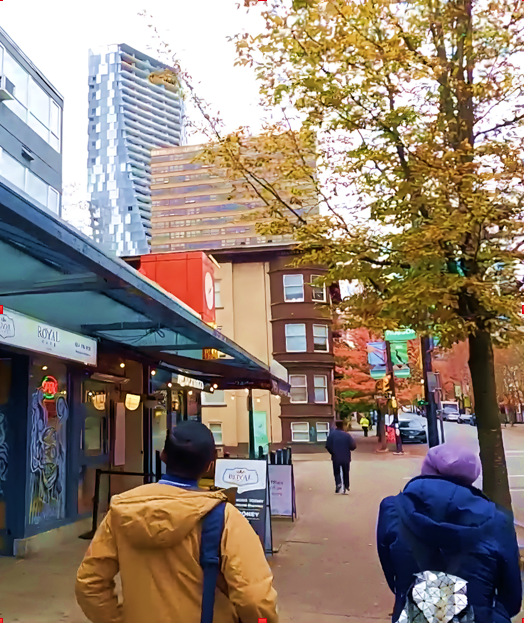
We explored the walking experiences of 26 people living with dementia through sit-down, walk-along, and follow-up interviews in Metro Vancouver. Using a novel methodology, we uncovered shared priorities, subgroup-specific needs, environmental barriers and facilitators, and the coping strategies employed by participants. Our goal was to identify key insights from participants’ perspectives to serve as the foundation for actionable strategies in designing dementia-friendly neighborhoods that support mobility, safety, and inclusion.
Our study’s contribution
Our study provides critical insights into the walking experiences of people living with dementia, highlighting shared priorities and subgroup-specific needs. These findings contribute to dementia-friendly neighborhood design by:
• Identifying environmental barriers and facilitators to mobility and safety.
• Highlighting coping strategies employed by individuals across diverse sociodemographic groups.
• Offering actionable recommendations for inclusive urban design, such as memory-triggering landmarks, accessible sidewalks, and culturally inclusive public spaces.
These insights bridge research and practice for creating supportive communities.
Impacts for city policy and practice
Our findings offer practical guidance for city leaders and urban planners to create dementia-friendly neighborhoods that promote mobility, safety, and inclusion. Key recommendations include:
• Improving sidewalk accessibility, lighting, and maintenance to ensure safe and barrier-free pathways.
• Introducing memory-triggering landmarks and clear wayfinding systems to enhance navigation and reduce anxiety.
• Developing inclusive community spaces and programs that foster social interaction and cultural responsiveness.
These strategies aim to create equitable and supportive urban environments.
Further information
Full research article:
Twenty key insights into neighborhood walking experiences of people living with dementia in Metro Vancouver: a quantitative analysis of qualitative data by Mohammadjavad Nouri and Habib Chaudhury
Related posts

Our study identified predominant research themes, influential publications and authors, and emerging trends in pedestrian-built environment research. A database was used to analyse publications from 1975 to 2024, identifying research gaps and charting future research directions.

This pioneering study on healthy and sustainable indicators for Jakarta is the first in Indonesia to use the Global Healthy and Sustainable City Indicators framework. As the most populous city in Indonesia and Southeast Asia, Jakarta’s inclusion provides valuable insights into its status compared to 25 international cities. We offer a critical perspective on existing spatial indicators, highlighting the need for precise definitions and careful interpretation within the city’s local context. Additionally, we propose new indicators to help policymakers and public health officials develop more adaptable measures for urban health and sustainability.

Understanding of the influence of local political actors helps to highlight where their influence is limited, particularly by national-level housing policy, which in the UK is focused on housing numbers, rather than quality of new homes, as well as financial viability and public opinion. Understanding this can help to build trust in the political processes of decision-making and inform interventions for healthier place-making.