


City Know-hows
Many walkable areas fail caregivers. This study reveals how dense, mixed-use environments near public transport often lack essential caregiving services—especially in vulnerable neighbourhoods—undermining mobility justice. Integrating caregiving needs into planning is key for inclusive, resilient cities.
Share
Target audience
Urban mobility and accessibility planners, local policymakers involved in caregiving and social services, and Transit-Oriented Development (TOD) professionals
The problem
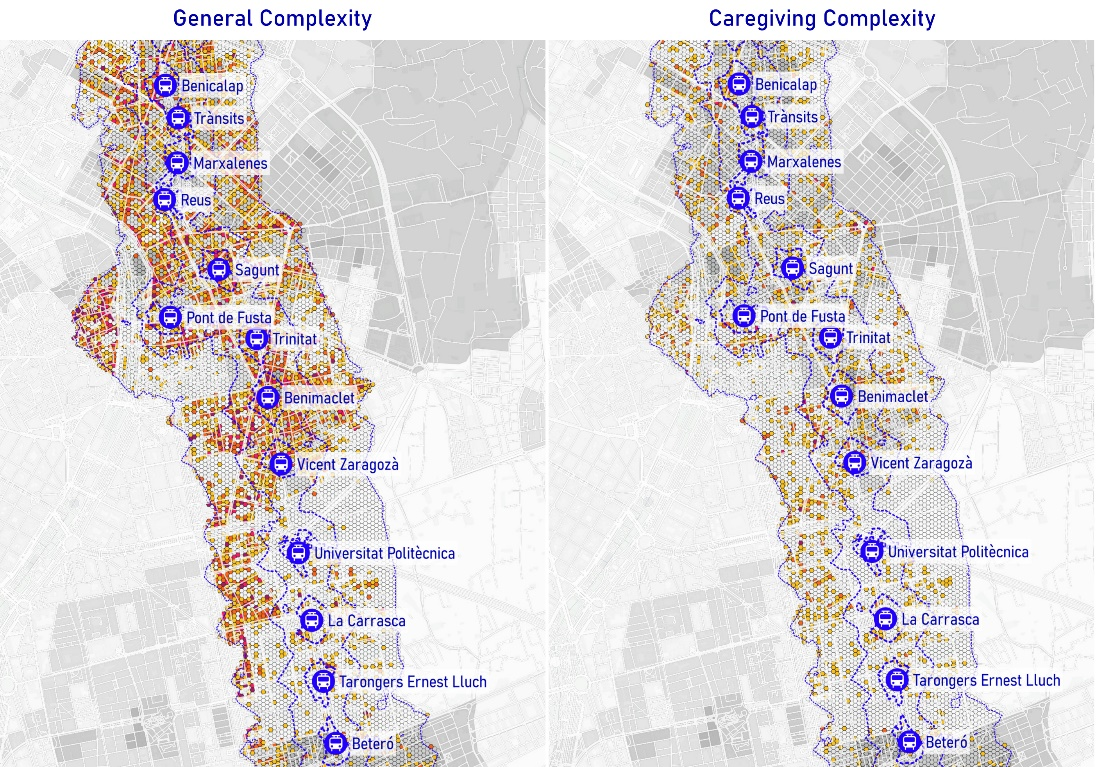
We examine how caregiving-related needs remain overlooked in walkability and Transit-Oriented Development strategies. Despite high levels of urban complexity, many transit-accessible areas lack essential caregiving-support places, particularly in vulnerable neighbourhoods. This spatial mismatch limits care-engaged individuals’ ability to chain trips, and access services, reinforcing mobility and social inequities. Our research highlights the need to integrate caregiving accessibility into planning frameworks to ensure that walkable cities are also inclusive and care-supportive.
What we did and why
We analysed the spatial distribution and urban complexity of caregiving-support places near tram stations in Alicante and Valencia, Spain. Using Google Places data, we assessed the density and diversity of both general and caregiving-related functions within walkable distances. Our goal was to evaluate whether transit-accessible areas truly support care-engaged mobility. We aimed to uncover spatial mismatches that limit walkability for caregivers, especially in vulnerable areas, and to inform more inclusive urban and transport planning.
Our study’s contribution
his study brings caregiving needs into the spotlight of walkability and transport-oriented planning. We reveal why current approaches to urban complexity fall short when it comes to supporting care-engaged individuals.
• We show that walkable, transit-accessible areas often lack essential caregiving-support places.
• We expose how this gap is most pronounced in socioeconomically vulnerable neighbourhoods.
• We provide a replicable method to map caregiving-related accessibility using Google Places data and spatial analysis.and identify needs and challenges
Impacts for city policy and practice
Our findings call for urban and mobility policies that explicitly address caregiving-related accessibility in transit-oriented areas. To make walkable cities truly inclusive and equitable, we recommend:
• Integrating caregiving-support places into zoning and land-use regulations, especially near transit hubs.
• Prioritising caregiving infrastructure in vulnerable neighbourhoods to reduce spatial inequities.
• Expanding walkability metrics to include care-related functions, ensuring planning frameworks reflect the diverse mobility patterns of all residents.
Further information
Full research article:
Walkability and caregiving support places: exploring urban complexity as a path to mobility justice by Leticia Serrano-Estrada, Mariana Huskinson, Rita F. de Oliveira & Álvaro Bernabeu-Bautista
Related posts

Despite historic disinvestment and stigmatizing portrayals of public housing, residents often describe their place as a source of refuge. We explored the ways residents of a predominately Black public housing complex undergoing redevelopment construct meanings of place, emphasizing their place-making efforts to challenge their social marginalization and foster community health.

Insights into life conditions of residents in social housing in Medellin, Colombia to contribute to the planning and management of healthier housing using a novel

Young people are satisfied with many aspects of their local area except for active travel to school and for those living in rural areas. There was strong correlation between living in more crime prone areas and feeling unsafe.